
From Labor Retention to Continuous Flow: How DCs Are Redefining Efficiency

Leading warehouse automation solution providers are transforming distribution centers and empowering the workforce.
Distribution centers (DCs) are busy places these days, and the demands on them are growing. Ecommerce led to new expectations, challenges, and opportunities that DC operators are eager to meet. Their most pressing concerns include finding ways to operate more efficiently as orders rush in, customer expectations for rapid deliveries build, and the labor market remains tight.
The demands associated with finding and keeping workers are among the main drivers of innovation and an intensifying embrace of sophisticated technological tools in the distribution center environment.
“The biggest issue that we consistently hear about is turnover,” says Stefan Friedrich, product marketing manager for Gorbel, a Victor, New York-based provider of a wide range of cranes and ergonomic lifting, fall protection, and warehouse solutions. “A facility’s entire workforce can turn over in one year or less because it can be physically demanding, tedious, and repetitive work.”
“The labor squeeze is tighter than ever,” agrees Robert Nilsson, chief commercial officer for VARGO, a material handling solutions company based in Dublin, Ohio. “The number of labor resources needed to operate in a warehouse has not gone down, and the turnover is significant. But labor will always be part of the equation.
“Ecommerce remains a constant growth vector as far as the eye can see,” Nilsson adds, and that will continue.
An Eye Toward Automation
The industry also is witnessing an accelerated rate of advancement and progress in the tools that DCs are using. “The market’s R&D is higher than it has ever been,” Nilsson says.
Against that backdrop, many DCs are ambitiously turning to automation. “If you look back one decade ago, you see a lot of additions to the marketplace, such as goods-to-person, automated mobile robots, and other advances,” Nilsson says. “Many facilities have added these tools, and the choices are plentiful.”
When it comes to automation, “We’ve come a long way,” says Don Caddy, CEO of Engineering Innovation, an automation company based in Lafayette, Indiana. One decade ago, automation was out of reach for many operations. Today, “it’s more accessible, faster to deploy, and just better,” he notes.
“We work with many companies just starting their automation journey, and we notice that these smaller operations look to support their existing teams and build more resilient systems,” Caddy says.
Investing for the Future
The DC and warehouse space is entering “a period of massive investment,” Caddy adds.
“Over the next few years, spending on automation and robotics is expected to double,” he says. “For many of our customers, that means greater access to tools that used to be out of reach. For businesses like ours, it means growing demand—for hardware and for smart, practical solutions.
“The companies that manage this boom well will be the ones that build real partnerships between their workforce and their automation,” he adds. “That’s how you stay ready for the ups and downs that are bound to come in this industry.”
It is a complicated journey to implement new automation in a warehouse, whether starting with an all-manual facility or adding more automation to existing automated tools, Nilsson says. Those managing DCs must determine which solutions are the best fit for them, including what they are equipped to implement and maintain.
“Warehouse buildings are expensive, so you have to create an automation journey with those constraints in mind,” Nilsson says. “Space is at a high cost.”
The significant expense of warehouse space is one reason that goods-to-person automated tools are “here to stay,” Nilsson says. “Those tools deal fundamentally with space savings.
“The importance of labor availability is huge, so how do you maintain the labor balance that you need?” Nilsson asks. “Will workers go across the street to get a job somewhere else or will they stay with you? What can you do with automation to help you retain labor?”
The future holds the introduction of increasingly more automated and semi-automated systems, Friedrich expects. “We will see more incremental automation,” he says. “Companies may not automate the full warehouse, but it’s a step in that direction.”
Distribution centers are among the links in the supply chain that are benefiting from access to more data—and those benefits will grow, allowing for smarter, more informed management of facilities, Friedrich says.
“Collecting more data is one big benefit of automated systems,” he says. “We will start to see more warehouses adopt the software and infrastructure to manage and make decisions from all that data.”
Improving efficiencies in DCs does not always involve sophisticated technology or innovative strategic thinking. Sometimes, it’s more about common sense, Friedrich says.
“I was in a warehouse where workers had to walk huge distances across the facility,” he recalls. “They had forklifts, but not everyone is licensed to use a forklift and you’re not supposed to carry passengers on them. So the company let workers drive around in golf carts. That was a simple but effective way to reduce the number of steps workers were taking.”
Here’s how three leading companies help DCs operate on a higher level, using tech-based tools to tackle challenges and boost efficiencies.
Taming the “Ugly” Package: Engineering Innovation’s Secret to Smooth Transitions
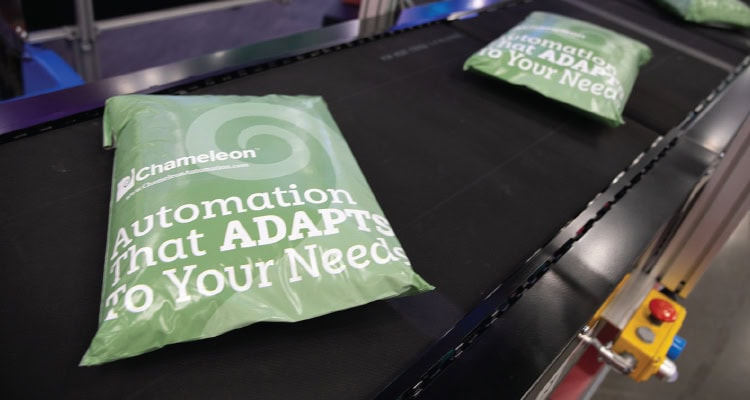
Engineering Innovation provides automated sorting, weighing, and routing systems that streamline material handling and reduce manual labor in distribution centers.
The explosive growth of ecommerce has led to a range of fresh challenges, including the increasing prevalence of “ugly” packages. These packages—such as polybags, underweight or oversized parcels, and other “outside the box” items—often trip up traditional sorting systems unaccustomed to such variability.
“In a traditional setup, the system can’t handle when one of these ugly packages hits the line,” says Don Caddy, CEO of Engineering Innovation. “So someone has to pull it, sort it, and possibly give it a second or manual pass. That slows down everything and takes up manpower, which we’re already struggling to get in the door and keep.”
Consequently, Engineering Innovation has created a new divert module for its Chameleon SLAM solution to contend with those troublesome packages. With the new module, “those items stay in the flow,” Caddy says, leading to fewer disruptions and smoother operations across the board.
“We created a Pop-Up Shuttle Divert with minimal gaps between rollers, which means shifting and crushed polybags can no longer get snagged, ensuring a more consistent and smoother downline,” Caddy says.
An effective introduction of new automation tools to the workers who will use them is critical to maximizing the value of those tools, and it is too often overlooked, he says.
“If you don’t manage change well, you will have problems,” Caddy notes. “Workers get anxious and tend to assume the worst. Productivity drops despite all you’ve invested in new technology—nothing goes as you had hoped. That’s a communication problem.
“On the other hand, if you take the time to explain what’s happening, involve your teams, and show them how the changes support their work, they’ll usually get behind it,” he adds. “Most people want to do a good job. They just need to know they’re not being left behind.”
Start Early
The first step is to get people involved early in the process.
“Don’t just drop new systems on them and expect it to go well,” Caddy says. “People need to understand what’s coming, why it’s happening, and how it will help them.
“Years ago, we had a customer whose floor operator thought the install of our machines meant he’d be out of work,” he says. “But through involving him in the process, he’s now the one who shows new hires how to run the SLAM line. It’s about ownership. When people feel like they’re part of the solution, the transition goes smoother.”
Engineering Innovation spends a lot of upfront time ensuring the rollout of its automation is practical and well-planned through training programs, on-hand installs, and extended customer support that breaks things down into manageable phases for its customers.
“If I had one piece of advice for someone looking to automate a facility it would be this: You don’t need to automate everything at once,” Caddy recommends. “Start where it makes sense. Get your people comfortable and grow from there. Of course, we encourage customers to choose systems that can scale and shrink as processing volumes and labor issues fluctuate throughout the year.”
Gorbel® Creates a Faster, Worker-Friendly Way to Unload and Load Floor-Loaded Trailers
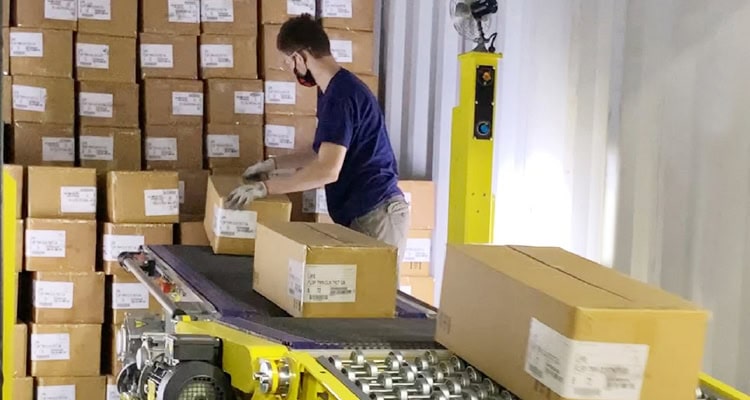
Gorbel’s Destuff-it™ solution is designed for unloading operations and contains a conveyor belt that moves in one direction.
The unloading and loading of floor-loaded (non-palletized) trailers at distribution centers is a notoriously demanding process for workers and can undermine a facility’s efficiency. Bottlenecks are just one of the many delays caused by manual handling that slow down overall operations.
Gorbel’s Destuff-it™ and Restuff-it™ pivoting conveyor systems are portable and ergonomic conveyors used to unload and load floor-loaded trailers, bringing not only new efficiency to the process but improving the experience for warehouse associates.
“With these systems, we’re focused on improving the handling process from the trailer to the first 100 feet into the warehouse,” says Stefan Friedrich, product marketing manager for Gorbel.
Each system has a motorized operator platform and a conveyor that can pivot up-and-down and side-to-side. For workers unloading a trailer, for instance, rather than lifting a box, dropping it onto a pallet and then removing the pallet when it is full, they simply slide boxes onto the conveyor, which pulls the boxes out of the trailer and into the warehouse.
Friedrich points to three pillars of benefits to the Destuff-it™ system: productivity, ergonomics, and safety.
Friedrich says a team of three or four people typically can manually unload a trailer at a rate of about 350 to 650 cases per hour. With Destuff-it™, 900 cases per hour is the bare minimum, 1,200 cases per hour is more to be expected, and some facilities have topped 2,500 cases per hour, Friedrich says.
“We’re at least twice as fast as a manual crew of people, but typically we’re three or four times as fast,” Friedrich says. Destuff-it™—a system that augments and enhances human workers—also is more efficient than fully automated systems, he adds.
The increased productivity proves particularly important during peak seasons when more trailers arrive and depart a warehouse, and when finding sufficient labor undermines efficiency, Friedrich notes. The improved productivity in the unloading and loading process also means that warehouses do not have to reallocate workers to the dock door, pulling them away from other warehouse tasks, when volume is at its highest.
It is physically demanding work for team members to manually unload a trailer. In addition to the heavy boxes, workers often must climb on step stools to access the top of box walls, which can lead to both safety hazards and hazards to the products in the boxes. The operator platform and pivoting conveyor on the Destuff-it™ allow workers to reach the top of box walls without a step stool or strenuous lifting.
“With our system’s pivoting conveyor, you can nose right up to the package—we bring the conveyor to the package, rather than the package to the conveyor—and that lets operators slide boxes onto the conveyor without any major ergonomic strain on their bodies,” Friedrich says.
With a Destuff-it™ system, workers are augmented instead of removed. Workers can move within their optimal ergonomic zone instead of bending, twisting, and straining. When workers are comfortable, their jobs are more enjoyable and retention goes up.
Gorbel’s case studies include interviews with warehouse associates who use the system. A common comment is how much better they feel at the end of the day from using the system. “They’ll say things like, ‘I can go home and play with my kids because I don’t feel physically drained from lifting stuff all day,’” Friedrich says. “That’s an important benefit and core to Gorbel’s mission of improving people’s lives.”
VARGO Helps Find Continuous Flow in Order Fulfillment
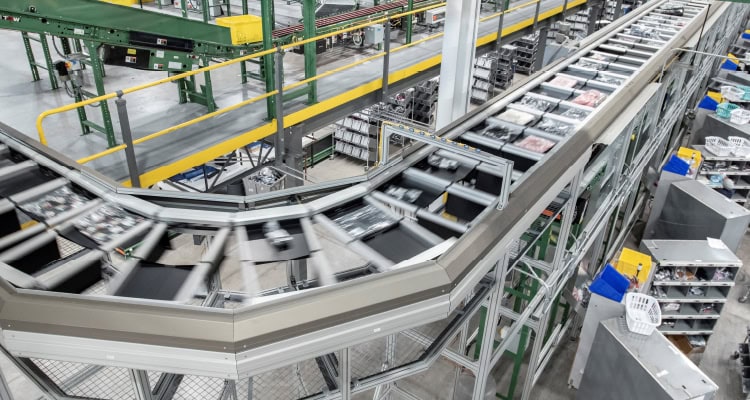
VARGO’s continuous flow warehouse execution system synchronizes workers and machines for peak efficiency, resulting in increased output without big bottlenecks.
When it comes to order fulfillment, waves are best to be avoided in a warehouse—they’re liable to pull you under.
That belief is behind the approach that VARGO takes when helping their clients improve their fulfillment process, says Robert Nilsson, chief commercial officer for VARGO. The efficient use of a warehouse’s resources, such as equipment and people, can dramatically improve fulfillment. The reason is that orders arrive and are processed in waves, leading to spikes and dips in activity and an inherent inefficiency, he says.
“When you do waves, then it becomes difficult to handle exceptions and prioritization, because the wave is set,” Nilsson says. “You can suddenly have a big wave of orders waiting for an exception order or a prioritization, so utilization grinds to a halt and inventory sits in different steps.”
Continuous Flow
VARGO uses COFE, its warehouse execution system (WES), to help warehouses achieve a continuous flow of order fulfillment that keeps the work going at a more predictable, stable pace. In focusing on creating a continuous flow in fulfillment, VARGO employs its WES to improve the utilization of a DC operator’s equipment and labor. The resulting flow leads to the “whole building” working in sync, Nilsson says.
“Those fulfillment steps—sort, pick, pack, and ship—is where you need to get constant utilization, and that’s what we are 100% focused on,” Nilsson says.
The benefits of the higher utilization that comes with constant flow is considerable, including in some cases for VARGO clients a doubling of output from a facility, he adds. “That’s the power of boxes coming out of inventory and moving continuously without big bottlenecks when a big wave comes in,” Nilsson says.
VARGO is not focused on maximizing efficiency at just one stop, but on maximizing efficiency across the entire fulfillment process, he says. Increasing the speed of just one step in that process might actually undermine the efficiency of the overall process, because other steps in the process might not be able to keep up with that new pace.
“The number one goal is running at the right speed continuously based on the other steps that need to be done,” Nilsson says. “That balance drives up utilization.”
This continuous flow and balance means workers and equipment throughout the fulfillment process work in sync. “When you see this in action, it looks non-stressful,” Nilsson says. “The work flows continuously, and you don’t get those spikes.”
A continuous flow versus a wave leads to a decrease in peak modules, so that a warehouse does not have to keep as much inventory on hand—“utilization is a key for keeping your inventory tighter,” he says.
It makes life easier for workers, too.
“The software manages the people at the pick stations, so the picker doesn’t have to decide, ‘Hey, give me more orders,’” Nilsson says. “We send orders to the resources that are available at the time. So if someone walks away, orders are routed somewhere else. Managing that continuously is a labor satisfaction piece.”
Automation Innovators
Engineering Innovation has developed a new divert module for its Chameleon SLAM solution to handle “ugly” packages, ensuring they stay in the flow and reduce disruptions. They also emphasize practical and well-planned automation rollouts, offering training programs and scalable systems to support existing teams and build resilient operations.
eii-online.com • 765-807-0699
Gorbel offers Destuff-it™ and Restuff-it™ pivoting conveyor systems, which are portable and ergonomic solutions for unloading and loading floor-loaded trailers. These systems improve efficiency, enhance worker ergonomics, and increase safety in distribution centers.
gorbel.com • 844-268-7055
VARGO utilizes its warehouse execution system, COFE, to help distribution centers achieve a continuous flow in order fulfillment, optimizing the use of equipment and labor. This approach leads to more predictable and stable work paces, significantly improving overall facility output and worker satisfaction by ensuring all fulfillment steps work in sync.
vargosolutions.com • 877-876-6384