
WMS Remix: Attuned to Variability

Adaptability is key as warehouse operators navigate changing order profiles, seasonal surges, labor shortages, business growth, and external disruptions. A warehouse management system (WMS) has to be flexible and configurable enough to keep pace. Here are four leading providers that are dialed in.
Warehouse management systems have always promised flexibility. Today that promise is being tested at a faster tempo and some platforms can’t keep up.
The status quo has left the building. Order profiles are splintering, labor pools are thinning, and a single facility might ship a full pallet to a grocery chain in the morning and a single sneaker box to a doorstep by afternoon.
The WMS platforms making it possible are being asked to absorb changes that, a decade ago, would have triggered a multi-year IT project.
Increasingly, organizations favor converged WMS and supply chain execution systems that connect the software with transportation, yard, order, and returns management, enabling unified execution and analytics across the end-to-end logistics network, according to the 2026 Gartner Magic Quadrant for Warehouse Management Systems.
“In the past five years, much more of a 3PL’s business depends on getting integrations right on the first try,” says Dan Cavanaugh, CEO and president of Da Vinci. “A 3PL running diverse accounts is integrating to a different ERP or EDI for practically every client.”
Shifting Control
For legacy enterprise WMS systems, changes such as adding new customers or products meant either filing a ticket and waiting, or hiring external IT support for customization. That model is losing favor fast. Vendors increasingly describe their platforms in terms of who holds the authority to make a change—the operator or the provider—and the industry consensus is shifting firmly toward the former.
A modern system closes the gap by offering robust capabilities to handle diverse workflows and putting configuration back in the operator’s hands rather than the vendor’s.
The stakes go beyond convenience. When a 3PL wins a client with unusual requirements, the speed at which it can adapt its own workflows often determines whether it can take the business at all.
“The difference is whether the system can flex its handling of an order the moment it comes in,” Cavanaugh says. “A retail order and an ecommerce order in the same warehouse need different logic, not different buildings.”
Ask multiple vendors to name the single biggest operational headache, and the honest answer, increasingly, is that there isn’t one. It’s the churn itself, from staffing to order mix to customer terms, that wears operations down.
“A WMS designed for a stable state is constantly being stretched,” says Derek Armanious, chief engineering officer at Datex. “A modern WMS addresses this more through adaptability than through any one feature.”
WMS users are moving away from one-size-fits-all solutions that offer broad capabilities but don’t stand out in any one function. Modern WMS design takes a best-of-breed approach, where the WMS integrates with other leading solutions, such as ERP, robotics, and warehouse automation.
Harmonizing Workflows
“Integration flexibility in modern software is now the status quo,” says Shaun Hagen, CEO of CartonCloud. The line separating pallet-based distribution from parcel fulfillment is fading. Warehouses now routinely pick full pallets and eaches from the same inventory pool, sometimes for the same customer, and systems built around one fulfillment model struggle to keep pace.
Buyers evaluating a WMS today are told to look for a single inventory engine that can serve every channel through configuration, rather than separate modules stitched together after the fact.
The moment a vendor’s answer to a new requirement starts with “that’s a customization project,” the added complexity slows implementation. It delays the project’s start date and time to start earning its keep.
A recurring theme among providers pushing artificial intelligence is that the technology only works on top of a foundation most warehouses haven’t finished building. Legacy, on-premise systems simply can’t support real-time analytics or automation, no matter how advanced the add-on. “The foundation for AI is clean data, and that is what most warehouses and warehouse management systems, both from a technology and process standpoint, lack today,” says Rishabh Narang, vice president of product and market strategy at Made4net.
As warehouse operations scale up, vendors report deployment templates now compress rollout schedules from many months to a few weeks per site, a pace that large multi-location retailers increasingly expect as standard.
Artificial intelligence is proving useful in the back office for configuration, reporting, exception handling, admin-heavy judgment work, and considerably less proven at the point of physical execution, where errors carry real cost.
“Does it do the work that a person had to do yesterday? If that’s a demo rather than a removal, then it’s still a promise,” Hagen says.
Some providers rule out full autonomy on principle rather than just readiness. “The whole hype bubble around agentic AI that will replace the traditional WMS is not going to happen,” Narang says.
Staying Tuned for the Future
Buyers tend to evaluate a WMS against their current operation rather than the one they’ll have in three years, after a new client, a new channel, or a second facility has changed the requirements entirely.
“Every WMS demos well against your current operation,” Armanious says. “The right question is: what happens when things change?”
The warehouse operators struggling most are those locked into systems that make them wait for a vendor, a services team, or a software update to respond to a business that no longer moves on a predictable calendar.
Whether the remedy is labeled configuration, modernization, or simply eliminating unnecessary admin, the direction is the same. The warehouse of 2026 doesn’t have the luxury of a fixed shape, and the systems running it are being rebuilt to match.
CartonCloud: Flexibility for Mid-Market Logistics
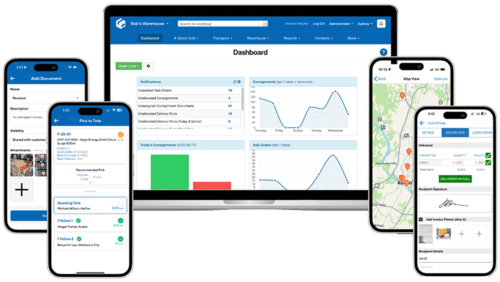
CartonCloud lets companies connect every part of their warehouse and transport management together in one platform for complete visibility and control.
Shippers and third-party logistics providers rarely switch warehouse management systems because a shinier feature caught their eye. They switch because their current system is broken.
That’s the premise driving CartonCloud, an Australia-founded WMS and TMS provider expanding its footprint in North America.
What’s breaking, in many cases, is the old model of enterprise software: sprawling, feature-heavy platforms that promise to do everything but increasingly can’t keep pace with modern fulfillment demands, says CEO Shaun Hagen.
The company has spent the past six years building that North American presence around a different pitch: fast implementation, deep configurability, and a platform that serves 3PLs and mid-market in-house logistics teams without forcing them to choose between ecommerce and B2B fulfillment.
CartonCloud now supports roughly 650 logistics operations worldwide and 50,000 daily users, with a dedicated North American team serving more than 150 customers across the United States and Canada.
Scaling Operations
The line between ecommerce and B2B order profiles has blurred to the point of irrelevance, Hagen says. A $10,000 seafood order now carries the same customer expectations as a retail package: speed, visibility, accuracy. Legacy systems, built for an earlier era of enterprise procurement, struggle to flex across both.
CartonCloud runs warehouse and transport on one platform rather than two integrated ones—solving a common problem for small, frequent shipments, where the handoff from warehouse to carrier is where most of the friction and reconciliation error lives.
That flexibility shows up most concretely in onboarding. Where traditional WMS rollouts can stretch to 12 months, CartonCloud customers typically go live in days or weeks, largely because configuration lives with operators rather than buried in code or gated behind an IT team or vendor service desk.
Hagen points to customers who are seeing 60% to 80% reductions in admin overhead, freeing staff to focus on growth or, in some cases, simply reclaiming time.
On labor, Hagen pushes back against the assumption that optimization tools are the answer. “The most valuable labor tool in the WMS isn’t the labor module,” he says. “It’s every hour of admin or rework that you can delete before you even need to manage it.”
He frames the real value in eliminating unmanaged paperwork and manual data entry before headcount ever becomes the bottleneck. The WMS helps move process knowledge out of a supervisor’s head and into the system itself so that newer staff can be productive faster.
Unlocking AI Value
Artificial intelligence is the next step in that philosophy. CartonCloud already runs AI in production: turning unstructured customer paperwork, emailed orders, PDFs, and spreadsheets into clean, structured orders and letting users ask the system questions in plain language instead of building reports. His test is simple: “Does it do work a person had to do yesterday?”
Behind that is a bigger shift. For 30 years the WMS has been a system of record. Hagen sees it becoming a system of operations: software that doesn’t just log what happened in the warehouse but also handles routine work (billing, data entry, exception handling) and passes judgment calls to a person. Because CartonCloud runs warehouse and transport on a single platform, its AI sees the whole flow from the rack to the dock door, context that point solutions can’t replicate.
He’s direct about where the industry’s marketing has outrun reality. Fully autonomous physical optimization is still “more promise than practice,” he says, and operators are right to be skeptical of anyone claiming otherwise. “On the administrative side, though, the value is real today. That’s where a mid-market operator gets enterprise-grade leverage without an enterprise-grade headcount.”
Hagen’s advice to operators evaluating any WMS: Nail down inventory depth requirements first—traceability, expiry control, labeling—then prioritize configurability and honest vendor partnerships over hype.
“You shouldn’t be waiting six to 12 months to get time to value anymore,” he says. The bigger priority, in Hagen’s view, is who gets access to serious capability. “Within three years, the capability only a Manhattan or SAP customer can afford today will be expected by every serious operator, at mid-market prices, live in weeks,” he says.
The question buyers should ask isn’t how big their company is but how sophisticated their operation is.
“Plenty of 40-person 3PLs run more complex fulfillment than a Fortune 500 DC,” Hagen says. “They’ve been stuck in the middle: too sophisticated for entry-level tools, but not about to sign up for a two-year enterprise implementation. That’s the gap we’re built for.”
Datex: Adapting to Variability
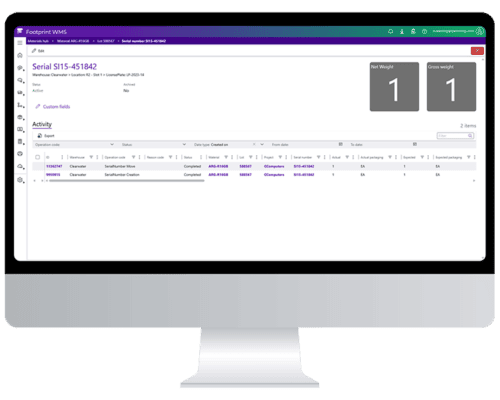
Datex’s Footprint® WMS, which the company built on its own Datex Studio platform, gives each client self-service visibility into their own inventory and orders.
Accommodating variability is key in WMS software. “The common thread we see across shippers and 3PLs isn’t any single pain point; it’s variability,” says Derek Armanious, chief engineering officer at Datex. “Labor availability changes week to week, order profiles change season to season, and customer requirements change contract to contract.”
Operations built for a stable state are becoming overextended—and that’s reshaping what shippers and third-party logistics providers expect from a WMS.
Rather than pointing to any single feature, Armanious frames adaptability as the real differentiator. Directed workflows let new or temporary workers become productive in hours rather than weeks, task-level tracking gives supervisors real-time visibility into where labor is going, and the deeper test comes at peak season: Can a warehouse change its wave logic, allocation rules, or workflows without triggering a software project and a six-week wait?
“If reconfiguring for peak season requires a change order and a six-week timeline, the system is part of the problem,” he says.
That philosophy runs through Datex’s Footprint® WMS, which the company built on its own Datex Studio platform with the multi-client complexity of 3PL operations at its core.
While many WMS platforms are designed for single-inventory operations and retrofitted for multi-client use, Armanious describes Footprint’s approach as native separation: Inventory, orders, tasks, documents, and reporting are all client-scoped from the ground up.
That structure extends into billing, where the system captures billable events at the task level as work happens, and into a customer portal that gives each client self-service visibility into only their own inventory and orders.
Cascading Benefits
With leaner headcounts, a WMS directly impacts on-the-floor productivity by directing work and removing the need for employees to make decisions.
“Every time a worker has to decide where to go, what to grab, or where to put something, you’re counting on experience you may not have on the floor anymore,” Armanious says.
“When the WMS makes those decisions—directed putaway, directed picking, intelligent location recommendations—a first-week employee performs close to a first-year employee,” he adds.
Integration has also changed shape, Armanious says. While an ERP ran on nightly batch files, the WMS now sits within a real-time mesh of order sources, marketplaces, robotics, and customer portals, with little tolerance for latency.
Because Footprint is built on the Datex Studio platform, an integration endpoint becomes a configurable artifact rather than custom code.
That means Datex and its customers can stand up a new client feed or piece of automation in days and end up with a configuration that survives future upgrades.
Datex engineering and services teams already use AI agents equipped with a library of company-built skills to build and modify reports, dashboards, and workflows for customer deliverables, compressing work that used to take days into hours.
Conversational AI and AI-powered analytics are reaching users directly too, with more agentic capabilities in development. But Armanious is candid about where the technology is and isn’t proving itself. He draws a firm line at full autonomy inside execution.
“Anything touching inventory accuracy, compliance, or billing needs determinism and an audit trail,” he says. “The pattern that works is AI proposing and humans, or deterministic rules, disposing; vendors claiming otherwise are ahead of their skis.”
Armanious is direct about how shippers frequently go wrong with WMS selection, calling out the tendency to buy based on the demo rather than year three. His advice: ask every vendor exactly what happens when requirements change—who does it, how long it takes, and what it costs—because that answer, more than any feature list, determines the real cost of ownership over time.
Da Vinci: WMS Built for Omnichannel Fulfillment
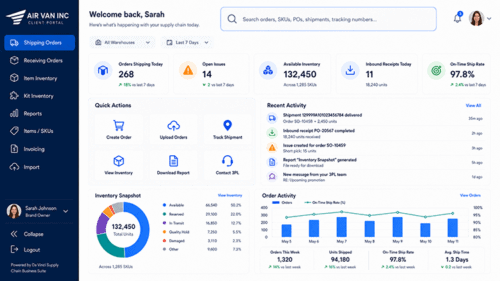
Da Vinci’s configurable WMS is designed for 3PLs and growing brands, supporting customers with highly variable operational requirements.
Da Vinci, a warehouse management platform built for 3PLs and complex distribution operations, is positioning itself around a distinction its leadership argues most buyers overlook: the difference between a configurable system and a customizable one.
Customizable means every change, such as a new billing rule, a modified pick workflow, or a relabeling requirement, routes back through the vendor as a ticket or a services engagement. Configurable means the operator’s own team makes that change directly, without waiting on outside development cycles.
The inflexible nature of many legacy WMS options leaves 3PLs looking for a solution to what they see as a technology problem. They may have capability shortcomings, as their system doesn’t have the functionality to handle the new business they’re trying to bring on. Or, they have a dependency problem, as any change that modifies a workflow has to be routed back through the vendor. It becomes a ticket, a services engagement, or a development cycle, and the 3PL waits.
Da Vinci has built its highly configurable platform as a flexible alternative to support what it calls Super Users: floor and operations staff empowered to adjust workflows, billing logic, labels, and reporting themselves, without the need for outside tech support.
Enabling Speed
This no-code, no-ticket platform gives users the ability to respond quickly and cost-effectively to conditions the 3PL market now faces: rapid client growth, tightening peak-season windows, and diversifying order profiles that mix B2B pallet allocation with B2C small-parcel fulfillment inside the same facility.
“A modern system closes the gap by having the robust capabilities to handle diverse workflows and by putting configuration back in the operator’s hands instead of the vendor’s,” says Dan Cavanaugh, CEO and president of Da Vinci.
With a labor management system built into the WMS rather than bolted on, Da Vinci tracks labor productivity and costs through streamlined, task-level logging designed not to slow workers down. Tracking labor at the task level and tying it to billing lets a 3PL see productivity and cost by customer and facility, equipping the operation to run leaner while maintaining service levels.
Other priorities operators raise consistently include integration complexity with ERP, TMS, and automation systems, which buyers often underestimate when comparing vendors on paper. The WMS can play a new role in managing space utilization, where real-time visibility into bin and pallet occupancy is increasingly treated as an alternative to simply leasing more square footage.
Compressing Timelines
Implementation speed is part of the pitch as well. Da Vinci says its deployments typically run in weeks rather than the year-plus timelines associated with Tier 1 enterprise systems, shortening the runway before a mid-market 3PL sees measurable ROI.
None of this suggests WMS selection has gotten simpler. If anything, the range of workflows a single platform is expected to handle—B2B and B2C, multiple units of measure, client-specific billing, peak volume swings—has widened considerably. The operators best positioned, Da Vinci argues, are the ones who can adapt their systems themselves, on their own timeline, rather than waiting in a vendor’s ticket queue.
“A strong WMS allows a 3PL to say ‘yes’ to any new client and supports running dozens of client configurations on one platform without the need to call the vendor every time something changes,” Cavanaugh says.
Made4net: Modern Tech Drives Innovation
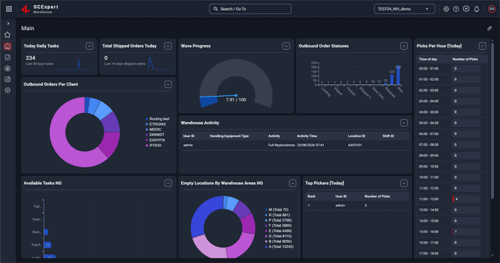
Made4net’s SCExpert™ platform enables supply chain convergence, providing a configurable cloud-based WMS software solution, along with other systems.
Warehouse operators are under growing pressure to modernize. Still, as WMS vendors race to market AI copilots and agentic capabilities, many buyers are shopping for a future their own infrastructure can’t yet support.
Many companies still run warehouse management systems built decades ago, some still on AS/400-era platforms, that can’t support the analytics, robotics, or AI capabilities being marketed to them today.
“AI readiness isn’t really the first step for most organizations,” says Rishabh Narang, a nearly 15-year veteran of the WMS industry now serving as vice president of product and market strategy at Made4net. “The first step is technology modernization.”
That runs counter to the industry’s own sales narrative. As nearly every WMS vendor adds some form of AI messaging to its roadmap, the platform usually isn’t the constraint. The buyer’s underlying architecture is.
WMS modernization starts with the cloud. Moving off legacy, on-premise systems is increasingly the first step, not just for AI readiness but also for basic scalability. Cloud infrastructure supports multi-site rollouts, reduces the burden of on-premise setup, upgrades, and maintenance, and enables faster go-lives for growing operations.
A cloud-based approach supports a templated model at the company level, with site-specific configuration for multi-location and multi-client deployments. “When the vendor manages the upgrades, you’re not the one investing in ongoing product upgrades,” Narang says. “That can get expensive fast if you’re running a multi-site deployment.”
A second major trend reshaping WMS selection is the blurring of the lines between B2B and ecommerce fulfillment. Warehouses are increasingly expected to support pallet-based and each-based picking, freight and parcel shipping, and multi-tenant operations for 3PLs, all from a single configurable platform rather than a patchwork of point solutions.
Vendors that can’t flex between these modes, or that lack integration with upstream partners and ERP systems such as SAP or Oracle, are often the ones companies outgrow.
Defining the Role of AI
Underlying both trends is a data problem the industry is only starting to reckon with. Inconsistent units of measure, mismatched item codes, and manual database edits are long-standing, unglamorous issues in warehouse operations.
These inconsistencies also now a primary obstacle to any AI ambitions. Clean data is what feeds AI copilots and, eventually, agents capable of analyzing inventory, labor, and storage data to recommend warehouse priorities in real time.
Labor is another area where AI is expected to play a growing, if still early-stage, role. Clean data will help forecast staffing needs, orchestrate task assignments, and redistribute work based on historical performance. But even the most bullish predictions have limits. Agentic AI replacing core WMS execution outright is not one of them.
“I do not want AI to do order fulfillment on my behalf,” Narang says. “That’s way too risky.” AI’s more realistic near-term role, he suggests, is in adjacent functions: invoice processing, transportation planning, wave optimization—working alongside the core system, not replacing it.
Dodging Avoidable Mistakes
Buyers evaluating WMS vendors also continue to make avoidable mistakes, says Narang. They focus on upfront licensing costs while overlooking the hidden expense of customizations and integrations. They over-buy enterprise-grade capability that doesn’t match actual operational complexity. And they fail to involve data and integration stakeholders early enough in the evaluation process.
As fulfillment networks grow more complex, the throughline across these trends is foundational readiness. A scalable, cloud-based, fully integrated WMS is the prerequisite for everything warehouses hope to build on top of it, AI included.
WMS Solutions: Chart Toppers
CartonCloud | cartoncloud.com
CartonCloud lets companies connect their warehouse and transportation management systems in one platform for complete visibility and control, providing one login, one data source, and one workflow. With an average onboarding time of around 6 hours, the solution offers fast ROI and gives companies the agility to grow when opportunity strikes.
Da Vinci Unified | dvunified.com
Da Vinci WMS was designed to absorb operational complexity. The solution lets companies onboard new customers, inventory types, and workflows with flexible configurations to drive their growth. The powerful and configurable WMS is designed for complex 3PLs and growing brands, supporting customers with demanding, highly variable operational requirements.
Datex | datexcorp.com
Built for 3PL operations, Footprint® WMS delivers capabilities that support multi-tenant environments, maximize revenue, and differentiate through technology. Footprint WMS was designed with configuration in mind, with no-code workflows that let companies update processes in minutes. The solution helps 3PLs get clients live faster with configurable workflows, client-specific rules, and mobile options.
Made4net | made4net.com/warehouse
Made4net provides a full suite of supply chain execution solutions and best-in-class WMS software for companies of all sizes. Companies can automate, optimize, and streamline every aspect of their operations with Made4net’s configurable cloud-based warehouse management system software. The end-to-end solution offers supply chain convergence, with a fully integrated platform, including WMS, WCS, YMS, labor, routing, and proof of delivery solutions.