
Supply Chain Sustainability Focus Shrinking; Global Trade Defies Tariff Pressures & More Logistics News

Logistics and supply chain news and highlights shaping the future of global logistics.
Sustainability No Longer a Top Concern
Despite public commitments to decarbonization and efficiency, U.S. logistics companies continue to view sustainability as a secondary concern, according to a new Tech.co survey of more than 1,500 professionals in the transportation and shipping sectors.
From April through August 2025 (per data reported in October), just 7% to 11% of respondents identified sustainability as a top operational focus, placing it far behind priorities such as vehicle upkeep (19%–23%), financial pressures (16%–21%), and staffing (12%–26%).
When logistics operators do invest in green initiatives, their decisions are closely tied to cost reduction and measurable ROI, the report notes. The most common sustainability practices are reducing idling time (43%) and optimizing delivery routes for fuel efficiency (40%), both of which directly reduce fuel costs.
Sustainability is not a core consideration for the logistics sector at the moment, as it struggles to deal with a volatile year, the research shows. Instead, the investments of time and resources needed for progress in this area are being spent elsewhere.
Policy reversals, such as the repeal of California’s Advanced Clean Fleets Act, have dampened enthusiasm for EV adoption and other long-term green initiatives, Tech.co notes.
Funding Frenzy?
Logistics experts argue that government investment hasn’t kept pace with the growing importance of trucking to the U.S. economy. From training incentives to infrastructure and technology upgrades, the industry needs targeted support before capacity constraints slow recovery. In a recent Inbound Logistics LinkedIn poll, we asked our audience whether or not they believe it’s time to channel more infrastructure funds into trucking. The answer? A resounding yes.
Should federal and state transport funds be directed to strengthen trucking and keep freight moving as the economy heats up?
62% YES — Trucking is essential
29% MAYBE — Balanced with other needs
9% NO — Private sector should pay
All About the Inventory
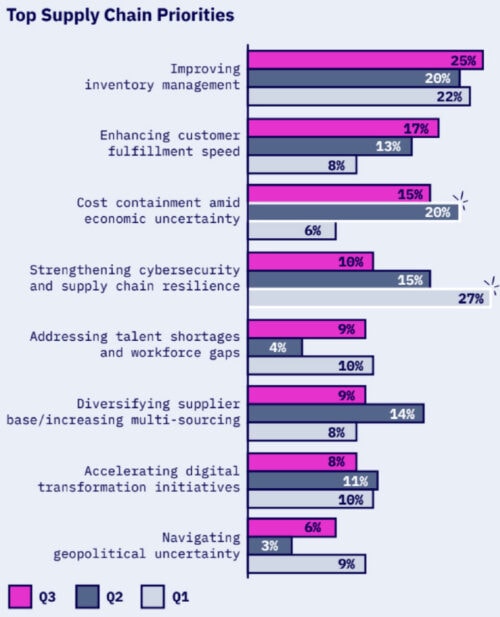
Source: West Monroe
Inventory management is king. That’s the short take from the most recent West Monroe Quarterly Supply Chain Poll, which surveyed 250 industry leaders across manufacturing, retail, and distribution to track how they’re responding to supply chain disruption in real time.
Against a now familiar backdrop of margin pressures due to tariff policies, AI transformation impacts, and growing worry over labor constraints, survey respondents indicate that inventory control remains the anchor of supply chain priorities. Snagging the No. 1 spot, 25% of respondents name “improving inventory management” their top focus (up from 20% in Q2). The surprise mover? Customer fulfillment speed, which jumped three spots to become the No. 2 priority. As realigned supply flows and tariff-driven delays mount, speed is emerging as a competitive necessity (see chart).
Looking ahead, West Monroe predicts the next chapter will show which companies lean in and differentiate. Structural agility—data, scenario modeling, responsive networks—will matter more than ever, the company says.
Global Trade Defies Tariff Pressures
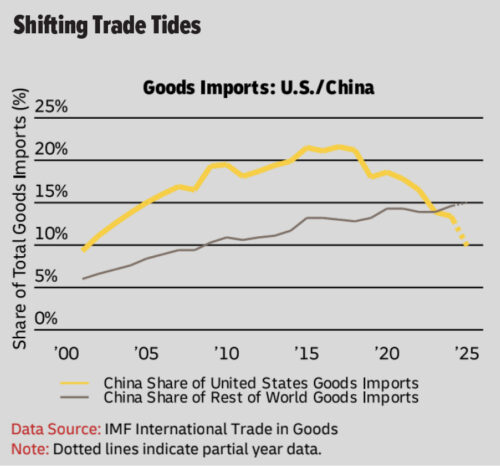
Even as U.S. tariffs hit their highest levels in nearly a century, global trade continues to expand, according to the updated DHL Global Connectedness Tracker, developed in partnership with New York University’s Stern School of Business.
Drawing on more than 20 million data points from 25 sources, the report provides one of the first systematic looks at how global trade and investment are adapting to shifting U.S. trade policies under President Trump’s second term.
Global trade volumes are projected to grow at an annualized rate of 2.5% through 2029, roughly matching the pace of the previous decade, according to the Tracker. The resilience is partly because the United States accounts for a smaller share of world trade—just 13% of imports and 9% of exports in 2024—and most countries have not mirrored U.S. tariff increases.
While tariffs are slowing growth, they are not reversing it. North America saw the steepest downgrade in trade forecasts, while Latin America, the Caribbean, and the Middle East gained ground due to lighter tariff exposure and stronger energy exports.
“Despite all the headwinds, the DHL Global Connectedness Tracker highlights the enduring strength of global trade,” says John Pearson, CEO of DHL Express.
The report also shows these key findings:
- Global trade grew faster in the first half of 2025 than in any period since 2010 (excluding the pandemic rebound).
- No major reorientation of trade along geopolitical blocs is evident.
- Average trade distance hit a record 3,200 miles (5,000 kilometers), disproving claims of “deglobalization.”
- Globalization remains near its record high at 25% on DHL’s index scale.
- The share of U.S.-reported imports coming directly from China plummeted to only 9% over the first seven months of 2025, down from 13% one year earlier and 22% in 2017 (see chart).
What’s In Store for the Freight Market?

Muted demand and cautious optimism define the outlook for Q4 2025, according to the latest TD Cowen/AFS Freight Index, which tracks truckload, LTL, and parcel rate trends using freight audit and payment data from $39 billion in annual transportation spend.
The report shows carriers leaning on pricing discipline and operational efficiency to protect margins in what has become the third year of an extended freight downturn. While macroeconomic signals such as GDP growth and lower interest rates offer modest encouragement, capacity imbalances and trade policy shifts continue to limit recovery.
The environment is one where “carriers are relying on hard-won lessons of the past to prioritize profitability and hang on in a soft environment,” says AFS Logistics CEO Andy Dyer.
Key report highlights include:
Parcel: Ground parcel rates are projected to climb 4.8% year over year (YOY), reaching 32.4% above the 2018 baseline as FedEx and UPS introduce new dimensional rounding rules and holiday surcharges.
LTL: The rate-per-pound index is expected to hit 64.8% above 2018 levels, marking eight consecutive quarters of YOY growth as carriers maintain yield discipline despite lower shipment weights.
Truckload: Rates remain sluggish, with Q4 index levels forecast at 6.1% above the 2018 baseline—virtually flat versus prior quarters—despite small upticks in economic activity.