
Supply Chain Autonomy Gets in the Zone
From AI-driven advancements in perception to new lanes for self-driving trucks, companies are making moves toward autonomy.
Perception Bubbles Up
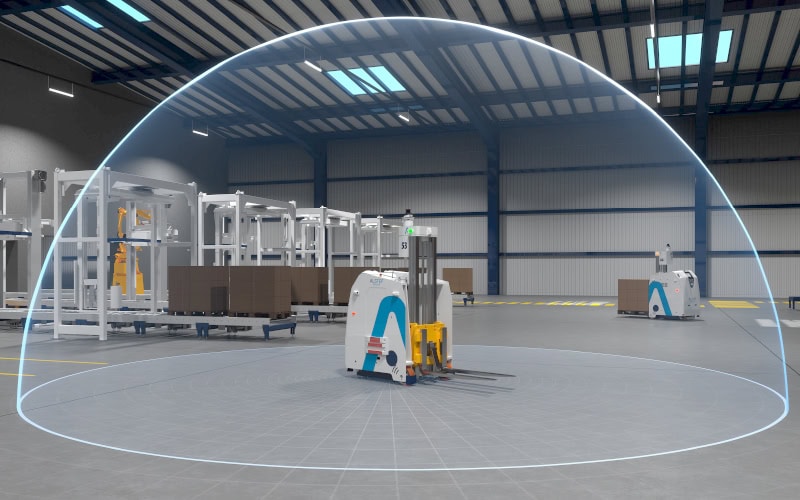
Intralogistics solutions provider Alstef Group’s new autonomous industrial vehicle (AIV) features an advanced perception bubble—a continuously updated awareness zone that enables the vehicle to detect, interpret, and respond to people, equipment, and environmental changes within its operating area.
By combining on-board cameras with artificial intelligence models, the vehicle can distinguish between pedestrians, manual carts, pallets, and fixed infrastructure. For instance, the vehicle adapts its docking trajectory based on the position of a pallet and can determine whether a pallet is empty or loaded and reroute accordingly. Two configurations are available: a light perception bubble, covering the front and rear of the vehicle, and a full perception bubble, providing 360-degree awareness.
All-Around Awareness
Orca AI SeaPod
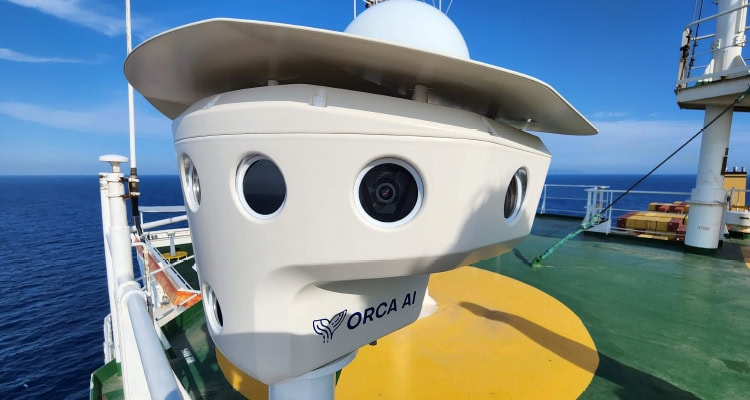
Maritime AI company Orca AI launched its latest AI-based operational platform, delivering a 360-degree field of view (FOV) around a vessel as a foundation for autonomous navigation at sea.
The 360° FOV configuration is enabled by three SeaPod lookout units, each equipped with high-sensitivity RGB and thermal cameras. Working in unison, they deliver continuous full-perimeter coverage and unified situational awareness around the vessel, enabling detection of overtaking vessels and piracy threats, and overcoming line-of-sight constraints caused by cranes and other deck equipment. On vessels such as heavy-lift carriers, this can eliminate blind spots.
Navigating Overnight Runs
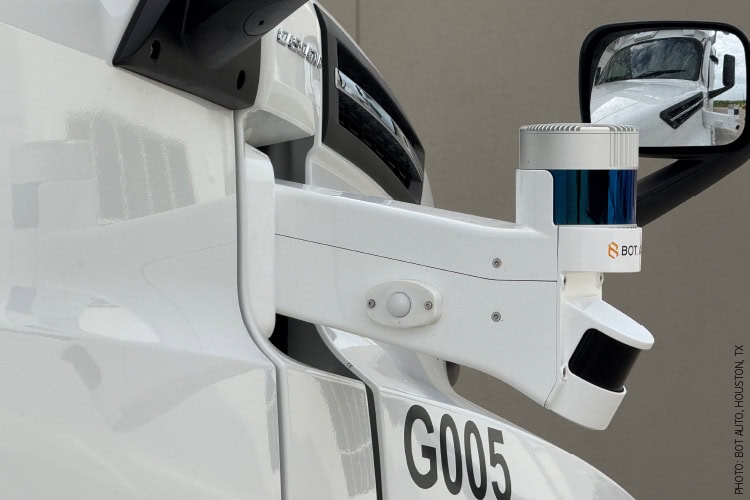
Bot Auto, an autonomous transportation provider, is launching autonomous freight operations between Houston and Dallas, in partnership with Ryan Transportation. Driverless runs are expected to begin in spring 2026.
The deployment covers an overnight lane connecting Houston to the southern Dallas-Fort Worth metroplex, a roughly 200-mile corridor. Fatigue, hours-of-service limits, and driver availability make these overnight runs challenging to cover reliably with traditional capacity.
Bot Auto’s autonomous trucks—classified as Level 4 autonomous vehicles—are designed for high-frequency, time-sensitive freight. Level 4 autonomous vehicles (AVs are classified in levels 1 to 5) do not require human interaction in most circumstances, but a driver can manually override systems.