
Green Seeds: Logistics Companies Logging Real Environmental Progress
From the trans-Pacific corridor to natural gas exhausts, industry players are making measurable environmental progress—on the water, in the air, and on the ground.
By Ashley Prince | April 24, 2026
The logistics industry does not suffer from a shortage of sustainability commitments, but it is a lot harder to find real results and hard numbers to back them up.
According to the EPA, transportation has been the largest source of greenhouse gas emissions in the U.S. since 2016. This position has made the industry a target of both environmental regulations and consumer criticism. These pressures have led to an influx of public-facing statements that do not always translate into actual impact.
Some industry players have worked hard to prove that their sustainability commitments are more than just lip service. The following companies have launched initiatives that make a difference worth documenting.
On the Water
Ocean shipping accounts for roughly 3% of global greenhouse gas emissions, according to the International Maritime Organization. That share is expected to grow as global trade volume increases. Forward-looking organizations in the space are making decarbonization efforts a priority, not just an ambition.
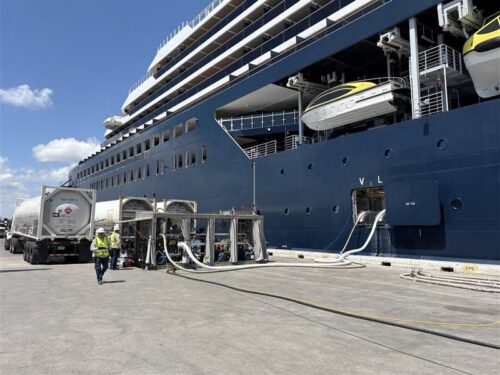
Source: Sawgrass LNG & Power
Singapore, Long Beach, and Los Angeles Ports
The Maritime and Port Authority of Singapore, the Port of Long Beach, and the Port of Los Angeles recently renewed their Green and Digital Shipping Corridor memorandum of understanding for another three years, extending a partnership that was first established in 2023. The agreement keeps all three ports committed to collaboration on low- and zero-emission fuels, port-to-port data connectivity, and decarbonization along the trans-Pacific corridor. As one of the highest-volume shipping lanes in the world, environmental progress along this route makes a real splash.
Sawgrass LNG & Power and Port Everglades
In late March, Sawgrass LNG & Power completed the first-ever shore-to-ship liquefied natural gas bunkering operation at Port Everglades in Fort Lauderdale, Florida. The operation fueled the Ritz-Carlton Yacht Collection vessel Ilma, a 790′ superyacht. This is a significant step for Port Everglades, which has not historically been part of the LNG conversation.
In the Air
Aviation is responsible for approximately 2.5% of global CO2 emissions, but its total climate impact, accounting for contrails and other non-CO2 effects, is estimated to be significantly higher. Unlike ground transportation, the sector has few zero-emission alternatives at commercial scale, meaning operational efficiency and mitigation strategies are often most impactful.
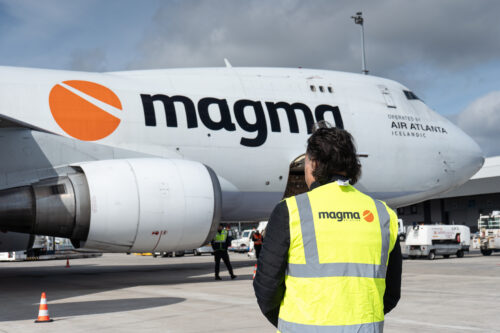
Source: Magma Aviation
Magma Aviation and Air Atlanta
Magma Aviation has partnered with Air Atlanta to monitor fuel performance and identify efficiency opportunities across its operations. Air Atlanta uses the SkyBreathe AI platform to track flight data to pinpoint specific fuel-saving options. In 2025, the initiative led to a reduction of more than 250,000 kg in fuel consumption, translating to an estimated 800,000 kg reduction in CO2 emissions.
Chapman Freeborn OBC and Freeze Carbon
On-board courier specialist Chapman Freeborn OBC has partnered with Freeze Carbon in an effort to improve emissions measurement, transparency, and mitigation across its time-critical aviation operations. The partnership also provides Chapman Freeborn OBC access to verified climate projects supporting broader mitigation efforts, a practical option for a segment where the nature of the work makes direct emissions reductions difficult to achieve.
On the Ground
Ground transportation represents the largest share of logistics-related emissions in the U.S. Electrification and alternative fuels are advancing, but infrastructure gaps and long transition timelines mean that efficiency gains and targeted abatement technologies are pulling significant weight in the near term.
CEVA Logistics and Lenovo
CEVA Logistics and Lenovo completed an eight-day long-haul pilot using a pure-electric heavy-duty truck from Shenzhen to Alashankou, China before transitioning to diesel for the final leg to Almaty, Kazakhstan. The route spanned nearly 6,000 kilometers and transported 5.3 tons of cargo. The electric portion of the journey reduced CO2 emissions by 46%. While infrastructure gaps required the diesel transition, the pilot confirms the model is viable where the charging network exists.
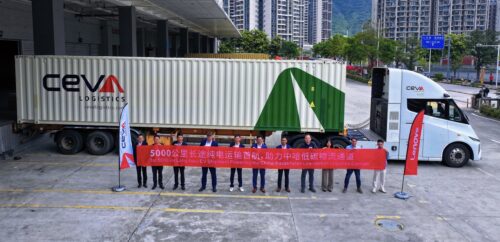
Source: CEVA Logistics
Daphne Technology
Daphne Technology recently closed its Series B funding round, led by Taranis, to accelerate commercialization of its SlipPure methane abatement system. The system reduces methane slip in natural gas engine exhaust by 90%. The raised capital will fund U.S. manufacturing capacity and expanded field deployment targeting midstream and upstream natural gas operators.
Gebrüder Weiss
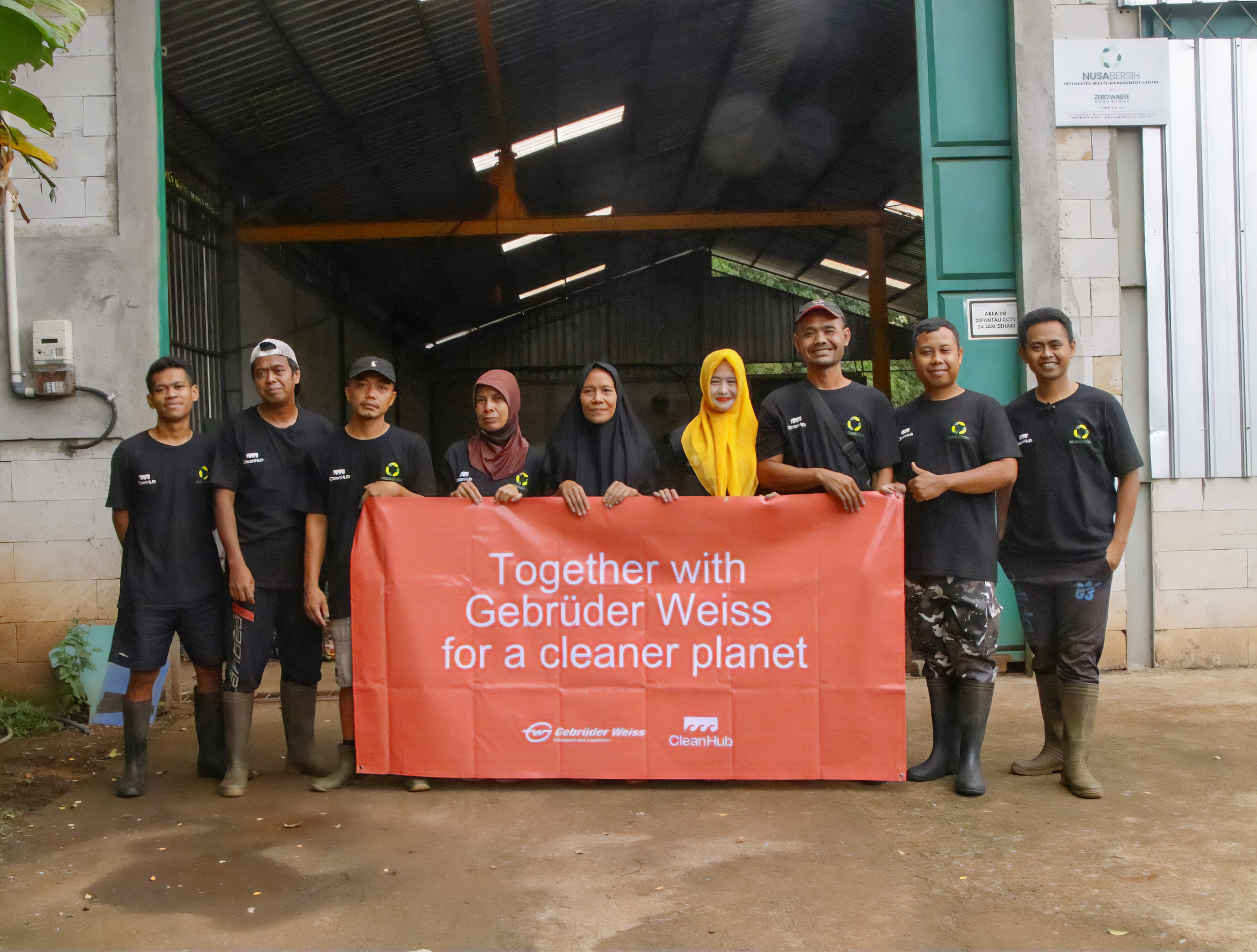
Gebrüder Weiss launched its fifth annual GWcycles campaign on April 1. The initiative calls on participants to collectively cycle one million kilometers to fund plastic waste removal from rivers and coastal regions. Through a partnership with Berlin-based environmental company CleanHub, every kilometer cycled funds the collection of 10 grams of plastic waste. If the goal is reached, that’s enough to remove 10 tons of plastic from waterways.
The Bigger Picture
No single pilot program or partnership is going to decarbonize global logistics on its own. When multiple companies across sectors and modes do the work required to live up to their sustainability promises, their combined efforts begin to compound into something measurable.
Documented outcomes, productive partnerships, and published targets make the difference between a commitment and a proven track record. The industry needs more of the latter.
Each year Inbound Logistics recognizes 75 companies whose sustainability efforts go beyond the press release. If your organization has the numbers to back up its commitments, fill out the Green Supply Chain Partners Survey to be considered for this year’s G75 list.
The survey is open through May 15. Winners will be announced in the June issue.