
Trump Administration Launches “Freedom Haulers” to Steer Veterans Toward CDLs
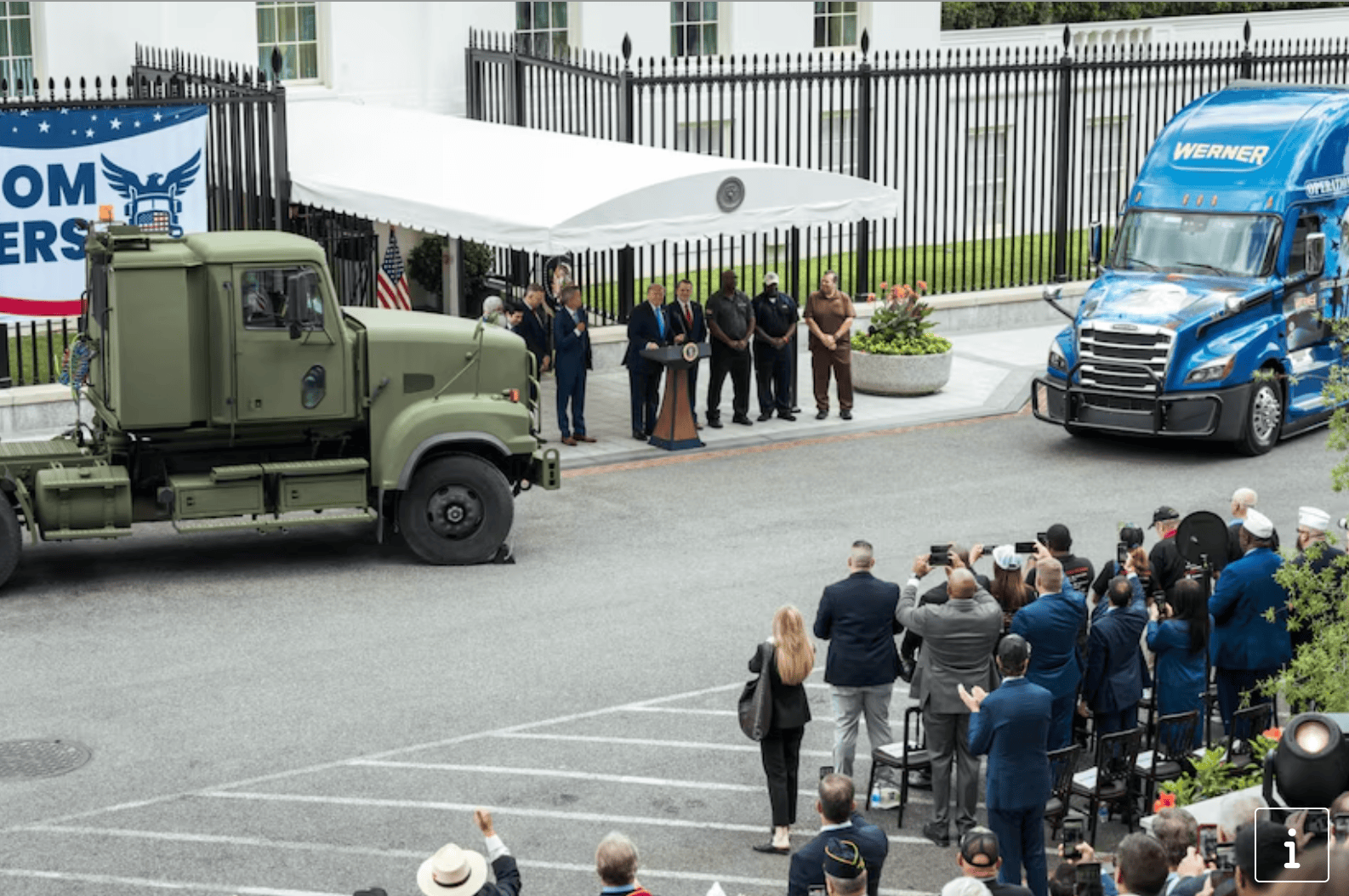
Interagency campaign shortens the runway from military service to a commercial license, as DOT pairs the recruitment push with continued enforcement against non-domiciled drivers.
July 31, 2026 | By Amy Roach
The Trump administration on July 30 launched Freedom Haulers, an interagency campaign built to move separating service members into commercial driving jobs and, in the process, address a driver pool that has been thinned by enforcement actions against improperly licensed and non-domiciled CDL holders.
President Trump announced the initiative at a White House event alongside Transportation Secretary Sean Duffy and Veterans Affairs Secretary Doug Collins. The campaign runs across five federal bodies — the White House, the Department of Transportation, the Department of Veterans Affairs, the Department of War, and the Department of Labor — and pulls in industry partners including the American Trucking Associations, the Owner-Operator Independent Drivers Association and carriers such as Werner Enterprises.
What changed
The centerpiece is an extension of the Federal Motor Carrier Safety Administration’s Military Skills Test Waiver. The waiver lets veterans with at least two years of safe heavy-vehicle operating experience skip the CDL road test. Previously, veterans had 12 months after leaving active duty to claim it; Freedom Haulers doubles that window to 24 months. FMCSA says roughly 40,000 veterans have used the waiver since it took effect.
The campaign also expands the Even Exchange program, which lets qualified military drivers skip the CDL knowledge test as well. Seven states — Alabama, Arkansas, Florida, Indiana, Louisiana, Maryland, and Wyoming — signed on, bringing total participation to 34 states. A separate change allows active-duty service members to apply for a permit or CDL in the state where they’re currently stationed rather than returning to their state of domicile to test.
For veterans without heavy-vehicle experience in the military, the administration is directing them toward state- and VA-approved CDL training programs. The VA’s tuition cap already covers up to 100% of CDL training costs for veterans with at least 36 months of service; the campaign folds that existing benefit into its outreach. DOT also created a Freedom Haulers microsite, cataloging training resources and hiring partners, backed by a digital and radio ad push.
Werner Enterprises used the event to pledge 1,400 new hires of veterans and military spouses in 2027. OOIDA President Todd Spencer endorsed the campaign, noting that close to 40% of the association’s membership has served in the armed forces and calling veterans some of the safest operators of large commercial vehicles.
What the change doesn’t touch
Several elements predate the campaign and remain unchanged. Veterans meeting the 383.77 waiver criteria have long been exempt from the federal Entry-Level Driver Training mandate, as FMCSA determined years ago that military training and testing meet or exceed its own standards. The two-year experience requirement, the safe-driving-record standard and medical certification rules are all unchanged. No new federal appropriation accompanied the announcement.
For carriers, that distinction matters operationally: the waiver window and the Even Exchange expansion widen the pool of veterans who can bypass testing, but a veteran hired under either program has still not taken a skills or knowledge test administered by the state. Insurance carriers may apply their own experience thresholds independent of what FMCSA requires, and fleets recruiting veteran drivers should confirm those terms before extending an offer. Carriers should also verify what a veteran’s military occupational specialty actually reflects — an operator with experience on heavy transport equipment is a different hire than one whose military driving time was largely on light tactical vehicles.
The broader context
Freedom Haulers follows a run of FMCSA enforcement action this year against non-domiciled CDL holders and drivers who don’t meet English-language proficiency requirements, tied in part to fatal crashes the agency has attributed to unqualified drivers. Duffy has framed the two efforts as connected: tightening scrutiny on one segment of the driver pool while expanding access for veterans.
The numbers involved are not symmetrical. FMCSA’s non-domiciled CDL rule is projected to affect more than 194,000 drivers, phased in over one to three years. By comparison, the Military Skills Test Waiver has moved roughly 40,000 veterans into CDLs over its entire operating history — a few thousand per year. Werner’s hiring pledge, one of the largest announced by a single carrier, covers 1,400 positions in 2027. Whether an expanded waiver window and additional Even Exchange states meaningfully close that gap, or simply raise awareness of programs that already existed, will depend on uptake over the next hiring cycle.