
Barrett Distribution Centers: Turning a Security Challenge into a Cost-Savings Win
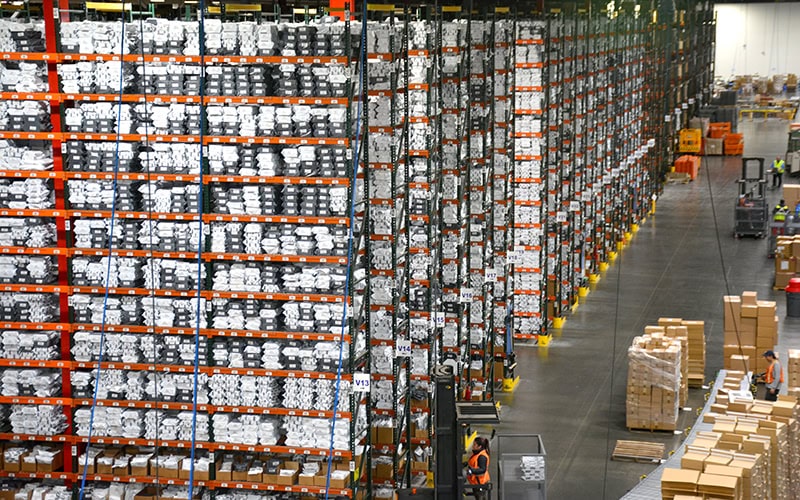
At Barrett Distribution Centers, we’re always looking for ways to do more than just move product — we want to move the needle for our customers. This case study is a great example of what happens when a strong partnership, some honest problem-solving, and the right technology come together.
At Barrett Distribution Centers, we’re always looking for ways to do more than just move product — we want to move the needle for our customers. This case study is a great example of what happens when a strong partnership, some honest problem-solving, and the right technology come together.
We had the opportunity to take on a complex fulfillment challenge for a well-known, high-value footwear brand. And when I say high-value, I mean it — this is the kind of product where security isn’t optional. With an average of 260,000 unique pairs (one pair per SKU) flowing through the facility and outbound orders running around 11,000 per week — spiking well past 20,000 at peak — we needed a solution that could scale without sacrificing security or accuracy.
The Challenge
The Original Setup — and Where It Started Breaking Down
Our initial approach was straightforward: auto-bag every pair before put-away, then at outbound, pick the bag and run it through our automated cartonization machine, box it up, scan it, and manually apply a shipping label. Logical enough on paper.
The problem? That bagging process alone required 10 warehouse associates just to keep up. On top of the labor cost, the bags were causing what we call “oversizing” — the bagged pair was taking up more dimensional space inside the shipping carton than the actual product required. In the small parcel world, DIM weight is money, and we were leaving savings on the table with every single shipment. The manual label application process was another friction point — slow, prone to error, and just not built for the volume we were running.
The Solution
Rethinking the Approach
Rather than just throwing more labor at it, we sat down with our customer and asked the harder question: is the bag actually solving the security problem, or is it just the way we’ve always done it?
The answer led us to a smarter solution. We eliminated the auto-bagging process entirely and redirected our cartonization machine to do what it does best — fit each pair into a carton sized precisely to that pair. The machine runs at up to 650 pairs per hour, so the throughput math was compelling. More importantly, every pair now ships in a right-sized carton, which directly translates to lower dimensional weight charges across every single outbound order.
The labor impact was immediate. We went from 10 associates on inbound bagging down to 5 — a 50% reduction — while actually increasing daily throughput. And with auto-shipment labeling coming online through the cartonization machine in the next month, we’ll push efficiency even further by eliminating the manual label application step entirely.
The Results
The improvements hit across multiple cost categories simultaneously:
- Cost-per-unit savings year over year — meaningful reduction across the board resulting in a Warehouse Services Cost per Unit (CPU) reduction of ~$2.30/Unit during the first year
- Lower small parcel costs — right-sized cartons mean optimized DIM weights on every shipment
- Elimination of bag costs — a direct material cost removed from the equation
- Inbound labor reduction — from 10 associates down to 5
- 99% of Outbound Orders Ship Same Day – Our investment in automated CMC boxing and labeling technology has substantially increased daily throughput, allowing us to ship more orders the same day while supporting later order cutoffs.
And there’s a sustainability angle here that shouldn’t be overlooked. Removing the bagging process entirely cuts down on packaging waste, and shipping in optimized cartons means fewer trucks needed to move the same volume. That’s a real ESG win for the customer — something their VP of Operations called out directly:
—VP of Operations, Footwear Brand Customer
The Takeaway
What makes this one worth talking about isn’t just the cost savings — it’s the mindset behind it. We didn’t wait for a contract renewal or a customer complaint to surface the opportunity. We looked at the operation, identified where costs were hiding, and brought a collaborative solution to the table. That’s what a real 3PL partnership looks like.
If you’re running a high-value, high-SKU fulfillment operation and you haven’t stress-tested your inbound process lately, this is a good reminder that the inefficiencies you’ve lived with the longest are often the ones with the most upside.
 To learn more:
Barrett Distribution Centers
mhealy@barrettdistribution.com
barrettdistribution.com
508-553-8800