
Guide to Plumbing Inventory Software: How to Track Tools & Cut Costs
Plumbing Inventory Software: Track Parts & Cut Costs
Ever sent a technician to a job site only to discover the part you swear was in the truck isn’t there? Or realized you’ve been sitting on $15K of pipe that’s been gathering dust in your warehouse for six months? These aren’t just annoying mistakes, they’re profit leaks that add up fast. Plumbing inventory software fixes this. It tracks inventory in real time, syncs across your team, and stops you from bleeding money on parts you can’t find or don’t need. Here’s what actually works.
Why Spreadsheets Are Killing Your Plumbing Business
Let’s be honest, most plumbing contractors start with a spreadsheet. It’s free, it’s familiar, and it works… until it doesn’t.
The problem isn’t Excel itself. It’s that spreadsheets can’t keep up with a plumbing business that’s actually moving. Your plumber updates their copy in the truck, you update yours at the office, and nobody knows what’s actually in stock. There’s no mobile app access, so techs can’t check the stock level when they’re standing in a customer’s basement. Manual data entry guarantees errors, wrong quantities, duplicate orders, missing expense tracking. You can’t see inventory usage per job or customer, and there’s zero visibility into what’s actually costing you money.
Moving to inventory management software means leaving Excel behind, and yeah, your team needs Android or iOS devices to make it work. Budget 2-3 weeks for the transition and expect some grumbling. But here’s a test worth doing right now: pull your last three months of spreadsheet data and count how many times you emergency-ordered parts you already had. That’s your baseline cost of chaos, and it’s probably higher than you think.
What Plumbing Inventory Management Software Actually Does
Inventory tracking software isn’t magic, it’s just organized paranoia that pays off. Instead of guessing what’s where, you know. Instead of scrambling to find parts, they’re already tracked. Here’s how it works in practice.
Track Inventory Across Every Truck and Warehouse
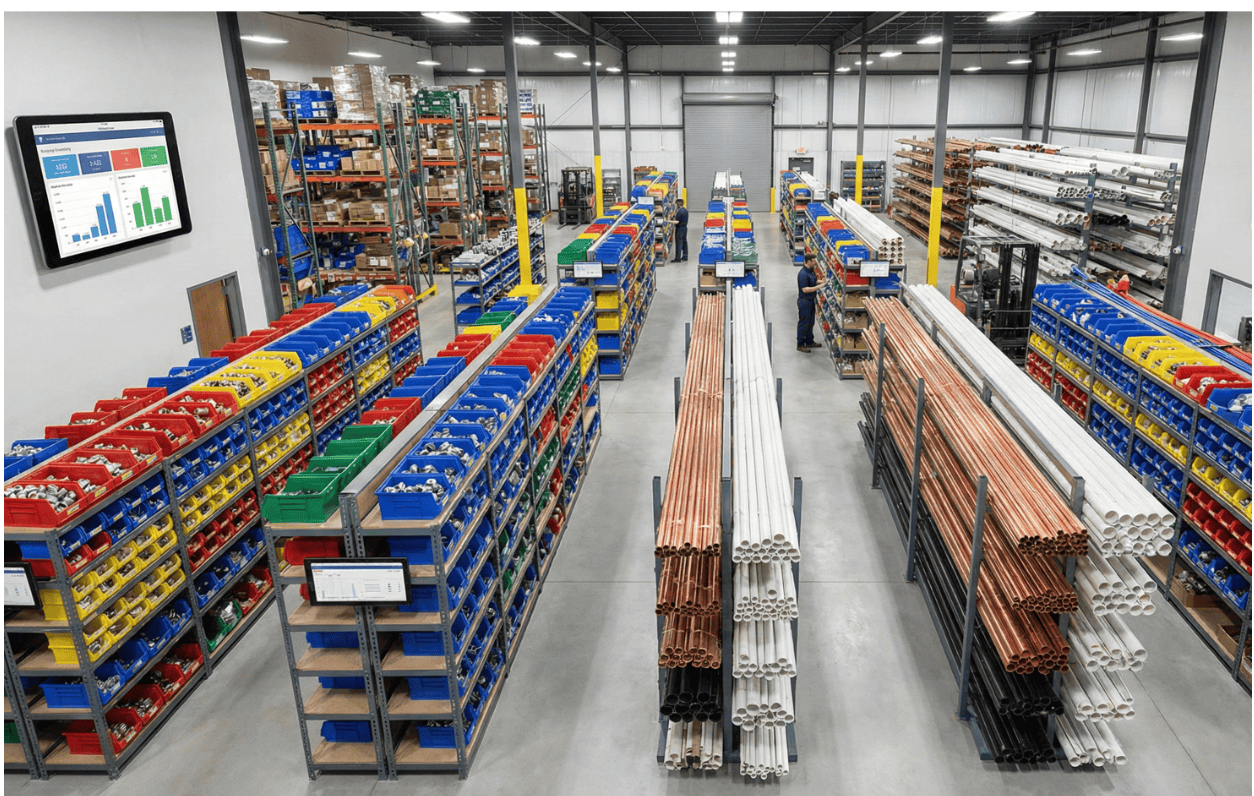
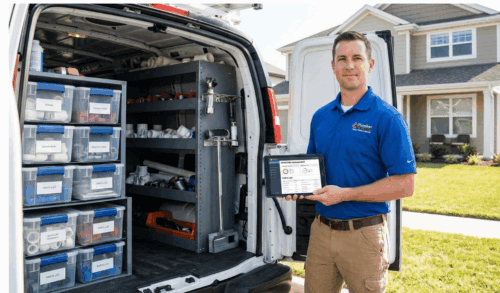
Good plumbing inventory management software shows you stock in real time across every location, trucks, warehouse, even materials sitting at a job site. Barcode scanning eliminates manual counts (and the errors that come with them). You set low inventory alerts so you get notified before you run out of the copper fittings everyone needs. Your plumbing team gets mobile inventory access on Android or iOS, which means they can check stock from anywhere.
This matters more than you’d think. When your technician is at a residential plumbing job and realizes they need a specific valve, they can check the system instead of calling the office or driving back to the warehouse hoping it’s there. Time saved = money made.
Connect Materials to Invoices Automatically
Here’s where plumbing inventory software actually pays for itself. The system tracks what gets used on each job and pulls those parts straight into your invoice. No more guessing what to bill or forgetting to charge for materials. Integration with QuickBooks handles pricing and expense tracking automatically, and you can see the actual cost versus what you charged, which tells you if you’re making money or just staying busy.
According to research from the National Association of Home Builders, material costs represent 30-50% of total project expenses for residential contractors. If you’re not tracking this accurately, you’re probably undercharging on half your jobs.
Manage Inventory Without the Busywork
The right inventory system automates reordering when stock hits your threshold. You set up custom inventory categories for plumbing parts, pipe, fittings, fixtures, whatever makes sense for your business. Track everything by supplier, cost, and workflow. Point of sale integration handles counter sales if you sell parts directly to customers or other contractors.
Now, good plumbing inventory management software costs $50-150/month per user. Cheap options lack mobile apps or real-time sync, and you’ll waste more money on workarounds than you save on software. You get what you pay for. Start with one truck as a test. Use barcode scanning for two weeks. You’ll immediately catch parts “walking away” or sitting unused in someone’s personal stash.
The Features That Actually Matter for Plumbing Companies
Every software company promises everything. Here’s what plumbing contractors actually use daily, based on what separates functional systems from shelfware.
The non-negotiables are simple: Real-time sync across all devices (office, truck, warehouse). A mobile app that works on both Android and iOS so your technician can access it at job sites. Barcode support for fast scanning instead of typing serial numbers. QuickBooks integration for pricing and expense tracking. Job-based tracking so you can see exactly what got used where. Alerts for low stock level or materials about to expire.
The nice-to-haves make life easier but aren’t dealbreakers: customer relationship management integration to link parts to customer history. GPS tracking to know which truck has what without calling everyone. Purchase order automation where the software auto-orders when you hit minimums. Reporting on inventory usage patterns. Tool tracking, because yes, expensive tools disappear too.
| Feature Category | Must-Have | Nice-to-Have | Skip It |
| Mobile Access | iOS + Android app with offline mode | Tablet optimization | Desktop-only solutions |
| Tracking | Barcode scanning, real-time sync | GPS truck tracking, tool inventory | RFID tags (overkill for most) |
| Integrations | QuickBooks, basic invoicing | CRM, purchase orders | ERP systems (too complex) |
| Alerts | Low stock warnings | Expiration dates, usage spikes | Predictive AI (usually marketing) |
| Reporting | Basic inventory levels, job costs | Trend analysis, supplier comparison | Advanced analytics dashboards |
What you don’t need: fancy dashboards nobody looks at, “AI-powered” features that are usually marketing fluff, or capabilities built for manufacturing plants instead of residential plumbing. More features mean a steeper learning curve, so start simple and add complexity only when your team’s comfortable. Test the mobile app first, if your plumber can’t figure it out in five minutes at a job site, the software’s too complicated.
How Inventory Control Stops You From Losing Money
You’re not just tracking parts. You’re plugging holes in your budget.
First leak: buying stuff you already have. Without solid inventory data, you reorder “just in case” because you can’t risk showing up without a part. The solution is software that shows exactly what’s in stock across all locations. Track inventory usage to spot hoarding, that one tech with 47 ball valves in his truck who swears he needs them all. When you can see the data, these conversations get a lot easier.
Second leak: parts disappearing into the void. “I thought we had that” equals lost revenue. Every time you can’t find a part, you either delay the job (customer’s annoyed) or make an emergency run to the supply house (you’re bleeding margin). Barcode scanning plus real-time tracking creates accountability. You know exactly when materials leave the warehouse and which job site they went to. Software helps plumbing companies turn chaos into visibility, but only if your team actually scans items. No scanning means no data, which means you wasted money on software.
Third leak: sitting on dead stock. You’ve got plumbing parts for jobs you don’t do anymore taking up space in your warehouse. An inventory system flags slow-moving items so you can turn that pipe into cash or return it before the warranty expires. Run a report on your oldest inventory right now. Anything sitting for six months or more? Discount it, return it, or eat the loss and clear the space for parts you’ll actually use.
Fourth leak: you can’t prove what you used. Customer disputes the invoice because you can’t show what went into the job. Materials to invoices automation with timestamps creates a paper trail. Your inventory software keeps the receipts. According to ServiceTitan’s State of Field Service report, contractors who track inventory digitally recover 23% more material costs on average than those using manual methods. That’s real money.
Choosing the Right Inventory Software for Plumbing Contractors
Not all inventory management software understands plumbing. Some systems think you’re running a retail store. Others assume you’re manufacturing widgets in a factory. Neither scenario matches how plumbing contractors actually work, so here’s how to avoid buying the wrong tool.
Ask these questions before you commit:
- Does it handle residential plumbing workflows? (Not every system understands emergency calls or truck stock)
- Mobile app or just mobile-friendly website? (There’s a huge difference when you’re in a crawlspace)
- Can it sync with your existing tools? (QuickBooks, customer relationship management, point of sale systems)
- Do you pay per user or flat rate? (Pricing matters when you’re scaling from three trucks to ten)
- Can you track both materials AND tools? (Your expensive pipe threader needs tracking too)
Red flags to watch for: No free trial or demo (they’re hiding something). Only works on one platform, especially desktop-only (that’s a dealbreaker). Can’t export your inventory data (you’re locked in forever). “Contact us for pricing” usually means overpriced for small plumbing companies. Built for generic retail instead of contractors (you’ll fight the system daily).
What good software solutions look like: made specifically for field service, not warehouses. Works offline because basements don’t always have cell signal. Support team that actually understands plumbing business problems instead of reading from a script. Transparent pricing with monthly plans you can cancel if it doesn’t work out.
Free software doesn’t exist in any meaningful form. Free trials do. Sign up for trials with your most skeptical technician, if they don’t complain after a week, you found a winner. Platforms like field service management software often include inventory tracking as part of a broader toolkit for managing your entire plumbing business, from scheduling to invoicing to stock management.
Getting Your Plumbing Team to Actually Use It
The best software in the world means nothing if your plumbers ignore it. And trust me, they’ll try.
Start with why. Show them how inventory software tracks their time and makes their job easier, not harder. Less time hunting for parts means more time on actual jobs, which means more money in everyone’s pocket. When techs understand this helps them, not just the office, resistance drops.
Train on one feature at a time. Barcode scanning first. Then tracking inventory usage. Then running reports. Don’t dump the entire system on them at once. Make it mandatory for new jobs only, forcing them to backfill old inventory data guarantees mutiny. Celebrate small wins loudly. When someone catches a billing error using the system or finds a “lost” part worth $200, make noise about it in your team meeting.
Get your dispatcher or office manager bought in first. They set the tone for whether this is “another stupid thing we have to do” or “the tool that finally makes sense.” Expect about 30% of your team to resist no matter what. That’s normal human behavior, not a reflection on you or the software. Focus on early adopters first and let peer pressure do the rest. Your tech-savvy plumber makes a better champion than boss mandates ever will.
The inventory system only works when people use it consistently. That means making it as frictionless as possible and proving the value quickly. When your plumbing team sees their own paychecks go up because they’re finishing more jobs per week, the software sells itself.
Stop Guessing, Start Tracking
You’re already doing inventory management, you’re just doing it the hard way. Spreadsheets, phone calls, memory, hope. It works until it doesn’t, and when it fails, it costs you in ways you don’t always see immediately. The emergency supply run that kills your margin. The duplicate order sitting in your warehouse. The part you didn’t charge for because you forgot it got used.
Plumbing inventory software stops you from guessing what’s in stock, bleeding money on duplicate orders, and arguing with customers about what got used. Modern inventory tracking gives you visibility into every pipe, fitting, and fixture across your trucks, warehouse, and job sites. Real-time sync means everyone sees the same data. Barcode scanning eliminates guesswork. Automatic integration with invoices ensures you actually charge for what you use.
Start small. Pick one truck. Scan for two weeks. Track the ROI. When you see how much money you’ve been leaving on the table, parts you bought twice, materials you couldn’t bill for, inventory sitting unused, you’ll wonder why you didn’t do this sooner.
Here’s your action plan:
- Calculate your current inventory chaos cost (duplicate orders, missed billing, emergency runs)
- Sign up for three free trials this week
- Test each system with actual jobs, not hypotheticals
- Pick the one your team doesn’t hate
- Start with your most organized truck as a pilot
- Expand once you’ve proven the ROI
The right inventory management software pays for itself in the first month if you’re currently winging it with spreadsheets. Your plumbing business deserves systems that work as hard as you do. Stop managing inventory like it’s 2005 and start tracking it like the valuable asset it actually is.