
Uber Freight and Tesla, Watco and Intramotev: Two Tracks for Electrifying Logistics
Logistics companies are experimenting with EVs—but questions around cost, infrastructure, and scalability remain.
By Amy Roach | September 24, 2025
In a pair of developments this month, logistics players are pushing the electrification frontier—albeit in very different ways. One signals incremental evolution in rail-yard operations, the other a bold bet on electric heavy trucks. Together, they underscore both the potential and the uncertainties around EVs in freight.
TugVolt Hits the Yard: Watco’s Agreement with Intramotev
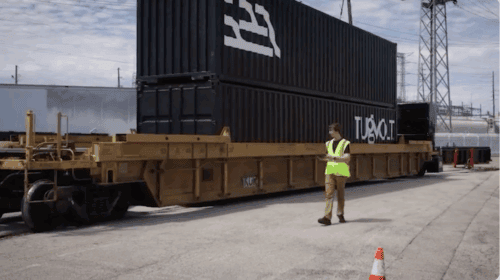
Photo courtesy of Intramotev
Intramotev, a firm specializing in autonomous battery-electric rail technology, has inked a commercial agreement with Watco to deploy its TugVolt system at Watco’s transload terminal in Wood River, Illinois. Beginning in January, Watco will use the battery-driven, self-propelled cars to handle switching operations at the yard.
Intramotev retrofits conventional freight cars with its battery-electric system, enabling them to run autonomously, by remote control, or in traditional consists. The company claims more than 250,000 tons of material have already moved via TugVolt in revenue service, delivering over 3,500 carloads this year.
Watco frames the move as an experiment in innovation: “We’re always exploring new ways to support our customers,” said a company spokesperson.
Yet for many in freight and logistics, yard switching is a relatively constrained environment—lower speeds, known distances, and less complex conditions than over-the-road trucking. The real test will be whether such tech can reliably scale and integrate into broader operations.
Tesla & Uber Freight Team Up for Semi Discounts
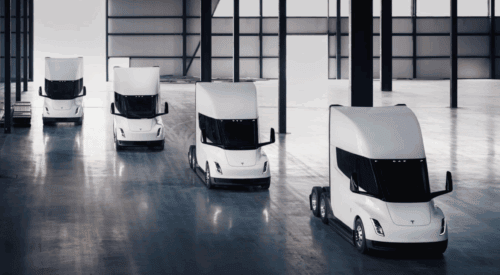
Photo courtesy of Tesla
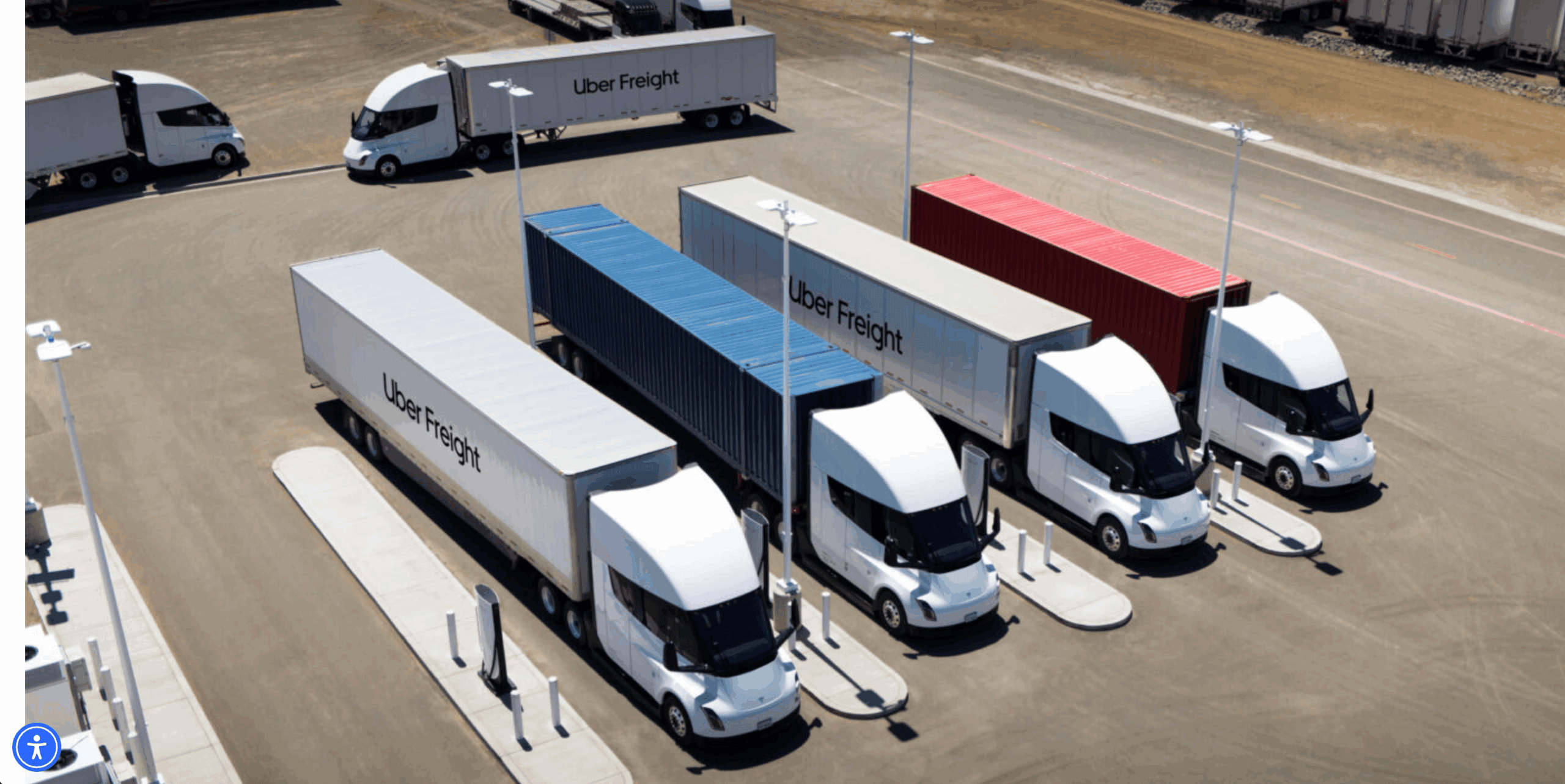
On the trucking side, Tesla and Uber Freight this month announced a Dedicated EV Fleet Accelerator Program aimed at lowering the upfront barrier to Class 8 electric truck adoption. Under the program, fleets buying Tesla Semis through Uber Freight gain access to purchase subsidies, and in return commit the trucks into dedicated routes within Uber Freight’s network.
The idea is that guaranteed freight volumes and route planning tied to Tesla’s emerging charging infrastructure could help de-risk the investment. Uber Freight will also integrate route-matching features to optimize utilization of electric trucks. Key details remain opaque, however: the size of the subsidy, the adjusted truck price, and how the economics will hold up once real-world maintenance, charging times, and operational constraints are folded in.
Tesla first pitched a price of $150,000 for a 300-mile range version and $180,000 for a 500-mile version years ago, but those figures are widely regarded as outdated. Some documents submitted by early customers suggest price increases by factors ranging from modest to dramatic. Production is expected to ramp in 2026.
3 Key Takeaways for Logistics Professionals
These two stories highlight distinct pathways—and challenges—in electrifying logistics.
- Scope & Risk: Yard switching is a relatively low-risk, controlled domain. Success in that setting doesn’t necessarily translate to viability across long-haul freight. Conversely, trucking is full of variables—traffic, weather, charging constraints, haul length, and more.
- Infrastructure & Economics: The Tesla–Uber model hinges on not just the truck hardware, but also reliable chargers, grid capacity, and route certainty. If utilization falls short, or charging infrastructure lags, the math could flip.
- Adoption Doubts Remain: Many in logistics still view EVs with caution—concerns persist over upfront cost, battery lifespan, charging reliability, and compatibility with existing operations. Neither of these announcements is proof of broad-scale success; they are experiments in specific niches.