
TMS and DRP: The Recipe for Resilience

Ajinomoto Foods North America (AFNA) worked with EY Consulting and Blue Yonder to digitize its largely manual resource planning system and logistics processes that were hampering AFNA’s visibility, service, and efficiency.
THE CUSTOMER
Ajinomoto Foods North America (AFNA) is a leading manufacturer of frozen foods, known for producing a wide range of Asian-inspired and comfort food products for grocery stores, restaurants, and institutional customers across North America.
As a subsidiary of Japan-based Ajinomoto Co., the company leverages global expertise in seasonings, amino acids, and food innovation to develop high-quality offerings.
THE PROVIDER
EY Consulting, the advisory arm of Ernst & Young, provides strategy, transformation, and technology services to organizations worldwide. The practice helps clients improve performance by aligning business strategy with digital innovation, risk management, and operational efficiency. EY Consulting helps companies navigate complex challenges, drive growth, and build long-term value.
Like many companies navigating the pandemic, Ajinomoto Foods North America (AFNA) faced multiple supply chain challenges including disruptions, changing consumer preferences, and rising freight and warehousing costs.
Rather than settle for getting back to normal, however, management decided to transform the company’s supply chain organization, including its production planning process, which had been largely manual. AFNA also implemented a more robust transportation management system. To accomplish this, AFNA partnered with EY Consulting and implemented software from Blue Yonder and Oracle.
The supply chain organization within AFNA, the company behind multiple consumer brands including Ajinomoto, Tai Pei, José Olé, and Hondashi, faced several challenges as it worked to optimize operations in the face of multiple challenges occurring during the pandemic.
One challenge was the autonomy of its nine manufacturing plants. “They weren’t aligned,” says Gema Verdin, global vice president of supply chain management planning. There was no standardization and no formal best practice. If a salesperson needed more of a specific product, they typically would just call a colleague and ask for additional units.
Production planning for the plants and more than 30 co-packers had been managed by spreadsheets, each of which also varied between plants. Products often weren’t located where they were most needed, which impacted service levels and costs.
Because AFNA lacked a robust planning system, management often wouldn’t know, for instance, that Plant A needed 30 trucks in a specific sequence and going to specific locations. Sometimes delivery trucks were dispatched when half full, wasting space. Verdin and her colleagues often struggled to access carriers’ rates and performance, hampering their efforts to evaluate them.
From Spreadsheets to Continuous Improvement
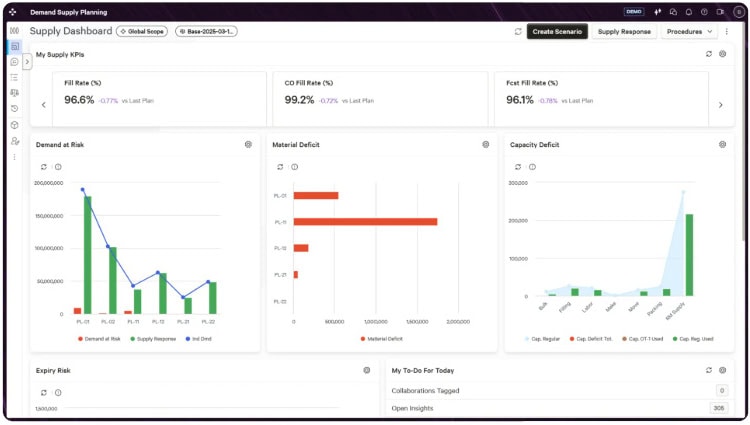
Blue Yonder’s software synchronizes forecasting and planning to warehousing, transportation and order fulfillment.
EY, a professional services firm, had been AFNA’s audit partner. When that engagement concluded, AFNA was able to work with EY as a consultant. Together, the two companies helped AFNA transition from a production scheduling process that had been based on spreadsheets to a continuous improvement process that provided analytics that could help AFNA take action.
As part of this transition, AFNA implemented the BY Enterprise Supply Planning solution from Blue Yonder, which focuses on distribution requirements planning (DRP).
A DRP can help supply chain organizations determine the optimal allocation of products between plants and warehouses, minimizing both out-of-stocks and overstocking to boost service levels and reduce the need to relocate inventory. The Blue Yonder solution also synchronizes forecasting and planning with warehousing, transportation and order fulfillment.
At AFNA, the Blue Yonder deployment encompasses more than 550 finished goods produced at its plants and through co-packing partners, and that are transported to the distribution centers.
Taming the Mavericks
One challenge to the implementation was adjusting operations in an organization that included many “mavericks” who’d grown used to doing their own thing, Verdin notes. She and her team worked with EY to show their colleagues how the changes would impact the organization, and to reassure them that their jobs were safe. Sharing this information helped reduce concerns about the changes.
The AFNA team also worked with EY to show senior management how the DRP solution provided a return on investment. In part, this was a result of boosting visibility to planning requirements from about six weeks to 18 months, Verdin says.
Once the DRP was operating and generating benefits, AFNA and EY worked to implement a transportation management system (TMS) from Oracle. This transition ran into a few speed bumps, Verdin says, largely because the company’s previous transportation system was old enough that as parts were unplugged, some of the remaining functions started acting up. “There were band-aids on band-aids on band-aids,” she says.
The work to implement a new system proved valuable. While the previous transportation system helped to book carriers, it offered no visibility. Verdin and her team had no efficient way to determine, for instance, where AFNA’s trucks were, nor whether they’d picked up their loads.
Instead, the customer service team and logistics coordinators would call to check on loads that hadn’t arrived as expected at their destinations. “Phone calls alone could take up to half a day,” she says.
At times, the logistics providers working with AFNA would pick up several loads, but not enough to fill an entire truck. The loads could remain in their yard for days, as the trucks were filled. Not surprisingly, the customers impacted would wonder where their orders were, Verdin says.
The new transportation system lets dispatchers know if there’s room on a truck for additional products, or if it’s possible to combine loads. It provides this information with “a couple of clicks on the system,” Verdin says.
The solution also offers near-real-time tracking and carrier oversight. This helps AFNA build multi-stop and multimodal shipments, while also laying the foundation for real-time tracking, which is yet to be enabled.
While AFNA had been using emails and PDFs to communicate with its logistics partners, it now connects through an electronic document interface. This offers a seamless, trackable system for communications both internally and with vendors.
Now that AFNA is electronically connected to its carriers, it no longer needs to fax bills of lading. Its new system also highlights invoices where the dollar amounts fall outside the parameters AFNA has established. This benefits both AFNA and its carriers, as AFNA now can more quickly review its bills.
Just as it did when implementing the resource planning solution, AFNA partnered with EY to confirm the financial return the TMS was generating. The two teams also worked together to train employees and logistics partners on the new system, using a train-the-trainer approach.
“We want to make sure that after we leave a partnership, the client’s employees are self-sufficient,” says Oksana Chausova, a partner with EY, responsible for business transformation.
The goal in training is to create a positive environment so employees know they can make mistakes and experiment without fearing the consequences, she adds.
The partnership between AFNA, EY, and Blue Yonder resulted in multiple benefits. AFNA reduced the number of carriers it partners with by more than half, streamlining distribution and receiving processes at its plants and with co-packers, and across more than 1,000 transportation lanes. The new solution also lets AFNA more easily view carriers’ rates and on-time performance, among other information, than was possible with spreadsheets, says.
“We transitioned from a static process using spreadsheets to a continuous improvement process with actionable analytics,” Verdin says.
Closer Connections
Another positive change is the closer working connections between AFNA’s logistics, customer service, and transportation teams, Verdin says. They’re also able to let salespeople know when loads for different regions will be delivered. Overall, service levels have gone up by about 10%, Verdin says.
With the assistance of the DRP, AFNA is better able to optimize space on its trucks and ensure they’re going where they’re most needed, Verdin says. As a result, it’s able to use fewer trucks, saving money and cutting its carbon footprint.
Not only is information more easily accessible, but because it’s not concentrated among spreadsheet super-users, it’s easier to bring new employees up to speed on the system. Previously, when the super-users were promoted or otherwise left the team, it generally took some time for their replacements to learn the macros they had incorporated into the spreadsheets.
Warehouse recurring fees and the costs to redeploy products to other distribution centers were slashed by up to 50%, while inventory write-offs dropped by up to 40%. In addition, on-time delivery performance has climbed. AFNA can now be confident it will have the right product, in the right place, at the right time, to better serve its customers.
Overall, the DRP helped AFNA save about $4 million, while the TMS is expected to cut costs by about $2 million.
The right partnership has been key to these results. Without strong partners, many implementations, whether small or large, can grow frustrating and enjoy only limited success. “You’ve got to get the best,” Verdin says. Then, the companies need to write up the contract and work together to ensure the partner delivers.
Verdin and her team are not done. Her longer-term goal is to digitize AFNA’s supply chain as much as possible, automating routine transactions so employees are freer to handle decision-making. Even as she works toward digitization, people will still be needed, Verdin says, given the dynamic nature of supply chain decision-making.
From Chaos to Clarity
The Challenges: Digitizing the largely manual resource planning system and logistics processes that hampered AFNA’s visibility, service, and efficiency.
The Solution: Working with EY, AFNA implemented a digital resource planning (DRP) solution from Blue Yonder and a transportation management solution (TMS) from Oracle.
The Results: Significant reductions in warehouse recurring fees and the costs to redeploy products to other locations; a drop in inventory write-offs; and a jump in on-time delivery performance. Together, the DRP and TMS have helped AFNA save about $6 million.
Next Steps: Digitizing AFNA’s supply chain to the extent possible, including automating routine transactions, so employees can focus on decision-making.