
CSCMP EDGE 2026: AI and Freight Fraud Dominate Conversation in Nashville
CSCMP EDGE 2026 put AI and freight fraud front and center, featuring insights from company leaders and new 3PL research.

By Ashley Prince | October 9, 2026
Supply chain professionals gathered in Nashville earlier this week for CSCMP EDGE 2026. Sessions spanned a wide array of topics, but hot button issues like AI and freight fraud made it into most conversations.
The annual conference included more than 80 educational sessions across tracks on global supply chain, network planning, technology, transportation, and warehousing. Agenda topics included tariffs, geopolitical risk, nearshoring, warehouse automation, and cybersecurity.
Estée Lauder Segments Its Value Chain
Roberto Canevari, executive vice president and chief value chain officer at The Estée Lauder Companies, told attendees at Tuesday’s main session that the company’s dynamic value chain rests on speed, agility, and resilience. Estée Lauder cannot deliver all three for every product, so it segments its portfolio of more than 20 brands by which attribute each product needs most.
A trend-driven launch prioritized speed. Canevari said teams used an existing base formula and set efficiency work aside, which brought the product to market in under six months instead of the usual 12 or more. A flagship foundation, by contrast, was designed for resilience and efficiency. A problem with that product, he said, would disrupt the business for about two months.
Canevari said demand in China can spike up to 40 times normal levels for two or three weeks around shopping events, which forces the company to plan staffing and automation well in advance. He also said Estée Lauder reallocates value chain budgets toward consumer-facing investment rather than treating them as fixed.
The company is developing AI tools to support the roughly 1.2 million supply chain decisions it makes each week.
Estée Lauder is finishing its first fully virtual factory model, Canevari said. Teams will run product trials digitally before a physical pilot, which he said should cut industrialization time from months to days. Value chain teams are embedded within each brand, so supply chain decisions happen alongside brand decisions. He added that technology delivers faster answers, but people still supply the questions.
Cargo Theft Falls in Frequency, Rises in Value
Reported cargo theft incidents are down, but the value per theft is climbing, David Mitsui, Director of Risk and Compliance Operations at Total Quality Logistics, told Inbound Logistics.
A few thefts in the first half of 2026 involved data center servers and reached the $20 million range, compared with a typical top end of $1 million to $1.5 million. Those outliers skewed the totals.
Thieves also target shipments by lane, since high-value commodities such as copper and tree nuts move out of specific regions. California remains the top theft state, while activity has eased in Texas and moved toward Georgia.
Mitsui outlined a growing fraud tactic known as a redirect. After a legitimate carrier picks up a load, a fraudster obtains driver-level details and contacts the driver while posing as the broker, shipper, or customer, asking for delivery to a different warehouse. Spoofed phone numbers and compromised email accounts make the requests look authentic.
While technology plays an important role in preventing fraud, Mitsui cautioned against relying too heavily on automation. Firm business rules give bad actors something to test and exploit, so TQL finishes its automated checks with a human review. The company also runs a secret scammer program, in which employees call in on burner phones posing as fraudsters. Results are tracked, and staff who fail are provided additional training.
Mitsui urged companies to share information with competitors.
“The people I’m competing against are the bad actors,” Mitsui said.
Reports and Research
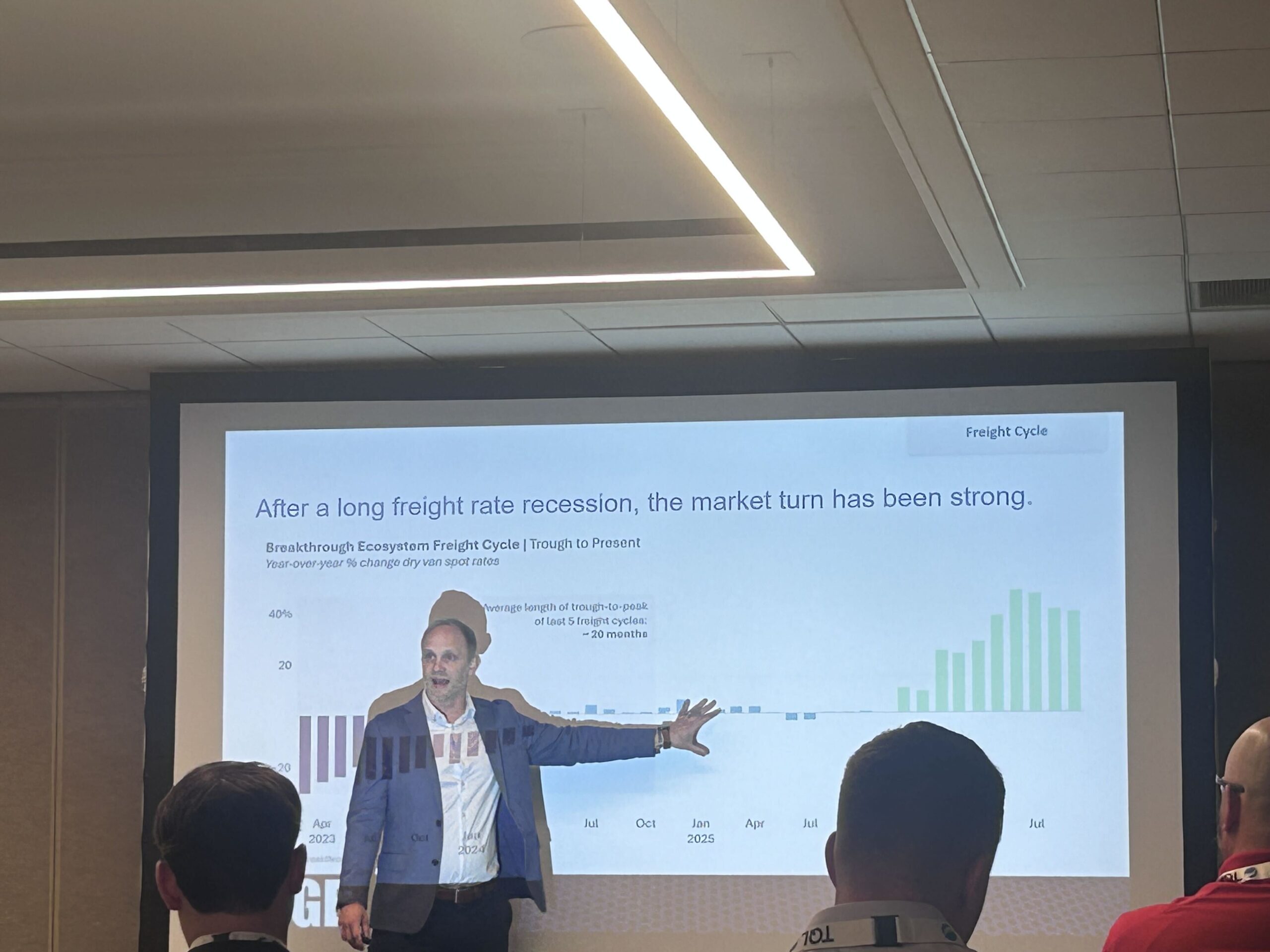
Breakthrough Research presented on diesel supply and truckload capacity as joint sources of cost pressure and described how shippers are responding.
The 31st Langley 3PL Study was also released at the conference. Sponsored by Penske Logistics and NTT Data, it covers strategic partnerships, AI adoption, freight fraud, and resilience in shipper and 3PL relationships. The report is free at threeplstudy.com.
CSCMP’s State of Logistics Report, released earlier this year, put 2025 U.S. business logistics costs at $2.4 trillion, or 7.8% of GDP. CSCMP President and CEO Mark Baxa said that next year’s logistics network will be “hardly recognizable.”
Inbound Logistics will report on these research efforts in more detail next week.