
A Dose of Innovation Cures Healthcare Supply Chain Ailments

Pharma and healthcare supply chains evolve with intelligent systems and agile methods that ensure safety, speed, and stability under pressure. See how smart planning, cutting-edge tools, and future-ready systems are treating the sector’s aches and pains.
The healthcare supply chain has been challenged in recent years by forces as diverse as the pandemic, natural disasters, cyberattacks, increasing costs, and geopolitical unrest. These disruptions revealed critical vulnerabilities, but also sparked opportunities for transformation and advancements.
As a result, healthcare companies are actively prioritizing supply chain resilience, efficiency, and agility, and new trends are beginning to emerge.
“Visibility is one of the most urgent demands we hear from our healthcare customers today,” says Cherie Brinkerhoff, senior vice president at Ryder Supply Chain Solutions, a Florida-based third-party logistics provider.
It’s not just visibility into product location, but visibility into true cost and clinical impact. Meeting that demand for visibility led Ryder and one large Midwest-based hospital network to reimagine the traditional distributor model for healthcare supply chain management and engineer a patient-centric, self-distribution model.
The solution took shape as a highly automated, 416,000-square-foot consolidated services center (CSC) for medical devices, pharmaceuticals, and everyday supplies that Ryder engineers and manages.
Inside the CSC, an automated-storage-and-retrieval system fulfills orders around the clock. It features 27,000 bins and 34 robots continuously feeding 1.3 miles of conveyors and a three-story pick tower.
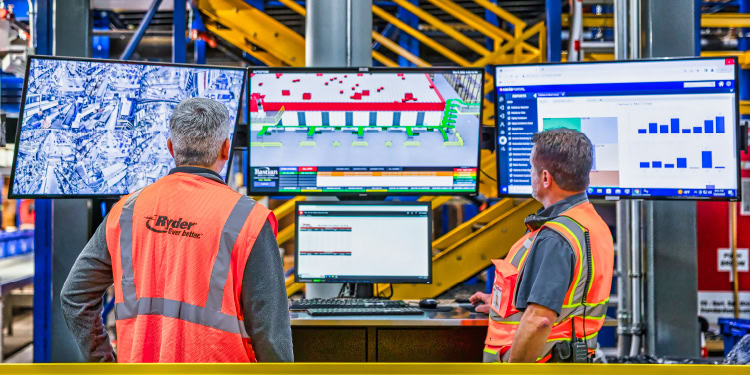
Ryder Supply Chain Solutions manages this 416,000-sq. ft. consolidated services center to handle medical devices, pharmaceuticals, and supplies for a Midwestern hospital network. Its customized solution gives the healthcare network 100% inventory control and real-time, end-to-end visibility.
The fully integrated, customized solution has given the hospital network 100% inventory control and real-time, end-to-end visibility across its supply chain. “It has brought real-time transparency across every touchpoint—where a shipment is, what it costs to move, and how it’s being used,” says Brinkerhoff.
Ryder originally built versions of the CSC model in sectors such as retail and automotive where precision and predictability are essential. Applying the solution to healthcare, however, required major adaptation. In the healthcare sector, supply chain solutions require a different mindset: less about product movement and more about patient impact.
“In healthcare, we don’t just move boxes—we support healing,” says Brinkerhoff.
Some adjustments the 3PL had to make include aligning deliveries with patient care schedules, supporting unit-dose level accuracy, integrating with clinical inventory systems, and factoring in cold chain needs.
“It’s not about how we deliver but more about the sequencing,” explains Brinkerhoff. The goal is to enable nurses, doctors, and other clinical staff to be able to spend more time with patients.
Since the CSC model is built for end-to-end performance and patient-centered logistics, clinicians gain back time—an average of 30 minutes per shift—that they previously spent searching for essential supplies.
The numbers speak volumes: In addition to 100% real-time visibility and inventory control, the 3PL and its hospital network now achieve 99.75% inventory accuracy, a 99.7% fill rate, and 99% on-time delivery.
Although the CSC distribution model isn’t the universal answer for all patient-centric supply chains, the principles behind it are sound. Large, integrated health systems benefit most from a full CSC approach, while smaller systems may adapt a hub-and-spoke or hybrid model.
What matters most is aligning the supply chain with clinical needs: centralization where it creates value, visibility at every node, and workflows that prioritize patient readiness. As Brinkerhoff notes: “The goal isn’t one size fits all; it’s fit for care.”
SPECIAL DELIVERY

DHL has built an advanced cold chain infrastructure, designed to meet the exacting standards of the life sciences and healthcare sector. The company’s multi-temperature pharma hubs now span key global regions as part of its commitment to invest approximately $2.7 billion over the next five years to help healthcare companies grow and thrive.
The importance of temperature-controlled networks, first- and last-mile specialty courier coverage, and integrated solutions recently led logistics provider DHL Group to acquire 100% of CRYOPDP, a New Jersey-based specialty courier focused on clinical trials, biopharma, and cell and gene therapies.
CRYOPDP’s white-glove courier expertise in cryogenic, refrigerated, and ambient transport strengthens DHL’s ability to manage highly complex, precision-sensitive shipments.
“DHL’s service has been particularly helpful in biopharma and clinical trials segments,” says Hendrik Venter, CEO of DHL Supply Chain Europe, Middle East & Africa (EMEA).
The acquisition aligns with DHL’s commitment to invest approximately $2.7 billion over the next five years to help its healthcare customers grow, innovate, and serve patients more effectively worldwide. The logistics provider recognizes that pharmaceutical, biopharma, and medical customers require agile, connected logistics solutions that extend beyond traditional service lines.
“We’ve expanded our geographic coverage and responsiveness,” says Venter, pointing to 39 additional depots and 400+ skilled professionals that are now part of DHL’s network.
This scale, combined with CRYOPDP’s shared commitment to quality and compliance, enables safe, seamless delivery from production site to patient—on time and in perfect condition, he adds.
DHL has built one of the most advanced cold chain infrastructures in the world, designed to meet the exacting standards of the life sciences and healthcare sector. The company’s multi-temperature pharma hubs now span key global regions.
The provider’s fleet includes newly commissioned temperature-controlled vehicles and depots offering validated solutions across a full temperature range: 2-8°C, 15-25°C, -20°C, -70°C, and as cold as -150°C, all to support therapies with highly specific handling requirements.
These purpose-built solutions provide the visibility, reliability, and compliance that DHL’s partners and patients rely on.
STABLE AND SECURE
As pharmaceutical companies work to stay in compliance with the Drug Supply Chain Security Act (DSCSA) and other regulatory requirements, many rely on RFID technology to gain the visibility and control they need.
The DSCSA—which outlines a phased approach to enhancing the security and traceability of prescription drugs in order to prevent counterfeit, stolen, or contaminated drugs from entering the market—has accelerated adoption of RFID across the healthcare supply chain.
Companies such as Intelliguard, a San Diego-based medical manufacturer, are leveraging RFID-enabled inventory intelligence to streamline compliance, boost efficiency, and improve medication management.
“Because of DSCSA and other types of legislation, there’s more pressure to have better control systems in place for the overall supply chain involving medication management,” says Tim Tinnel, executive vice president and COO at Intelliguard. “That’s where RFID-enabled inventory intelligence comes into play.”
Tinnel cites GS1 and similarly defined standards that enable medication tracking and tracing throughout the supply chain with total accountability and visibility. RFID makes it possible to do full inventories of tens of thousands of medications in seconds, he notes—eliminating the need for time-consuming manual counts.
RFID also enables streamlined cycle counts and helps ensure medications aren’t merely moving through the supply chain. It confirms they’re reaching hospitals, distributors, and ultimately the patient’s bedside, all while maintaining the same efficacy the pharmaceutical manufacturer intended.
“That’s the role of RFID throughout the ecosystem,” Tinnel adds.
Not surprisingly, there’s a goldmine of data in the supply chain environment where RFID dwells.
“Even as RFID performs necessary tasks, it also provides information to end users,” Tinnel explains. He points to anesthesiologists or pharmacists who can now track and have insight into their inventory, as well as buyers, who can analyze purchasing patterns to ensure they meet rebate requirements from pharmaceutical manufacturers.
The real-time inventory visibility that RFID provides can reduce medication waste, prevent stockouts, and ensure mission-critical drugs are always available where needed.
Intelliguard’s trademarked Mira Ecosystem features hardware powered by RFID technology and a data intelligence platform that enables users to see the movement of medications in real time.
RISK TO RESILIENCE
When any part of the healthcare supply chain is broken or vulnerable, it creates a domino effect that ripples across the entire entity. “It doesn’t matter which part of the chain is attacked, the entire chain is compromised,” says Sanjay Brahmawar, CEO of QAD Inc., an enterprise resource planning (ERP) provider.
Brahmawar considers ongoing developments with predictive analytics and AI to be among the most exciting and transformative of current healthcare supply chain advancements.
Currently, QAD’s Process Intelligence solution acts as a control tower and utilizes data from QAD’s ERP or other ERP systems to monitor processes and implement change in order to consistently identify areas of profit leakage and deviations from standard procedures.
The company also uses AI in its QAD Digital Supply Chain Planning solution, which learns over time to predict potential supply chain risks. Similarly, QAD Global Trade and Transportation Execution with AI learns product classification patterns, helping users expeditiously manage import costs in a dynamic environment and identify inconsistencies in their existing classification databases.
As a result, managers spend less time repetitively searching for product classification codes while organizations realize greater cost savings.
THE STARTING LINE
Enterprising drugmakers and healthcare manufacturing companies seeking to prioritize supply chain resilience, efficiency, and agility are taking a closer look at the source.
That’s where a production system developer and manufacturer like PIA Automation plays a role. A global company offering advanced automation for the healthcare industry, PIA designs and builds assembly systems for original equipment manufacturers (OEMs) that produce or manufacture medical devices, components, or instruments—items such as syringes, pens, and auto-injectors.
As price hikes and increasing demand continue to impact the healthcare supply chain, PIA Automation offers solutions to cost-effectively increase production at the source. “Medication costs for consumers can only be significantly reduced if you automate your manufacturing,” says Thomas Schwoerer, managing director for PIA Automation U.S.
HANDLING HIGH DEMAND
Pharmaceutical companies that use PIA equipment to manufacture on their own premises include Schott Pharma, Roche, Sanofi, and Flex Ltd.
PIA production methods deliver the highest level of product safety, says Schwoerer. The company’s assembly systems demonstrate a high degree of standardization and enable short time-to-market cycles.
“We can start with five or 10 parts a minute on a small, isolated machine and then grow easily to 40 or 50 million once a system begins producing 100 and more parts a minute,” explains Schwoerer.
Sudden spikes in demand, such as the current clamor for semaglutide injections, require this kind of rapid scaling. Once used primarily to treat Type 2 diabetes but now widely used as a weight loss tool, the popularity of semaglutide has suppliers scrambling for auto-injectors. PIA Automation is helping pharmaceutical companies efficiently meet demand.
As the pharmaceutical supply chain continues to evolve, the integration of advanced technologies, smarter strategies, and more agile production methods proves essential. These innovations don’t just help companies weather disruption—they enable them to proactively manage risk, meet rigorous regulatory requirements, and respond rapidly to shifting demand.
In an environment where precision, speed, and resilience are critical, the future of healthcare is dependent on these advancements.
Tariff Relief: Just What the Doctor Ordered
Global tariffs have the potential to significantly disrupt the healthcare supply chain. In light of the steep tariffs imposed by the United States on medical imports from key manufacturing countries, healthcare providers and manufacturers are concerned they’ll face increased expenses and operational challenges.
With China—a primary supplier of healthcare goods—directly impacted, sector leaders are bracing for disruptions reminiscent of those experienced during the pandemic, when lockdowns in China’s manufacturing facilities led to widespread PPE shortages.
As the industry grapples with today’s renewed uncertainty, one organization offering strategic decision support is ECRI.
An independent, nonprofit organization, ECRI has helped healthcare systems strengthen supply chain resilience and reduce clinical spend for nearly 40 years. On average, the organization analyzes $74 billion in annual supply and capital spend across more than 4,000 health systems worldwide.
ECRI’s clients uncover more than $13 billion in savings opportunities each year through its benchmarking and data-driven tools.
“ECRI provides comprehensive insights fueled by holistic data sets—spend, clinical, safety, and quality across thousands of medical categories,” says Stuart Morris-Hipkins, chief solutions officer.
As tariff-driven disruptions evolve, ECRI’s expertise and robust datasets prove helpful for healthcare organizations aiming to safeguard supply chains and maintain cost-effective, high-quality care.