
Betting on the Right Transportation Provider

Stack the odds in your favor with these six best practices for selecting a winning transportation partner.
The importance of prompt, accurate delivery has never been greater for shippers. Today’s most successful brands emphasize a seamless delivery experience for their customers, and they need the right transportation partners to make that happen.
“Companies are judged so harshly on delivery,” says Kelly Martinez, president and co-founder of ePost Global, a provider of international parcel and mail shipping solutions. “They can have the greatest product in the world, but if it doesn’t get delivered into somebody’s hands at the right time, they’re in trouble.”
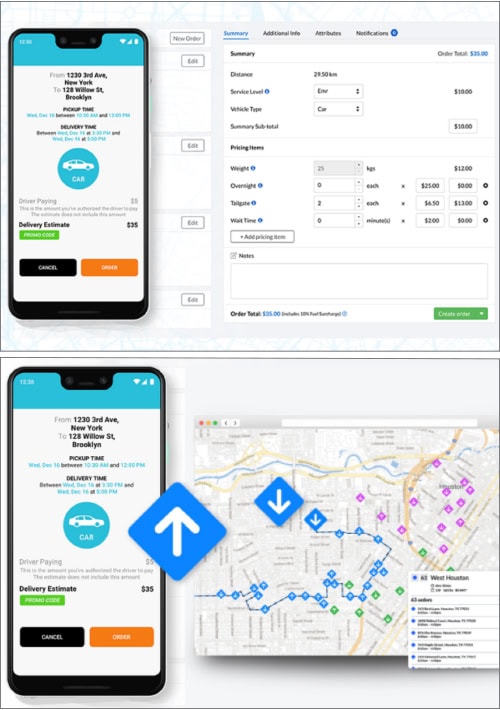
Technology that provides visibility data and integrates seamlessly with shipper solutions is now a must-have when choosing a potential transportation partner. Route planning and optimization tools, like this one from Dispact Science, provide real-time tracking and alerts.
Logistics professionals know that to drive growth and keep customers coming back, the entire experience must run smoothly and meet expectations every time.
Against that backdrop, the process of selecting transportation providers takes on added weight.
“Poor carrier selection or weak carrier management can erode margins, damage customer experience, reduce flexibility and scale, and limit the ability to adapt in a rapidly evolving marketplace,” notes Arthur Axelrad, CEO and co-founder of Dispatch Science, a logistics and delivery software platform.
“In a world where speed, visibility, and consumer expectations are accelerating, the choice of transportation partner becomes a competitive differentiator,” he says. “A strong carrier ecosystem backed by modern tech becomes a catalyst for growth, margin improvement, and customer loyalty.”
With those high stakes in mind, here are six key considerations when selecting a transportation provider:
1. Be Flexible in a Changed Landscape
One of the biggest recent shifts in the transportation provider selection process is fewer shippers using annual bids to select carriers.
“The process has become more fluid and flexible,” says Mike Hane, director of product marketing, TMS, for Descartes, which provides a logistics technology platform. “For shippers, that makes selecting providers an ongoing process marked by constant consideration of their carrier portfolio and what’s working or not working.
“Many larger companies still do annual bids, but it’s for their high-volume lanes,” Hane says. “There’s less of that and more mini-bids every few months. That means shippers constantly need to look at their providers and network of carriers, talk with their peers and ask, ‘Who could I bring into my network? What parts of my network aren’t working as well as they used to?’
“Data is more easily available now than it used to be, and shippers need to be out there constantly evaluating their network,” he adds.
2. Know Your Needs
Choosing the right partner starts with taking a good look at your business. “You can’t select the right partner until you’re honest about what your organization values,” says Erin Mitchell, COO of YMX Logistics.
“Spend time understanding your volume patterns, service requirements, flexibility thresholds, technology and visibility requirements, and type of partnership you are looking for,” she advises. “Map your network, including seasonal peaks, lane variability and dwell times.
“Define what ‘good’ looks like: on-time percentage, communication cadence, safety record, and sustainability metrics,” Mitchell adds. “Then decide which of those are non-negotiable. That self-assessment prevents mismatched expectations later.”
It’s also key for shippers to take a step back and define their requirements.
“Shippers often approach us with an RFP that is all over the place and doesn’t clearly communicate what they’re looking for in a provider,” Martinez says.
In particular, he points out that shippers sometimes go out to the market asking for a price and not understanding all the components that go into it.
“Shippers have to understand what they are shipping, where it’s shipping from, and all the different services they need—is it warehousing and inventory management, or is it just last-mile delivery?” Martinez says. “They need to know how all those components play as a whole, and if they are sourcing them separately or together.”
It is vital for shippers to clearly assess and convey their needs to providers. “Carriers need to understand your operations and your network, warts and all, if they are going to be effective partners,” Hane adds. If shippers are not forthright, the relationship likely will turn sour, the carrier might start to reject tender, and there will be a risk of service failure.
“Be open with potential providers instead of trying to pull one over on them,” Hane says. “There’s good freight and bad freight, and every company will have its own kind of good and bad freight. Be honest about it.”
3. Look Beyond Just Price

An ideal transportation partner should possess a variety of capabilities including comprehensive service offerings, consistent transparency and communication, the right cultural fit, modern technology solutions, flexible cost structures, and the ability to enable and adapt to growth.
Shippers can become fixated on price, but that can lead to a range of problems. While it’s tempting to optimize solely on cost, the hidden costs of unreliable carriers often outweigh the savings.
“The balancing act is critical; treat cost and service quality as dual pillars, and require carriers to present both,” Axelrad says. “For example, a slightly higher-cost provider that gives you near-real-time visibility, fewer exceptions, and stronger flexibility may well deliver better total value. A modern TMS supports this by giving you the underlying data to compare not just ‘rate’ but total landed cost including risk, exceptions, and variability.”
Shippers should start with alignment instead of price.
“Too often, selection begins with bids rather than values,” she says. “The right partner should share your view on safety, service, and transparency. When we evaluate a partnership at YMS, we look for cultural fit first—how the provider treats its people, how it manages safety programs, and how it communicates during disruption. A provider that invests in training, technology, and proactive communication will be far more reliable than one that simply offers the lowest rate.”
It’s also crucial to understand the total cost impact on supply chain operations.
“Unreliable service creates hidden costs—missed appointments, product loss, overtime, customer penalties,” Mitchell says. “The most cost-effective service provider is often the one that prevents those costs through consistency and communication.”
4. Ask Strategic-Minded Questions

When selecting a transportation provider, it’s important for shippers to fully understand what services they need—last-mile deliveries, for instance, require different capabilities and expertise than inventory management or cross-border transportation.
As part of viewing carriers as strategic partners and not merely transactional ones, Hane recommends that shippers evaluate transportation providers with an eye on how they can help grow their business. The best provider will enable a company to use transportation as a customer service differentiation or a competitive weapon.
“Shippers should ask, ‘Is there something that we could be doing with our providers to help grow our business?’” Hane says.
Mitchell recommends asking questions beyond the proposal packet, arguing that the most revealing questions are the ones that uncover how a carrier thinks.
“What’s the carrier’s process when a driver reports a safety concern? How does it coach the team after a preventable incident? What technology does it use for real-time visibility and exception management?” Mitchell says. “A good provider should welcome those conversations. If they seem defensive or vague, that’s a sign their internal culture may not align with yours.”
Digging beyond simple responses is helpful.
“Don’t just ask if a provider can meet your current volume, ask how they’ve helped similar clients grow without breaking their operations,” Axelrad suggests. “Request concrete examples of how they’ve adapted to unexpected challenges, whether that’s weather disruptions, surging demand, or last-minute changes.
“Simply put, carriers who can articulate their problem-solving processes and technological advantages are the ones equipped to become partners, not just service providers,” he adds.
Similarly, shippers should ask providers questions that “probe their systems, data integration, and resilience,” Axelrad says. For instance, how many manual interventions are required and how many processes are automated? Or, what historical KPIs have you hit and how are they tracked?
“Also, ask about their ability to integrate: how easily will they connect to your own TMS and ERP, and how seamless are carrier onboarding and rate changes?” Axelrad says. “If the provider struggles to answer these clearly, you’re likely headed toward operational friction later.”
5. Push Technology and Data to the Foreground
The most critical best practice for shippers is to evaluate a carrier’s technological capabilities alongside their operational performance.
“Companies should assess whether potential providers can integrate seamlessly with their existing systems through APIs, provide real-time visibility into shipments and adapt quickly to changing demands,” Axelrad says. “Look beyond capacity and pricing to understand how a carrier’s technology stack enables transparency, accountability, and agility.
“Ask to see their dashboards, understand their data-sharing capabilities and evaluate whether they can provide the kind of granular, real-time information your customers now expect,” he adds.
The preeminence of data in today’s AI-powered supply chain means that it is critical for companies to consider what data a carrier can provide and if it is the kind of data their operation needs.
“It’s another part of understanding what you require—and making sure the carrier understands what you require,” Hane says.
The logistics sector has reached an inflection point where technology capabilities have become the primary differentiator between carriers—and shippers should proceed accordingly.
“For companies evaluating carriers, the question isn’t whether technology matters, but whether you’re equipped to evaluate it effectively,” Axelrad says. “Request system demos, test integrations, review analytics dashboards and talk to current clients.
“Carriers investing in modern technology are better at execution and can be reliable partners who help identify opportunities, solve problems proactively, and scale efficiently,” he adds. “As we look ahead, transportation provider choice is multifaceted, delivering on the visibility, reliability, and agility your customers demand.”
6. Include the Right People in the Process
Shippers can avoid many problems with carriers if they include in the process relevant internal departments, such as finance and customer service, that might sometimes be overlooked.
“It benefits logistics executives to have their input and buy-in in the selection process,” Martinez says.
Axelrad agrees that selecting transportation providers should not live solely with logistics or procurement. “It should involve supply chain operations, IT, finance, customer service, and even sales and marketing,” he says. “A cross-functional team ensures carriers are evaluated not just on cost, but also on integration, risk, and brand impact.”
In particular, operations stakeholders are key.
“These stakeholders keep the warehouse budgets, on-time service metrics, and, in the instance of factory support, the lineup-time results,” Mitchell says. “Low-cost providers have their place, but when results matter, operations teams know the true cost of having a lower-quality service level in the yard or in their carrier base: it comes back in the form of fines, detention, overtime, and lagging equipment effectiveness.”
Including a variety of voices not only helps shippers select a provider with the best fit, but it also helps with the transition to new providers and reduces resistance to change.
“You don’t want the relationship to get off on the wrong foot after you did all the work to transition to a new supplier,” Martinez says. “It makes a transition more difficult when you don’t have all partners trying to reach the same objective. If people have a voice and are included in the process, it helps to make a smoother transition.”

Avoid Dicey Moves
Red flags to watch out for when vetting carriers.
With fraud and cargo theft on the rise—and safety as paramount a concern as ever—it is important when vetting carriers to validate their identities and ensure their paperwork is in order and “they are who they say they are,” notes Mike Hane of Descartes.
Shippers also need to investigate a carrier’s safety history and drivers’ qualifications, including how drivers are vetted and trained.
A lack of data transparency is one major red flag. “Providers should be focused not just on customer-facing metrics, but also internal metrics that can be used to inspire and motivate employees,” says YMX’s Erin Mitchell. “High driver turnover, limited training, or outdated equipment are others. And beware of ‘too-good-to-be-true’ rates; they usually mean corners are being cut somewhere.”
Fraud risk is also frequently linked to a lack of visibility and manual process gaps, adds Arthur Axelrad of Dispatch Science.
“Key prevention techniques require carriers to provide proof of delivery in digital form, ensure real-time location/ETA visibility to monitor extra stops and unauthorized detours, validate billing against route and load data, and establish rate contracts/lanes clearly in advance with audit trails,” he says. “A TMS can capture every touch, provide timestamped data, support electronic settlement and flag inconsistencies.”