
Conquer the Chaos: Why Global Trade Management Systems Matter Now

With tariffs, disruptions, and rate swings reshaping global trade, shippers need better visibility and agility. GTM systems help them keep up.
Global trade complexity is accelerating today, driven by a suite of factors including geopolitical realignment, shifting tariff policies, expanded sanctions enforcement, ESG reporting requirements, and persistent supply chain volatility. Regulations are changing fast and being enforced aggressively.
No one can predict where global commerce will head next, so shippers are focused on how best to prepare for the chaos. That preparation increasingly depends on technology that can monitor regulatory shifts, manage documentation, and keep trade operations moving without disruption.
To maintain strong supply chains, companies need to treat trade and customs compliance not as an insurance policy in case of an audit, but as a core operational discipline that can create competitive advantage when organizations take full advantage of beneficial trade processes and remedies.
“Sanctions, tariff shifts, and evolving export controls have turned trade compliance into a moving target, and our focus is to help customers operationalize compliance rather than treat it as a separate, manual checkpoint,” says Stewart Dunsmore, senior vice president of supply chain services for freight audit service company nVision Global.
The current environment is too complex to manage with spreadsheets. Leading trade management platforms integrate transportation management, shipment visibility, and business intelligence to provide a unified, real-time view across air, ocean, truckload, LTL, and warehousing. From a single dashboard, customers can see shipment status, documentation progress, customs clearance milestones, duty exposure, and invoice status.
With these tools, shippers can stay current on rapidly changing tariff policies to manage classification, documentation, screening, and audit trails, reducing the risk of penalties and shipment delays.
“The speed of regulatory change is one of the bigger risks today,” says Bojan Stbanovic, global director of trade for Logistics Plus, a global logistics provider.
Risks of Non-Compliance
Expanding regulatory requirements—in areas such as export controls, ESG and forced labor mandates, product classification scrutiny, and documentation standards—demand constant monitoring and adjustment. At the same time, organizations are under pressure to reduce operating costs, accelerate cycle times, and improve cash flow. Compliance is no longer just an administrative function; it is a measurable risk and cost center that leadership expects to manage tightly.
Without global trade management systems, organizations are constrained by manual processes. Many compliance teams still rely on spreadsheets, email-based reviews, and fragmented systems to track classifications, documentation, and screening outcomes. This creates duplicated effort, inconsistent data, and reactive issue management, often leading to clearance delays, post-entry corrections, penalties, or overpayment of duties.
“The hidden cost is not just the fines; it’s the time spent reconciling errors, responding to audits, and correcting upstream data problems,” Dunsmore says.
Given the pace of change, compliance teams are stretched thin, especially at mid-sized importers and exporters. Global trade management systems help companies reduce manual workload, centralize documentation, and improve audit readiness so they can scale without simply adding headcount.
“By preventing misclassifications, duplicate duties, and penalties, we help customers reduce compliance-related spend while maintaining regulatory integrity,” says Yuriy Ostapyak, chief operating officer for Logistics Plus.
Automation and AI are also transforming how companies manage freight audit, compliance, and exception handling. What was once a labor-intensive, document-driven process is becoming a structured, data-driven environment where issues are identified earlier, resolved faster, and documented more consistently.
Providers such as nVision Global and Logistics Plus are helping shippers bring these capabilities together, offering integrated global trade management solutions designed to help organizations gain visibility, maintain compliance, and navigate today’s increasingly unpredictable trade environment.
nVision Global: Unified Data Visibility
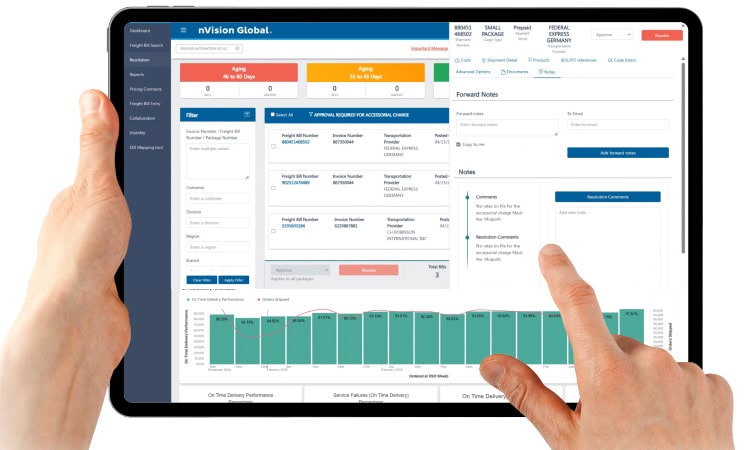
In order to a provide a single source of truth for global shippers, nVision Global’s systems are designed to function as interconnected components of a single ecosystem rather than standalone tools.
As trade networks are reshaped by sanctions, export controls, shifting tariffs, and regional trade policies, companies are managing more suppliers, more regions, and more modes than ever before. Layered on top of this are ongoing supply chain volatility, capacity fluctuations, port congestion, nearshoring strategies, and transportation provider variability—all of which create unpredictability in transit times, landed costs, and documentation requirements.
“These complexities are not just about compliance,” says Stewart Dunsmore, senior vice president of supply chain services for nVision Global. “It’s about financial exposure, operational resilience, and decision-making speed. Many organizations are discovering that legacy freight audit models built for stable, domestic supply chains are not designed for this level of uncertainty.”
nVision Global’s systems are designed to function as interconnected components of a single ecosystem rather than standalone tools. When deployed together, they create a closed-loop environment in which transportation execution, financial validation, and compliance oversight are continuously aligned, providing shippers with a unified global view of spend and risk across all transportation providers and modes.
Many organizations struggle because trade compliance, transportation management, warehouse operations, and finance often operate in parallel systems with limited data synchronization.
An integrated transportation and compliance management ecosystem, such as nVision Global, creates a single source of truth. That means every shipment has a single unified digital record that includes its transportation details, trade documentation, compliance checks, financial accruals, invoice status, and exception history.
All stakeholders use the same structured data, eliminating the need for manual cross-referencing and reducing the risk of inconsistencies between systems. Leadership has visibility into end-to-end performance across execution, compliance, and costs in a consolidated view, moving from fragmented functions into synchronized processes.
“At nVision Global, we are preparing customers for this future by continuing to unify transportation management, trade compliance, freight audit, and analytics into a single intelligent ecosystem,” Dunsmore says.
Embracing a Data-Driven Approach
With automation and AI tools, compliance and logistics are becoming more analytical and data-driven, with stronger skills in risk management, technology, and strategic sourcing.
These tools eliminate manual handling across a range of operations. For example, freight audit teams don’t have to match and validate invoices line by line manually. Now, advanced rules engines compare contracted rates, accessorial logic, fuel calculations, and customer-specific billing rules automatically against transportation provider invoices.
In trade compliance, automation and intelligent workflows embed classification checks, documentation validation, and screening processes directly into the shipment process. Rules engines apply customer-specific compliance logic consistently across regions and modes, flagging missing data elements, inconsistencies, or high-risk transactions before submission. Issues aren’t overlooked in spreadsheets and email chains.
At nVision Global, we are preparing customers for the future by continuing to unify transportation management, trade compliance, freight audit, and analytics into a single intelligent ecosystem.
Stewart Dunsmore
Senior Vice President of Supply Chain Services
nVision Global
“By reducing repetitive manual work and increasing visibility, these technologies allow teams to focus on higher-value activities, risk mitigation, strategic decision-making, and continuous improvement, while maintaining tighter control in an increasingly complex global trade environment,” Dunsmore says.
Looking ahead, digitization and automation will continue to reshape global trade management, as AI tools evolve to deliver sophisticated predictive and prescriptive capabilities and advanced analytics connect operations to financial and compliance outcomes.
“Ultimately, the organizations that will thrive over the next several years are those that treat global trade management not as a transactional back-office function, but as a strategic control tower powered by accurate data, automation, and real-time intelligence,” Dunsmore says.
Logistics Plus: Designed to Simplify Complexity

Combining hands-on global trade expertise with a technology suite that includes dashboards and reporting tools, Logistics Plus offers global shippers a unified view of their supply chain.
Global trade complexity today is being driven by geopolitical realignment, shifting tariff policies, expanded sanctions enforcement, reporting requirements, and persistent supply chain volatility. Companies still relying on disconnected systems and spreadsheets to manage global trade create knowledge gaps that could derail their supply chains.
Logistics Plus combines technology with hands-on trade expertise, with global trade management tools that provide real-time updates, automated compliance checks, and centralized visibility. The global operations team interprets those changes and applies them practically so customers can move from reactive to proactive compliance.
“You have to be nimble in this environment, and our platform supports the agility needed to adapt quickly to changes,” says Yuriy Ostapyak, chief operating officer.
Given the speed of regulatory changes and aggressive enforcement, companies need to view trade and customs compliance not as an insurance in case an audit comes along, but as a key foundational building block that creates competitive advantage by using the most beneficial trade remedies during the procurement process.
The Logistics Plus TMS, visibility platform, and business intelligence tools provide a unified, real-time view across air, ocean, truckload, LTL, and warehousing. Customers can view shipment status, documentation progress, customs clearance milestones, duty exposure, and invoice status in a single dashboard.
With a unified view of their supply chain through dashboards and reporting tools, shippers have the visibility needed to identify compliance gaps, uncover overcharges, and improve landed-cost accuracy.
“We’ve helped clients uncover systematic overcharges and reduce total landed cost by improving classification accuracy and routing strategies,” says Bojan Stbanovic, global director of trade.
AI Drives a Paradigm Shift
Agentic AI technology is shifting how logistics and customs teams work, allowing them to manage processes instead of being bogged down by repetitive data-entry tasks. Logistics Plus uses agentic AI specifically developed for trade and customs compliance, enabling the customs brokerage team to keep up with constant changes using up-to-date, platform-verified data in more than 30 countries worldwide.
“What is very important is that in this use of new emerging technology, human agency is not going away,” Stbanovic says.
The underlying requirement for successful AI systems is accurate data—from transportation rates to product classifications and tariffs. The first step is ensuring the company has clean, reliable data to support decision-making
“Having wrong data is actually worse than no data at all,” Ostapyak says. “If you’re analyzing wrong data, it points you in the wrong direction.”
With Logistics Plus technology and services, visibility into the entire supply chain allows users to manage global inventory in warehouses and in transit and adjust to market demands. Control towers track overall volumes and carrier performance to drive efficiency.
“The impact for our clients is huge, and it’s not just the visibility, but also the cost savings and a lot of cost avoidance,” Ostapyak says. “When we catch issues, it saves potentially huge sums of money and headaches down the road.”
While the promises of AI-driven transformation are compelling, shippers moving from spreadsheets to trade management systems need a clear starting point.
“The most important first step is not buying technology, it’s gaining clarity,” nVision’s Dunsmore says.
Digitization Journey
Many organizations operate with fragmented processes across transportation, compliance, warehouse operations, and finance, often supported by spreadsheets and email-based workflows. Before implementing new platforms, companies should map their current trade lifecycle and identify manual touchpoints.
The next step is to standardize and centralize core trade data to create a baseline for automation. Without clean, consistent data, even the most advanced software will struggle to deliver value. Capturing data at the source—ideally in the procurement process—is the best starting point.
Then, identify high-impact automation areas. Many organizations start with freight audit and document validation because they touch both compliance and financial controls. Automating invoice validation, rate matching, and document data capture can quickly reduce manual workload and uncover cost leakage, creating measurable ROI that supports further digital investment.

What is very important is that in this use of new emerging technology, human agency is not going away.
Bojan Stbanovic
Global Director of Trade
Logistics Plus
“Embedding rules-based compliance checks into shipment workflows, rather than reviewing transactions after the fact, also significantly reduces risk without requiring a complete systems overhaul on day one,” Dunsmore says.
The technology space advances rapidly, and so far, no single provider has solved all issues with a single tool, Stbanovic notes.
“The key to implementing and integrating effective technology is to start with practical pain points and resolve them one by one, rather than trying to use a single approach for all logistics and compliance needs,” he says. “Even implementing a basic TMS with compliance screening dramatically reduces risk. The key is incremental modernization—not trying to digitize everything at once.”
Global Trade Trends
Governments are increasingly expecting importers and exporters to demonstrate not just transactional compliance, but traceability across multi-tier supply chains. Paper-based processes and disconnected spreadsheets will not be sustainable in an environment where regulators expect structured, timely, and verifiable data submissions.
Digitization is the only practical way to comply with mandates such as e-invoicing, electronic customs filings, real-time reporting requirements, and standardized digital trade documentation across regions. Companies that cannot automate data capture and validation at scale will struggle to keep pace.
With global trade management systems, shippers can build the foundation to operate with the agility and visibility needed to compete in an increasingly complex trade environment.
Organizations most likely to succeed are those that view global trade management as a strategic command center—supported by reliable data, automation, and insights—to guide smarter supply chain decisions.
Overcoming Global Trade Complexity
Geopolitical realignment, shifting tariff policies, expanded sanctions enforcement, ESG reporting requirements, and persistent supply chain volatility drive global trade complexity. These providers equip shippers with the visibility, control, and agility they need to keep up with rapid shifts in trade policy and supply chain conditions.
Logistics Plus
www.logisticsplus.com
Logistics Plus fuses technology with hands-on trade expertise, offering global trade management tools that provide real-time updates, automated compliance checks, and centralized visibility. The global operations team interprets those changes and applies them, enabling customers to move from reactive to proactive compliance.
The Logistics Plus TMS, visibility platform, and business intelligence tools provide a unified, real-time view across air, ocean, truckload, LTL, and warehousing. Customers can view shipment status, documentation progress, customs clearance milestones, duty exposure, and invoice status in a single dashboard.
nVision Global
corporate.nvisionglobal.com
nVision Global’s systems are designed to function as interconnected components of a single ecosystem rather than standalone tools. When deployed together, they create a closed-loop environment in which transportation execution, financial validation, and compliance oversight are continuously aligned, providing shippers with a unified global view of spend and risk across all transportation providers and modes.
From a single dashboard, customers can see shipment status, documentation progress, customs clearance milestones, duty exposure, and invoice status. With these tools, shippers can stay current on rapidly changing tariff policies to manage classification, documentation, screening, and audit trails, reducing the risk of penalties and shipment delays.