
Deploying Physical AI for Smarter, Safer Inbound Logistics

Physical AI will transform many aspects of the supply chain. Starting with a small, focused inbound logistics use case now can make your warehouse operations more efficient, accurate, and safe, as well as help your organization build the skills needed to extend Physical AI into other areas of your business.
AI-powered software is already optimizing supply chain process automation and analytics. Now AI-powered hardware, known as Physical AI, is beginning to transform logistics, using specialized robots and drones that learn from their environments to make dock and warehouse processes faster, safer, and more efficient.
Physical AI addresses a longstanding barrier to inbound logistics optimization—the manual labor involved in its processes.
For decades, unloading, warehousing, and loading out have been bottlenecks that technology couldn’t effectively address, largely because the warehouse is an unstructured environment. Unlike a predictable assembly line, inbound docks deal with a constant variety of unit shapes, sizes, and weights. Traditional automation has struggled with this lack of uniformity, but modern AI-powered systems are finally up to the challenge.
Today’s Physical AI technology has moved from sci-fi concept to hardworking reality, already deployed and generating ROI for innovators and early adopters. This proven business case raises a question for everyone else in the inbound logistics space: When and how will your business leverage this technology?
From loading dock to warehouse slot, Physical AI streamlines processes
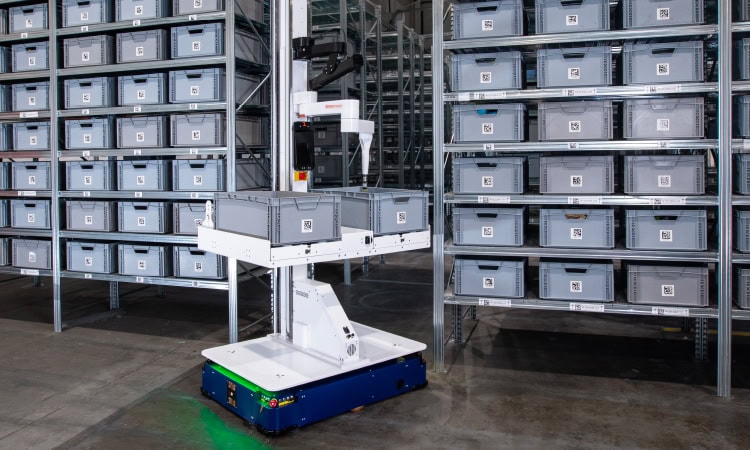
A walk through a modern warehouse shows the distinct roles Physical AI can fill. For inventory, autonomous drones perform nightly cycle counts. For moving goods, autonomous mobile robots (AMRs) now work alongside people, handling travel between aisles. This person-to-goods model can cut unproductive walking time by more than half, directly boosting associate efficiency. We’re also seeing the rise of goods-to-person (G2P) systems, where robots deliver entire shelves or bins to a stationary worker, flipping the traditional warehouse model on its head.
Benefits beyond efficiency: better employee experience, more flexibility
The impact of these Physical AI use cases extends far beyond simple efficiency gains. They relieve employees from hazardous and physically demanding tasks, reducing recordable injury rates. That in turn, reduces labor costs, and turnover.
Fleets of robots and drones also add flexibility. It’s easier to run a third shift, or to scale up during peak seasons with Physical AI devices, than to source increased labor to meet heightened needs. That’s especially true for companies using robots-as-a-service vendors to support their operations.
Implementing Physical AI for warehouse operations
Realizing the benefits of Physical AI requires extensive planning. Robots are an expensive capital investment, although it’s possible to reduce the initial cost by using robots-as-a-service that charges by the month or per picked item, which shifts the investment from a large CapEx spend, to a predictable OpEx cost.
Either way, robots and drones require integration with the existing warehouse management system (WMS) and warehouse execution system (WES), and the organization’s cybersecurity practices, to protect data and employees.
It’s also critical to deploy a change management strategy to help everyone work with these new tools, including upskilling the existing workforce. This is the most underestimated component of a successful pilot. It involves clear communication about how the technology will augment, not replace, jobs. Hands-on training and involving key warehouse associates in the pilot process itself are crucial for building trust and ensuring the solution is adopted smoothly.
It’s best to start with your single largest or most repetitive bottleneck, rather than trying to automate everything at once. Cycle counting and automated goods movement are common initial use cases where it’s possible to run a tightly focused pilot program, measure the ROI, and document lessons that can derisk and shorten the time-to-value for future deployments.
Over time, Physical AI will transform many aspects of the supply chain. Starting with a small, focused inbound logistics use case now can not only make your warehouse operations more efficient, accurate, and safe, it will help your organization build the skills needed to extend Physical AI into other areas of your business. The warehouse of the future won’t be empty; it will be a hub where technology empowers people to work smarter, not harder, making logistics a more attractive and sustainable career for the next generation of supply chain talent.