
Robots Take On Warehousing’s Hardest Jobs
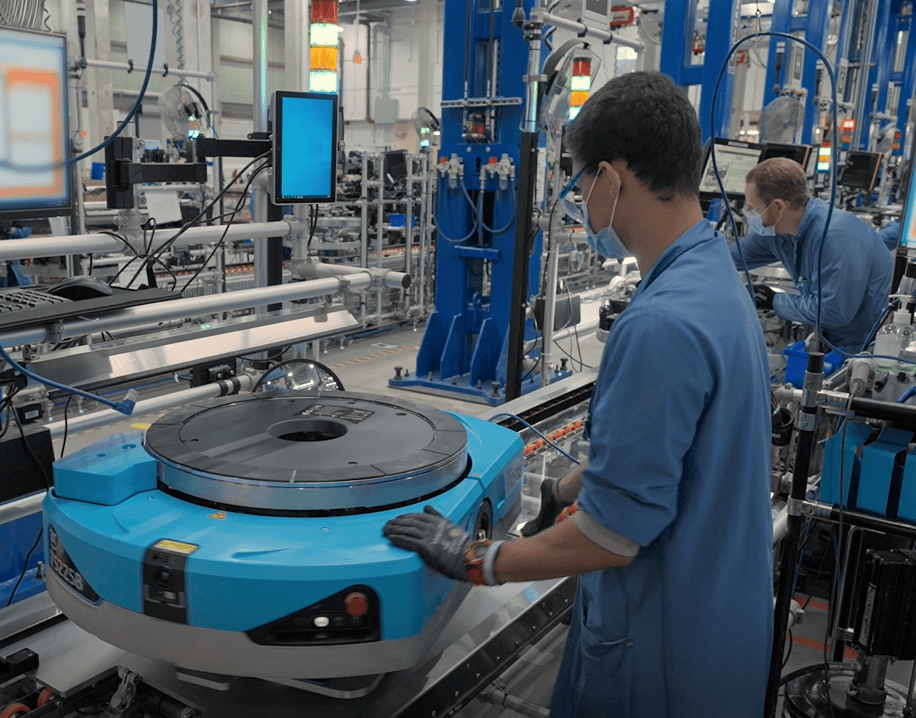
Warehousing jobs are getting harder to fill, and leaders are increasingly looking to robots to pick up the slack.
 By Ashley Prince | August 3, 2026
FedEx and Amazon made major robotics announcements within days of each other this summer. FedEx is scaling up a robot that loads trailers, while Amazon is putting more robotic arms on fulfillment center floors to speed up delivery. Both companies are using robotics to automate their most physically demanding jobs.
These early adopters provide insight into the future of warehouse automation over the next few years.
Grand View Research estimates the current global warehouse automation market size at $27.4 billion, up from $19.2 billion in 2023. The firm expects the market size to more than double over the next few years, reaching $59.5 billion by 2030.
At the same time, labor management is a preeminent issue in warehousing. A full 90% of supply chain organizations cited talent acquisition and other workforce issues as a challenge in the 2026 MHI Annual Industry Report.
The growth of the automation market has dovetailed with increasing labor constraints in the warehousing industry, creating a prime opportunity for implementing new technologies.
FedEx Moves Trailer-Loading Robot Beyond Pilot
Trailer loading has historically proven difficult to automate. It’s physically demanding, and unlike a fixed assembly-line task, no two loads are alike. Package size, shape, and density change with every shipment, requiring real-time decision making instead of one repeatable motion.
FedEx and Dexterity, a physical AI company, have been working together to create an automated trailer loading solution since 2023. On July 30, the duo announced the expansion of their multi-year collaboration. Dexterity’s robot, Mech, will move beyond the pilot site and begin full production at the FedEx Hagerstown Hub in Maryland.
Mech runs on a “world model” called Foresight that reasons across three spatial dimensions to decide how to place packages for space, stability, and speed. Kawal Preet, FedEx’s EVP of planning, engineering, and transformation, said the deployment is meant to prepare the network’s future, not just solve a single site’s problem.
“As we continue evaluating and deploying physical AI in real-world environments, we see opportunities to enhance the speed, reliability, and flexibility of our network, creating long-term value for our business and customers,” Preet said
Amazon Doubles Down on Robotic Arms
Same-day and next-day delivery have become one of the industry’s biggest battlegrounds, and victory is increasingly won or lost inside the fulfillment center. The faster a warehouse can pick, consolidate, and stage an order, the faster it moves out the door.
Amazon is leaning on robotic arms to reduce the time between clicks and deliveries. Cardinal loads packages up to 50 pounds into carts, and Sparrow uses computer vision to pick individual items from containers into totes for packaging.
Amazon plans to more than double its fleet of Cardinal and Sparrow arms in 2026 as it retrofits facilities with newer generations of the technology. The company also introduced Vulcan, its first robot with a sense of touch. It can stow and retrieve items at the highest and lowest levels of inventory pods, a task that previously required a person.
The company says it delivered more than 40% of items same-day or overnight globally in the first half of 2026, up from the same period last year. It credits robotics as a driver of that gain.
The Industry Forges Ahead
FedEx and Amazon aren’t outliers. Earlier this year, DHL Supply Chain and Locus Robotics announced that their fleet of autonomous mobile robots had crossed one billion warehouse picks across more than 40 facilities. UPS also has its own multibillion-dollar automation push running through its facility network.
The Association for Advancing Automation reported that, even as automotive robot orders fell in Q1 2026, collaborative robot orders jumped 55.6% in units. This is a sign that demand is spreading well beyond the auto plants that used to drive the robotics market.
Companies are most interested in purpose-specific systems designed to handle the tasks that are the most physically demanding and the hardest to staff. These roles, including trailer loading and consolidating totes, have the worst injury rates, the highest turnover, and the steepest training curves.
For shippers and 3PLs planning their automation strategies, these types of solutions should garner the bulk of their attention.