
Cybercrime at the Ports; Manufacturing Momentum Broadens; The Forces Reshaping Logistics & More Supply Chain News

Logistics and supply chain news and highlights shaping the future of global logistics.
Ports Under Siege
Cybercriminals set their sights on ports in summer 2026, targeting the software that keeps trade flowing. A June ransomware attack on the Adriatic Port Authority froze terminal operating systems, according to Ti Insight’s Global Supply Chain Risk Monitor. The software that schedules and clears cargo movement went down, halting vessel unloading across the region. The attack, attributed to the cybercriminal group Anubis, shut down local intermodal connections for days.
The disruption followed a larger breach in the United States in mid-June: a coordinated attack hit the digital systems tied to freight management and logistics providers at major U.S. port gateways, compromising cargo tracking platforms, terminal scheduling systems, and internal data nodes at more than 200 logistics and transport entities. Terminal operators locked out of their automated systems fell back on phone calls and paper manifests to keep containers moving. The resulting gridlock cost an estimated $380 million in delays and backlogs across the Americas, according to Zamak Technologies.
A July retrospective directive from the Cybersecurity and Infrastructure Security Agency traced the breach to unpatched legacy software and missing multi-factor authentication, a combination security researchers have flagged for years.
Ports have spent the past decade digitizing scheduling, tracking, and clearance to move cargo through gateways already strained by volume swings and geopolitical disruption. That same digitization creates a single point of failure when the software goes down. Summer 2026 showed how quickly a ransomware attack can turn automated efficiency into manual chaos, and it puts terminal operating systems alongside tariffs and weather on the list of disruptions supply chains now have to plan around.
Update on FedEx / CMA CGM Deal
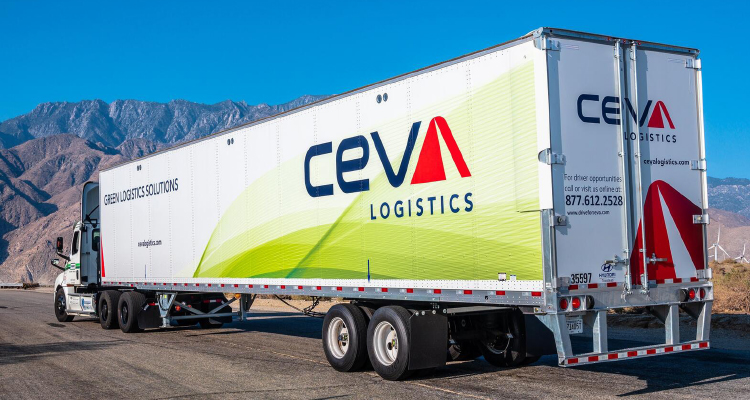
CMA CGM has agreed to buy FedEx Supply Chain for $1.4 billion, a deal that will nearly triple the North American footprint of CEVA Logistics, CMA CGM’s contract logistics arm. The acquisition, expected to close later in 2026 pending regulatory approval, folds FedEx Supply Chain’s roughly 10,000 employees and its physical network into CEVA. Combined, the two operations will run about 150 warehouses across more than 240 North American locations with a workforce of roughly 20,000, positioning CEVA to compete directly with the largest third-party logistics providers in the region.
The sale continues FedEx’s narrowing of its portfolio around express and ground delivery. The company’s DRIVE cost-reduction program has cut $4 billion in structural costs since 2023, with another $1 billion targeted for 2026. FedEx spun off FedEx Freight as a standalone public company in June 2026. Contract logistics work sits outside FedEx’s core networks, and CEO Raj Subramaniam said the sale lets FedEx focus on high-value verticals including healthcare, automotive, aerospace, and data centers.
The deal is not just an asset sale. FedEx and CMA CGM plan multi-year commercial agreements covering ocean and air freight, with CMA CGM becoming a preferred, non-exclusive ocean carrier for FedEx and the two companies collaborating on air cargo capacity. Those arrangements will roll out in phases through 2028, keeping the companies interlocked even as FedEx divests the unit.
For CEVA, which already runs 1,000 warehouses and handled 15 million shipments globally in 2025, the acquisition puts it on more even footing with the biggest names in contract logistics, right as shippers increasingly want partners who can handle warehousing, transportation, and cross-border freight under one roof.
North American Manufacturing Momentum Broadens
While renewal talks for the U.S.-Mexico-Canada Agreement (USMCA) stall, manufacturing momentum in the three countries continues to broaden across industries while completions for previously announced flagship projects are on the rise, according to a recent Manufacturing Pulse update from global real estate services firm Savills. Here are a few key points from the research.
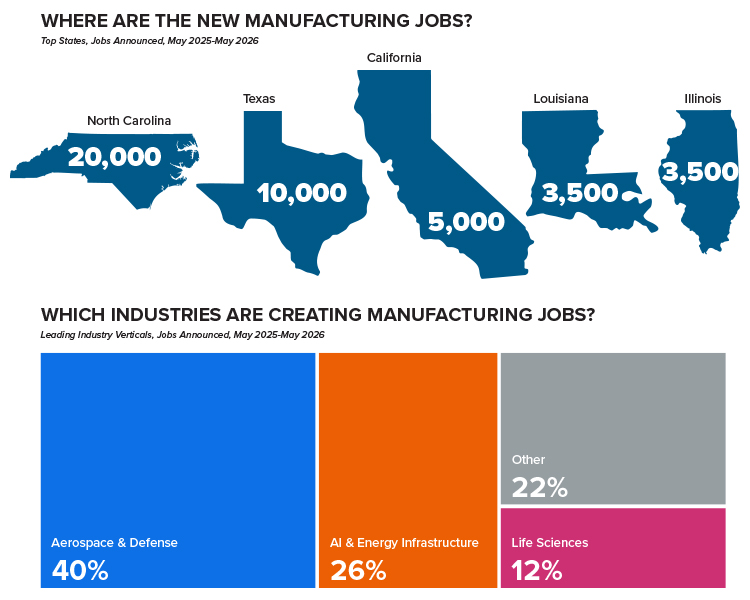
U.S. manufacturing enters a new phase as flagship projects complete. Over the past three months, the completion and commissioning of notable manufacturing projects have provided sector momentum. Multi-billion-dollar projects earmarked to create thousands of jobs (see top chart, below) have come to fruition and begun their first phases of production, including those by Anduril Industries, Canadian Solar, Micron Technology, and Austal USA.
Brownfield projects breathe new life into shuttered factory sites. The U.S. re-industrialization push has largely led companies and their site-selection decisions toward new leases and purpose-built facilities. A few recent announcements buck that trend as notable brownfield initiatives.
Life sciences joins defense and AI in broadening the industry landscape. The life science sector has emerged as a significant driver of U.S. manufacturing investment and a growing source of manufacturing jobs (see bottom chart, below). Over the past 12 months, the sector has generated nearly $25 billion in announced capital investment.
Megaproject deliveries represent 24,000 new job commitments.
Source: Savills Research
Logistics Forged in Disruption
Structural volatility, dynamic tariff shifts, and escalating geopolitical disruptions aren’t going away anytime soon. That’s the consensus from the recently released 2026 State of Logistics: Forged in Disruption report. Organizations relying on aggregate metrics or “managing to averages” face severe strategic liabilities in an increasingly bifurcated market, warns the annual study produced by Kearney in collaboration with the Council of Supply Chain Management Professionals (CSCMP) and Penske Logistics.
This year’s report arrives at an inflection point, as the authors note that “forces reshaping logistics are hardening into structural features of the operating environment rather than conditions to manage through.”
Here are some key trends currently impacting the global supply chain, as outlined in the report.
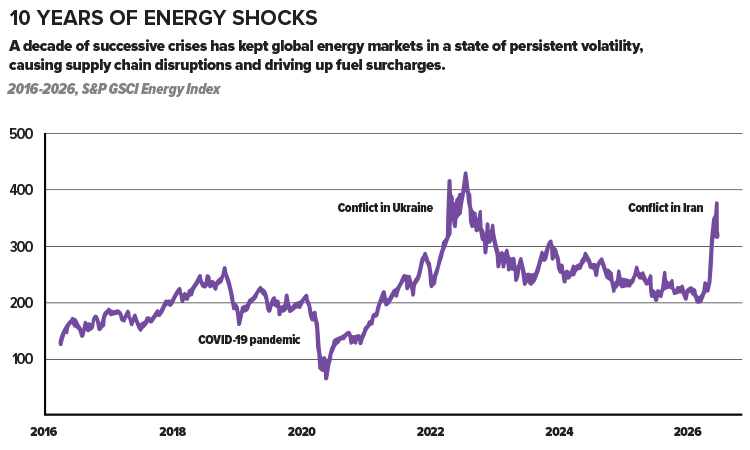
Fuel-price spikes: Ongoing conflicts in the Red Sea and Middle East shipping lanes have pushed global oil prices up nearly 60% since the end of 2025. This comes on the heels of previous crises (see chart, below) and is driving up fuel surcharges and insurance costs for everyone.
Smart software wins: The supply chain advantage has shifted to companies with smart software. The top delivery platforms now check 1,100 different variables (such as traffic, weather, and grid power) for every single shipment to find the best route.
Non-stop tariff changes: Governments around the world changed tariff rules an average of every 1.5 weeks over the past year. This forced companies to frantically rush shipments into warehouses early to beat deadlines.
Air cargo split: Air freight looks healthy on paper, but only in certain places. Air shipping from Asia to Europe jumped 10.3%, while shipments from Asia to North America actually dropped 0.8%.
Green costs money: Environmental rules are hitting the bottom line. For the first time, carbon taxes are appearing as a line-item expense on shipping bills for routes connected to Europe. Meanwhile, bad weather events caused a massive $145 billion in insured losses this past year.
Many companies are suffering from “network drift”—meaning they are making so many quick, reactive changes to dodge the daily chaos that their overall shipping strategy has completely unraveled, the report notes. To survive, the best companies are throwing out the old rulebook. Instead of locking in shipping rates with big, once-a-year contracts, they are using live data and AI to continuously buy freight space on the fly.
Source: S&P GSCI Energy Index; Kearney analysis