
The Great Trucking Contraction: Safety, Language, and the Future of the American Supply Chain
The American trucking industry, which moves 70% of domestic freight, is currently under the microscope. But the focus isn’t on speed limits or logging hours anymore. We are seeing a fundamental policy shift in commercial transportation regulations, and it involves the complexities of national security, immigration, and basic safety.
HMD Trucking is a Chicago-based carrier attempting to navigate these trends. We maintain strict hiring procedures and ensure that our drivers are legally eligible to drive. However, even if the new rules do not directly penalize our businesses, we are not immune to the situations a large number of drivers have to contend with today.
First, the Federal Motor Carrier Safety Administration (FMCSA) has begun cracking down on the issue of Non-Domiciled Commercial Driver’s Licenses (ND-CDLs). Second, roadside enforcement of English Language Proficiency (ELP) standards has become dramatically more common.
These policies and FMCSA enforcement expansion create a difficult paradox: there is high economic pressure to expand hauling capacity, but the accelerating demand for stricter accountability leads to the workforce pool shrinking. These changes put thousands of drivers’ livelihoods in jeopardy, and the smaller carriers that run our supply lines are hit the hardest – they already have to endure volatile operating costs. The main topic of this article is the future of such safety enforcement reforms and the urgency to pursue a better coordinated national security strategy.
Rules of Licensing and the Legal Backlash
Working for a massive commercial motor vehicle (CMV) requires higher levels of knowledge and experience than driving a standard car. Federal law generally requires a CDL to be obtained from the driver’s home state, known as the Domicile Rule. An exception was the ND-CDL created for foreigners legally working in the U.S. who needed a license for the country they worked in but whose home nation did not issue related credentials.
By late 2025, an Interim Final Rule (IFR) was introduced that drastically narrowed the category of drivers who could qualify for an ND-CDL. Applications are now temporarily limited to individuals with specific employment-based nonimmigrant status, such as H-2A, H-2B, or E-2 visas.
This change explicitly removes a large proportion of legally present workers who have relied on other forms of work authorization. This includes DACA (Deferred Action for Childhood Arrivals) recipients, asylum seekers, refugees, and others who have a general Employment Authorization Document (EAD). In addition, state licensing agencies must now strictly cap CDL validity to one year or the expiration of the driver’s immigration documents (whichever is sooner) and federally verify immigration status using the USCIS SAVE system.
Yet, here is the twist. On November 13, 2025, the D.C. Circuit Court issued an emergency stay, blocking the federal law. The court pointed out an apparent weakness of the government’s safety argument: although about 5% of nondomiciled drivers are in the driver pool, FMCSA data indicates that only 0.2% of fatal crashes involve nondomiciled drivers.
So, where does this leave us? In a fog. The rule is paused, but the chilling effect is real. States are confused, carriers are hesitant, and thousands of safe drivers are looking over their shoulders, wondering if their license is valid from one day to the next.

The Language Barrier
The language skills requirement, English Language Proficiency (ELP), has not been rewritten. Federal regulation 49 CFR § 391.11(b)(2) states that a driver must have sufficient knowledge of English to complete key safety tasks. These include:
- Conversing with the general public.
- Understanding English highway traffic signs and signals.
- Responding to official questions, including those from law enforcement or inspectors.
- Making official reports and records.
The rule is intended to make sure drivers on the road possess vital safety communication skills.
The Shift to Immediate Out-of-Service
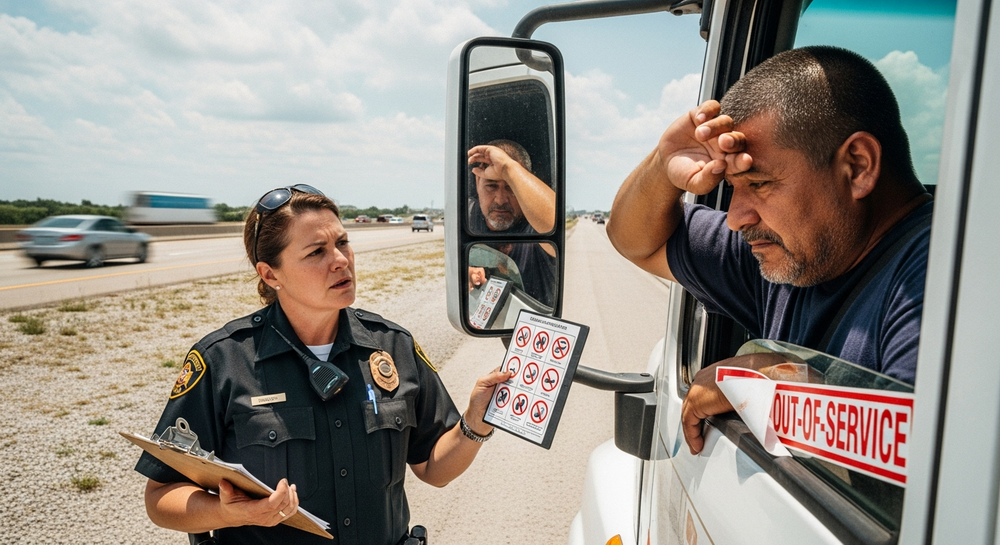
On the other hand, the law has drastically changed direction. The Commercial Vehicle Safety Alliance decided, after the 2025 Executive Order, to enforce the ELP rule on the official North American Standard Out-of-Service Criteria; hence, any driver found in noncompliance with a roadside checkup shall be put out of service immediately.
This stringent enforcement has resulted in immediate consequences. More than 1,200 drivers were stranded, mainly in Western and Southern areas, within the first weeks; that number increased fivefold by October 2025, and temporarily about 6,000 truckers were out of service because they did not have sufficient fluency in the English language. It is also an indication that regulatory compliance had been ignored consistently and for a long time, and we are now observing a harsh attempt at correcting this.
The Problem of Inconsistency and Ambiguity
While safety is urgently needed, testing English literacy is subjective in its assessment. The language test is not standardized. Instead, the FMCSA requires enforcement officers to conduct a two-step assessment during inspections:
- An interview with the driver in English; and a test of the driver’s knowledge of the trip and vehicle.
- A Highway Traffic Sign Recognition Assessment.
Finally, the “sufficiency” of the skill is measured solely by the subjective judgment of the inspector.
In addition, the Secure Commercial Driver Licensing Act of 2025 mandates English-only testing of CDL registration or renewal. These changes comply with safety standards but represent another barrier limiting the pipeline of foreign-born applicants by raising the language level necessary to enter the industry.

Economic Contraction and Supply Chain Vulnerability
At the same time, license-related restrictions and language proficiency matters are already affecting the logistics workforce.
The Capacity Shock
The enforcement actions are targeted at an enormous portion of the workforce. Around 200,000 drivers currently have non-domiciled CDLs and may be off the road by IFR implementation, which is a drastic capacity reduction at a time when the industry is already grappling with a long-standing labor shortage estimated at between 60,000 and 80,000 drivers. This urgent and sharp reduction of capacity threatens to worsen existing driver shortages.
Freight Rate Volatility and Long-Term Costs
The market responded immediately. The increased immigration enforcement targeting ND-CDL holders in transit hubs, particularly those in Southern and Western states, has created “widespread fear among drivers.” The vast majority of drivers are now staying away from certain routes or abandoning their operation entirely, resulting in a “rapid contraction of available freight capacity.”
This sudden capacity shock is contributing to the growth of spot market rates on affected lanes. Though volatility is not necessarily a genuine economic rebound, it is a direct consequence of a market that is reeling from a policy-driven capacity reroute. In the short term, if the IFR is fully implemented and 200,000 drivers are removed over the next two years, market analysts expect that structural capacity shrinkage will drive rate inflation and increase long-term freight hauling rates by up to 2% to 5%. These cost increases then spread across the supply chain, generating inflationary pressure on both retailers and consumers.
Small Carriers’ Vulnerability
The new regulations are significant to the smaller firms in the industry. 92% of American truckers are small-scale carriers, and 10% are carrying ten or fewer trucks. These small businesses depend on foreign-born drivers. It complicates access to this labor source by cutting Employment Authorization Documents (EADs) for nondomiciled CDLs. These limitations, as well as the delay of the work visa program offered to truck drivers by the State Department, could potentially lead to retention challenges for small carriers and may inevitably cause market consolidation and further reveal the fragility of the network.

The Workforce Debate: Skills, Safety, and the Economic Multiplier
Road safety is paramount, and federal laws require CDL holders to maintain some type of proof-based competency. To ensure road safety, all truckers are to have:
- A CDL with proper endorsement for the type of vehicle driven, such as hazardous materials or doubles.
- Understanding of Hours of Service (HOS) and cargo securement regulations.
- A complete driver qualification file consisting of a 10-year commercial vehicle operation record and a mandatory safety performance history inquiry, including the last three years of employment.
The FMCSA stated its intention of restricting the ND-CDL to eliminate the safety gap due to the lack of access to SPH and driving records for those from other foreign jurisdictions, bypassing “unknown-risk drivers” on U.S. highways.
The Competing Views on Driver Shortage
These crackdowns have continued to fuel debate on the problem of driver shortage. While bigger organizations (such as the American Trucking Association (ATA)) advocate for more stringent credentialing and verification standards, OOIDA, representing smaller truck owners, has also praised the regulatory move. The OOIDA leadership thinks that major carriers employing cheap labor are exaggerating the driver shortage. They argue that the ND-CDL crackdown adds a “greater barrier to entry” that will raise professionalism and pay for all truckers, thereby benefiting the profession. The current regulatory focus here seems to be more on the process of solving the labor shortage and, thus, making a market correction of low compliance and low-cost capacity.
The Economic Multiplier Effect
Foreign-born drivers are vital to the U.S. economy, with nearly one in six U.S. truck drivers being foreign-born. They are important because they are a critical tool in stabilizing supply chains, especially for high-demand markets like long-haul freight, and are crucial because of the declining native-born workforce. These workers also generate many secondary jobs for U.S. citizens. To move freight efficiently and ensure productivity, every immigrant driver also generates demand for workers such as:
- Logistics and Administration: dispatchers, route planners, and compliance employees.
- Service and maintenance: heavy truck mechanics and repair technicians.
- Professional services: For many foreign-born truckers who start their own owner-operator businesses or LLCs, citizens must be hired as accountants, lawyers, and business managers.
The Macroeconomic Cost of Exclusion
Economic analysis suggests that the mass removal of workers, even those living here illegally, results in net economic contraction. It is an incomplete thought to think that natives could simply fill the jobs of the removed workers, as skills often do not match, and workers are “imperfect substitutes.” As lost laborers decrease the consumer population, economic activity decreases, as does the tax base. Though many undocumented immigrants are denied federal assistance, they pay directly into Social Security and Medicare, providing a huge revenue base. These exclusionary policies will ultimately threaten the economic and job prospects of both native-born citizens and legal immigrants.

The Policy Crossroads
The trucking industry will have to face a new trade-off between strict safety enforcement and economic stability with the 2025 regulations. The aim of enhancing credential integrity and road safety is worthy and necessary, but the process of sudden mass exclusion is already destabilizing the supply chain and threatening small businesses.
To steer through this hurdle, more balanced methods and reform are needed:
- Standardize ELP Assessment: The FMCSA should move away from the subjective roadside interview and apply a standardized, objective language test to verify functional English proficiency. This would ensure consistent safety for transporters and drivers, rather than relying on the subjective judgment of an inspector.
- Establish Legal Pathways: In order to counter the chronic driver shortage and restore capacity, the government should make it a priority to create clear, specific legal visa pathways for qualified foreign-born drivers. These pathways must include all safety, skill, and language requirements before they are integrated into a stable, highly regulated workforce.
- Invest in Integration: In light of the vital role of foreign-born drivers, the U.S. should invest in federally supported programs that help provide English language learning and CDL preparation assistance. By improving skills rather than focusing on exclusion, thousands of skilled workers can become fully capable of fulfilling obligations, thereby enhancing safety and supply chain efficiency.

The regulatory climate in 2026 will likely be volatile. As the courts debate the IFR, roadside inspectors will continue to enforce strict ELP testing.
However, our philosophy remains the same at HMD Trucking. We are not hiring based on where you came from. We believe in “human attitude.” We know that skilled drivers are the most valuable asset of the supply chain.
We are looking for professionals who can meet the highest standards of the road. Here is our offer to you:
- Great Pay: We offer top-of-the-line pay rates and plenty of miles to keep your bank account happy.
- Great Gear: You’ll always be safe and comfortable in our well-maintained fleet.
- Great Life: We cover you with comprehensive benefits.
The road doesn’t care about politics. It cares about competence. If you’re ready to drive for a carrier that puts respect and safety above the noise, contact HMD Trucking today. Let’s keep America moving.