
Yard Management: Grounds for Improvement
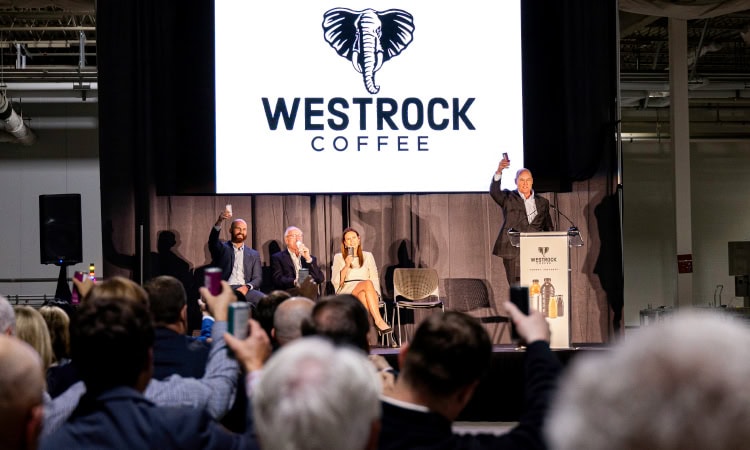
Depending on the amount of attention companies pay them, the yards outside warehouses and manufacturing plants can either be models of efficiency or a source of delays. A supportive yard management system (YMS) can make all the difference as Westrock Coffee Company has learned. Having gained a YMS during its acquisition of another company, Westrock continues to unlock impressive gains in efficiency, real-time visibility and operational control.
THE CUSTOMER
Westrock Coffee Company is a U.S. manufacturer and supplier of private-label coffee, tea, flavors, extracts, and ingredients solutions. The company handles sourcing, roasting, product development, packaging, and distribution for retail, foodservice, convenience, and hospitality clientele. Headquartered in Little Rock, Arkansas, with offices in 10 countries, the company sources coffee and tea from 35 origin countries.
THE PROVIDER
Kaleris is a global supply chain execution and visibility software company providing cloud-based yard, transportation, and terminal management solutions. Founded in 2004, and formerly known as PINC, Kaleris is headquartered in Alpharetta, Georgia.
When Westrock Coffee Company acquired S&D Coffee & Tea in February 2020, it inherited an important advantage. S&D had already implemented a yard management system (YMS) that continues to serve Westrock’s operations today.
To understand the scope of the original challenge, one only needs to consult J.T. Hinson, who was the former logistics manager at S&D Coffee & Tea and is now Westrock Coffee Company’s director of freight logistics. He began evaluating the feasibility of a YMS as early as 2015.
At the time, S&D relied on fairly manual processes. They functioned well enough, but as business surged in 2017 and 2018, the yard ballooned from 120-130 trailers to roughly 400. The pressure mounted with it.
“We needed visibility into the trailers and better workflow function for the drivers,” Hinson recalls.
Safety concerns added another layer of urgency. With five locations spread across the county, company drivers were frequently on public roads, and Hinson wanted to eliminate the need for constant phone calls to coordinate moves. “We didn’t want our drivers on the phone,” he says.
A YMS ultimately provided that safeguard. Warehouse teams could enter movement requests directly into a portal, allowing drivers to see their next assignment on-screen once they completed the previous one without any phone usage required.
HELP AT HAND
The decision to partner with Kaleris, a provider of cloud-based yard, transportation, and terminal management solutions, ultimately hinged on reliable support. Hinson wanted to know whether he could reach a real person when it mattered.
Having dealt with middle-of-the-night emergencies involving electronic logging devices—“An 8 a.m. problem at 2 a.m. is typically how it goes,” he says—responsiveness became a key consideration when evaluating a YMS provider.
So, at about 3 a.m. one day, Hinson simply called the Kaleris hotline. To his surprise, a technical support staffer picked up. Hinson explained he wasn’t yet a customer; he just wanted proof that the service side worked.
That 10-minute conversation checked a box for him and set the partnership in motion. From there, discussions shifted to return on investment, value, and how a YMS could address the company’s growing operational challenges. A contract was signed in December 2017 and implementation began in February 2018.
For its part, Kaleris approached the YMS implementation with an understanding of where S&D Coffee & Tea—which became Westrock Coffee two years later—stood operationally. The team recognized both the safety pressures the company faced and the need for a system that could grow with them without disrupting day-to-day work.
“It couldn’t be ‘stop doing this, start doing something different,’” says Greg Lauber, Kaleris’ enterprise account director. “It had to be a progression.” That steady, scalable approach helped smooth the transition as the YMS came online.
Lauber also credits the coffee company’s strong operational culture for the success of the rollout. “Their adoption was incredibly disciplined,” he notes. He points to their team’s consistent engagement and methodical use of the platform as a key reason the system continues to unlock impressive gains in efficiency, real-time visibility, and operational control to this day.
FROM PAPER TO PRECISION
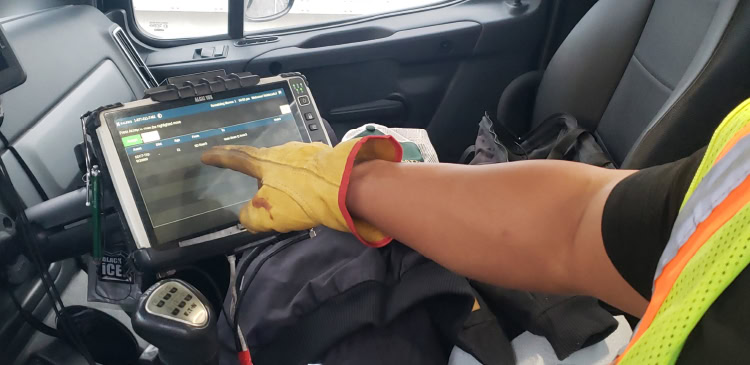
Using the Kaleris yard management system, drivers can view trailer move requests in a shared queue that replaces phone-based coordination. The system gives drivers and dock staff real-time visibility into each move, streamlining communication across the yard.
After implementing Kaleris’ YMS, one of the first improvements Hinson noticed was the end of manual yard checks. Previously, three drivers spent about 90 minutes collectively scanning remote yards and emailing a paper-based report across the plant. The problem was these reports were outdated almost as soon as they were distributed.
“Within 30 minutes, we were moving so much that the old yard check was no good on paper,” Hinson says.
Kaleris’ real-time location system (RTLS) and RFID technology changed that overnight. Manual scans were replaced by live trailer visibility the entire plant could depend on. The accuracy and immediacy of the data quickly proved their value.
“It took about six months to get everybody off paper and onto the platform,” Hinson recalls. “But once they saw a system that told them where every trailer was and what was on it, they couldn’t believe it.”
That real-time view remains one of the YMS’s biggest strengths. Hinson notes it delivers significant time savings across departments and strengthens decision-making from the warehouse floor to executive leadership. “It makes a big difference,” he says. “It’s a huge time saver for our team.”
The YMS has completely changed the way drivers and dock staff communicate. It has long removed the need for constant phone calls by keeping every move visible in one shared queue. Instead of a dock worker making three or four calls to coordinate a single trailer movement, the request now lives in the system where all drivers can see it.
This visibility matters. Some of Westrock’s operations span a remote yard two miles away, the main facility, and an additional roasting plant eight miles up the road. Before the YMS, a move might be assigned to whichever driver happened to get the phone call, even if they were 10 miles away. Now every driver can see the board and take the move closest to them. “We’re able to facilitate the closest move within proximity, saving fuel and time,” Hinson says.
The team also created a dedicated staging area for green coffee trailers. First-shift drivers queue up the trailers they know the second shift will need, placing them within about 100 yards of the roaster instead of miles away. As a result, spotters can grab the next trailer quickly. “It’s like a shortstop making the play,” Hinson says.
These combined efficiencies allow Westrock to increase output using the same resources. Most notably, the time needed to move a green coffee trailer from acceptance to roasting dropped from roughly 45-50 minutes to about 15 minutes. “It continues to be a big win,” Hinson says.
USER-FRIENDLY SOLUTION
For Hinson, one of the biggest advantages of the Kaleris platform is its ease of use. He admits he never considered himself especially tech-savvy, yet he was able to jump in immediately. “I can go in and create attributes, categories, and boxes without ever having to submit an IT ticket. The user can do it themselves,” he says.
That level of accessibility is intentional. Lauber explains that the user interface has evolved through years of direct collaboration with customers like Westrock Coffee. “We’ve worked hard to make the interface role-specific and highly configurable,” he says.
From the beginning, the application was designed to adapt to each operation’s terminology, workflow, and level of detail—whether a site needs a full picture at the gate or just a quick snapshot. For companies like Westrock that span manufacturing and distribution, the interface remains consistent across environments, reducing training time and friction.
Westrock has also taken advantage of the platform’s broader capabilities, from inventory to accounting functions. But Hinson notes that software alone isn’t the solution—discipline is.
“If it’s used properly, with supervisors and managers holding teams accountable, you’ll actually have software, not shelfware,” he says. That commitment has allowed the company to scale, adding sites while maintaining system-wide visibility and efficiency.
The relationship between the two organizations continues to strengthen. “I admire Westrock’s discipline in using the system, and they get a lot of value from it,” Lauber says. That shared focus on communication, flexibility, and continuous improvement, which dates back to that very first phone call, keeps both teams aligned moving forward.
Brewing Up Efficiency
THE CHALLENGE: As Westrock Coffee grew, trailer volume in its yards increased significantly, which created visibility gaps, inefficient driver coordination, and safety concerns. Manual yard checks and phone-based communication made it difficult to keep operations aligned across multiple facilities.
THE SOLUTION: Westrock adopted the Kaleris yard management system to modernize its processes. The cloud-based platform introduced real-time trailer visibility, automated driver tasking, and a configurable interface that fit seamlessly into existing workflows. The system also supported future scalability without disrupting daily operations.
THE RESULTS: Manual yard checks were eliminated, replaced by accurate live trailer tracking across all sites. Driver workflows became more efficient, reducing unnecessary travel and improving coordination. Trailer movements—from acceptance to roasting—were cut from nearly one hour to about 15 minutes, enabling higher throughput with the same resources.
NEXT STEPS: Westrock plans to expand the YMS to additional sites to maintain consistent visibility, unified workflows, and operational efficiency as the company continues to expand.