
Pallets, Elevated
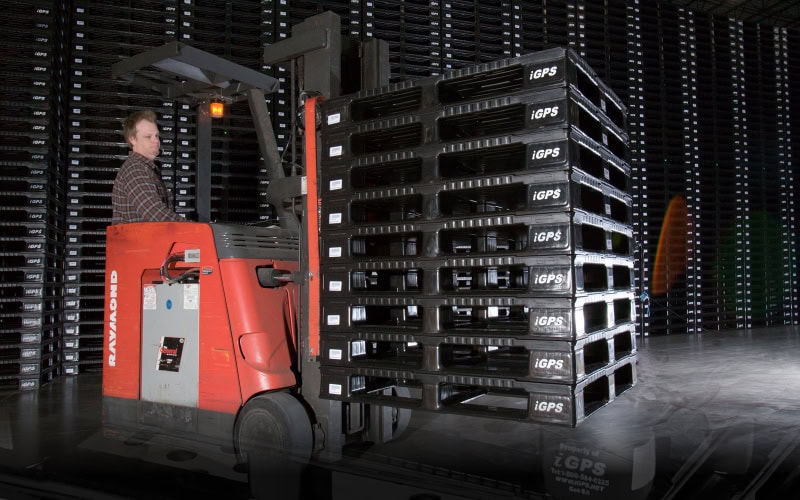
Afterthought, no more. Supporting sustainability initiatives and automated operations, pallet solutions lift their profile.
Pallets rarely get much attention, even though billions of them travel thousands of miles each year, helping to move everything from automotive parts to tennis balls across the country and around the world. “Some people look at a pallet like it’s a commodity and not that big of a deal,” says Donald Maier, Ph.D., associate professor of practice, supply chain management, at the University of Tennessee, Knoxville.
Yet pallets can add up to a hefty cost for many companies. Maier notes that when he worked in the corporate world, his company’s annual pallet expense hit seven figures.
Seeing Steady Growth and Material Innovation
The global pallet market is estimated to top $77 billion, and is growing at just under 6% annually, Business Research Insights reports.
The market for plastic pallets is expected to increase from $7.1 billion in 2024 to $10.5 billion in 2033, according to Strategic Packaging Insights (SPI). Innovations in materials, such as the development of biodegradable plastics and the incorporation of recycled materials, are also opening new avenues for growth, SPI notes.
Plastic pallets’ ability to resist moisture, pests, and chemicals makes them a good fit for industries such as food and pharmaceuticals.
The list of materials used to make pallets is expanding, Maier notes. In addition to plastic and wood, pallets can also be made from corn stover, he says. This is an agricultural byproduct—essentially, what’s remaining in the fields after the corn itself is harvested. While corn stover is widely available, the supply chain for its use in pallets needs to be further developed, Maier adds.
Another option is OSB, or oriented strand board, an engineered wood product that shares many of the characteristics of plywood.
Driving Sustainability
Pallets are being called into service to help companies reach their sustainability goals.
Plastic pallets, for instance, can take upwards of 100 trips through the supply chain (in contrast to about 25 trips for the average wood-block pallet) and are recyclable, says Jeff Pepperworth, president and chief executive officer with iGPS Logistics, which provides an all-plastic pooling system.
Because they’re about 35% lighter than wood, plastic pallets consume less fuel and generate fewer greenhouse emissions when used to ship goods, he says.
Today, forward-thinking shippers don’t think of pallets as commodities, but as important components of their supply chain infrastructure.
“In designing their supply chain, they look at how they can leverage pallets in ways that will enhance operations, improve supply chain resiliency, and meet sustainability goals,” Pepperworth says.
When it comes to pallet platforms, “there’s a place for everything,” says Jessica Dzugan, vice president of technology at PalletTrader. Many large-scale enterprises may require multiple pallet platforms to meet their needs. Forcing a one-size-fits-all approach often means that the pallets either don’t fit the task or cost more than they need to, she adds.
Enabling Automation and Tracking
The growing use of automation within manufacturing and distribution operations is also impacting the pallet market, says Zach Thompson, product manager with ORBIS Corporation, which offers reusable plastic pallets and other supply chain products.
Plastic pallets, because they’re precision molded, can offer repeatable, consistent sizing and dimensions—features that are often key to reliable performance in automated operations.
A growing number of companies are working to track the products moving through their supply chains. Although pallet tracking remains somewhat limited, the number of companies offering pallet tracking solutions has jumped in the past decade, Dzugan says. In addition, more of the software solutions are hardware agnostic.
Tracking solutions installed on pallets can help companies identify the locations of high-value loads, and pinpoint areas within their system that are experiencing shrink, Thompson says. Some regulations require tracking different products, like food products, he adds. Together, these trends are driving more requests for pallet tracking systems, he says.
While barcodes have been used to track pallets for a number of years, the cost of RFID has dropped, making it more feasible to use at scale, Maier says. Moreover, RFID solutions don’t require a direct line-of-sight to scan items, which allows multiple items to be scanned simultaneously. This saves time and cuts the likelihood of mistakes.
Advances in optical recognition solutions can also aid in tracking, Thompson says. For example, 3D vision systems that use two cameras allow automation cells (or complete, integrated automation systems) to align end-of-arm-tooling (EOAT) before beginning a process.
These systems are more expensive but over time, the efficiency they enable can cut costs. “It all comes down to what is most important to the client and the automation cell they are adopting,” Thompson adds.
For a tracking solution to work, the technology needs to be in place throughout the supply chain, Maier notes. As a pallet moves further from its origin, maintaining an accurate, reliable connection can become more difficult.
Successfully implementing these solutions also requires not just an investment in technology, but in employees who can track and leverage the information generated, he adds.
The following companies are helping supply chain organizations use pallets to boost operational excellence, productivity, and resilience.
iGPS: Revolutionizing Supply Chains
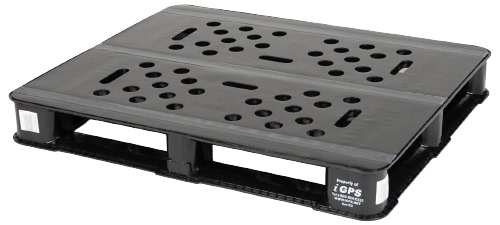
The iGPS plastic pallet is recyclable and lightweight.
The modern supply chain is more automated than ever, says Jeff Pepperworth, president and chief executive officer with iGPS Logistics, which provides an all-plastic pooling system. As a result, it favors smart assets that are designed to flow through and interact seamlessly within automated environments, he says. “Plastic pallets’ uniform dimensions help them flow through automated environments more easily,” Pepperworth says. That’s key, as a misshapen pallet or broken board can jam a conveyor or palletizer, he adds.
Plastic pallets also lack protruding nails and splinters, so they often behave more consistently when used within warehouse automation systems. This ensures less equipment downtime, fewer rejected loads, and lower clean-up costs.
“Our belief is that as the modern supply chain evolves, the benefits of plastic ‘smart’ pallets will only become clearer and more advantageous,” Pepperworth says. The generally lighter weight of plastic pallets allows shippers to move more products per truckload while spending less on fuel and generating few greenhouse gas emissions, he adds. They’re also safer and easier to transport.
iGPS pallets are embedded with RFID tags and barcodes that enable both tracking and integration with supply chain and warehouse management software. These capabilities enable near-instantaneous counting and visibility as the pallets move through the supply chain, as well as the ability to directly interface with robotic systems, Pepperworth says.
For example, an automated guided vehicle (AGV) can scan an iGPS pallet and, with no human intervention, the AGV will know where to move the pallet within an automated storage and retrieval system.
Maintaining a Circular Economy
To maintain a circular economy for its pallets, iGPS operates a network of more than 240 ‘iDepot’ locations, or retailer partnerships the company has established. Through these partnerships, retailers that receive goods shipped on iGPS pallets agree to sort, inspect, store, and reissue empty undamaged pallets back into circulation.
“This saves time and minimizes handling while removing a leg from the supply chain, since the pallets don’t need to be moved to off-site depots before returning to circulation,” Pepperworth says.
In 2025, iGPS won the ‘Top Supply Chain Projects Award,’ recognizing its pilot implementation of an integrated, fully automated pallet inspection and washing system. The customized solution uses a system of electronic eyes that monitor iGPS pallets as they move across a conveyor, while an AI-driven deep neural network scans for the smallest defects, including issues that human eyes might miss.
The system then automatically sorts pallets needed for washing. “We are ensuring that every pallet in circulation is as clean, uniform, consistent, and high-quality as possible,” Pepperworth says.
iGPS worked with a customer in the bottled water sector, helping it shift from wooden pallets to iGPS plastic pallets. Productivity jumped as employees spent less time on debris cleanup. The company could fit more pallets on each truck, leading management to estimate that it was able to cut 50 truckloads each year, while shipping the same amount of water.
“We consider ourselves more than a pallet company,” Pepperworth says. “iGPS is a partner in our clients’ supply chain success, constantly innovating and striving to deliver the best possible experience. The modern shipping pallet is not an afterthought,” he says. “It’s a central factor for success.”
ORBIS: Leading to a Sustainable Future
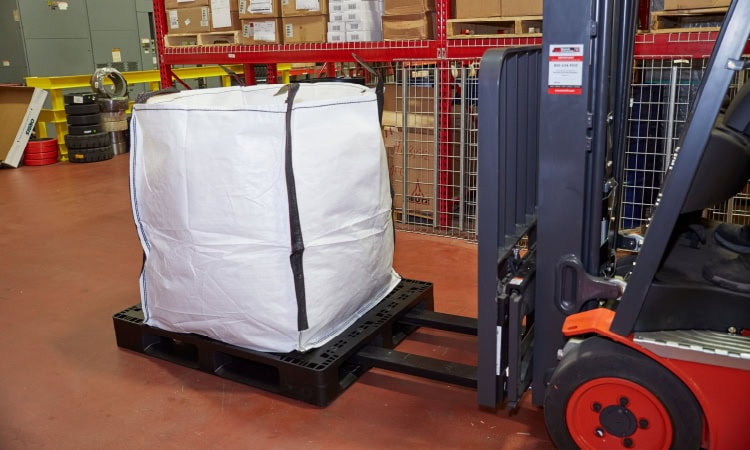
ORBIS Corporation optimizes supply chains with sustainable packaging solutions, including reusable pallets and other containers and racks.
ORBIS Corporation optimizes supply chains with sustainable packaging solutions, including reusable pallets and other containers and racks that can reduce costs and enhance profitability.
Across all its work, ORBIS is focused on sustainability and circularity. “It’s very important to us to keep supply chain packaging materials in use for a long service life,” says Zach Thompson, product manager. Many ORBIS employees are experts in integrated, reusable packaging and its role within automation and other systems used within distribution centers and supply chain operations.
Supply chains that offer an easy path to returnability for products like pallets can result in significant cost savings, Thompson says. Say a company makes product X and sends it to distributor Y, which sends it to retailer Z. When there’s a clear path of recovering that pallet, reusable pallets offer significant gains in return on investment (ROI).
As companies repeat the cycle multiple times each year, they can gain tremendous returns on their investment. “The investment into reusables is going to pay back many multiples of times, because they offer more usage before needing replacement,” he adds. Nestable pallets can offer even greater cost savings, as they require a fraction of the space of normal or block pallets during return trips or in storage.
Meeting Sustainability and Automation Goals
Independent testing has shown that ORBIS’ flagship plastic pallets can be used up to 400 cycles, Thompson says. Moreover, when a plastic pallet finally reaches the end of its life, it can be recovered, reprocessed, and recycled into another pallet. ORBIS is able to recover and reuse not just its own pallets, but those from many other manufacturers.
With most packaging solutions, safety and hygiene are serious concerns. That’s especially so when shipping food and pharmaceutical products. ORBIS’ pallets, because they’re made with non-porous materials, lack hidden cavities in which contaminants could collect, and feature contoured surfaces that can drain easily when washed as well as comply with multiple hygiene and safety standards and regulations, such as the Food Safety Modernization Act.
ORBIS worked with a large grocery retailer with operations in both the United States and Europe, and that is working to increase the percentage of recycled content in its supply chain. One way ORBIS is helping the company meet this goal is by making pallets that use recycled resin.
Another way is by making greater use of post-consumer BoPP, or biaxially oriented polypropylene. BoPP is widely used in consumer packaging that often finds its way to landfills. The material can be recovered, cleaned, and remade into new products like pallets, Thompson says. “We’re helping our customers reuse product packaging materials and achieve their circular economy goals,” Thompson says.
ORBIS recently acquired Robinson Industries, a pioneer in thermoforming, or heating a plastic sheet until it’s pliable, and then forming it into a specific shape. Robinson’s product lines include pallets, lids, and trays.
There are many ways that companies can use pallets to operate more sustainably and within automated environments, Thompson says. “Those are growing parts of the industry and we’re happy to help companies meet their goals around sustainability and automation,” he says.
PalletTrader: Simplicity, Efficiency, and Control for Pallet Management
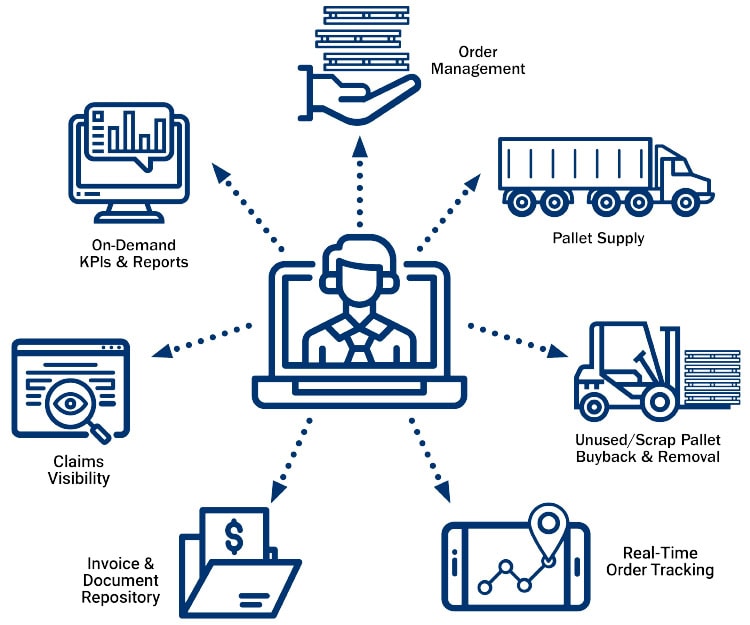
PalletTrader offers centralized management for sourcing pallets. Its neutrality is critical to the managed service.
Many large, enterprise shippers often need a mix of pallet solutions, says Jessica Dzugan, vice president of technology at PalletTrader. For instance, a manufacturing company shipping to big box retailers might be required to use rental pallets, but then use whitewood, which is typically lower in cost and has less management complexity, for all other distributors.
Until a few years ago, introducing a diversified pallet program was hindered by the fragmented nature of the market, few internal resources to manage it, and no enabling technology, Dzugan says. Pallets were often procured at local facility levels as a mostly manual activity.
PalletTrader, launched in 2022, is changing this. What started as a neutral, online self-service sourcing platform for whitewood pallets, has evolved into a full-scope, technology-rich “managed service” marketed as PalletTrader+. It was founded by Bettaway Supply Chain Services, an integrated material handling, transportation, and supply chain company with 40 years’ experience. PalletTrader+ is currently available in the United States and will launch in Canada in June 2026.
PalletTrader+ works with enterprises to analyze current pallet programs and identify opportunities to optimize them. “A big part of our value is spending time upfront learning each client’s needs,” Dzugan says. Pallet sourcing is often handled by general procurement teams that buy many indirect items, from office supplies to IT hardware to pallets. That broad portfolio can sometimes limit how deeply they engage in any single category. “We like to say that we will worry about pallets so you can focus on everything else,” she says.
Optimizing Pallet Sourcing
For example, PalletTrader helped one company optimize its pallet sourcing for its 20-plus nationwide locations, which had been procuring pallets haphazardly with little overall visibility, central direction, or control.
Working with the client’s onsite facilities, PalletTrader developed a consolidated strategy that maintained local decisions, instituted a common process, redefined specs, and leveraged net volume for best pricing.
It also provided centralized visibility, improving insights into location spend and network flow. “The company saved 20% just by making nuanced adjustments and centralizing management under us,” Dzugan says.
PalletTrader’s neutrality is critical to the managed service. “It’s what differentiates us,” Dzugan says. PalletTrader isn’t beholden to specific suppliers or platforms so it can be an objective arbiter, she adds, providing a single, expert resource that relieves the procurement burden and gives the client a purpose-designed, custom solution.
Today PalletTrader offers centralized management for sourcing pallets via its nationwide network, client incumbent management, sell-off/buyback programs, repair and return programs, rental management, and closed-loop pool solutions spanning wood and plastic options.
“We found clients wanted the benefit of an experienced, knowledgeable, and dedicated team backed by innovative technology to reimagine pallet sourcing and management in a better way,” Dzugan adds. “It’s a continuous improvement journey, using proven technology and expertise to source and recover pallets as efficiently, cost-effectively, and reliably as possible.”
Ensuring Durability and Compliance
Like most links in any supply chain, the pallet market is impacted by government regulations. As more supply chains cross national borders, the pallets used to move goods need to be durable and comply with multiple regulations.
The U.S. Department of Agriculture, for example, requires importers to ensure that all wood packaging material entering or transiting the United States is pest-free, debarked, heat-treated or fumigated, and marked with an ISPM 15 logo certifying that it has been appropriately treated.
“If the logo is not there, customs can reject the entire load,” says Donald Maier, Ph.D., associate professor of practice, supply chain management, at the University of Tennessee, Knoxville.