
$600,000+ to Build a Line Item Where None Existed: EdgeTrack’s First Commercial Contract Brings Edge-AI Driver-Detention Measurement Live Across Seven U.S. Hubs
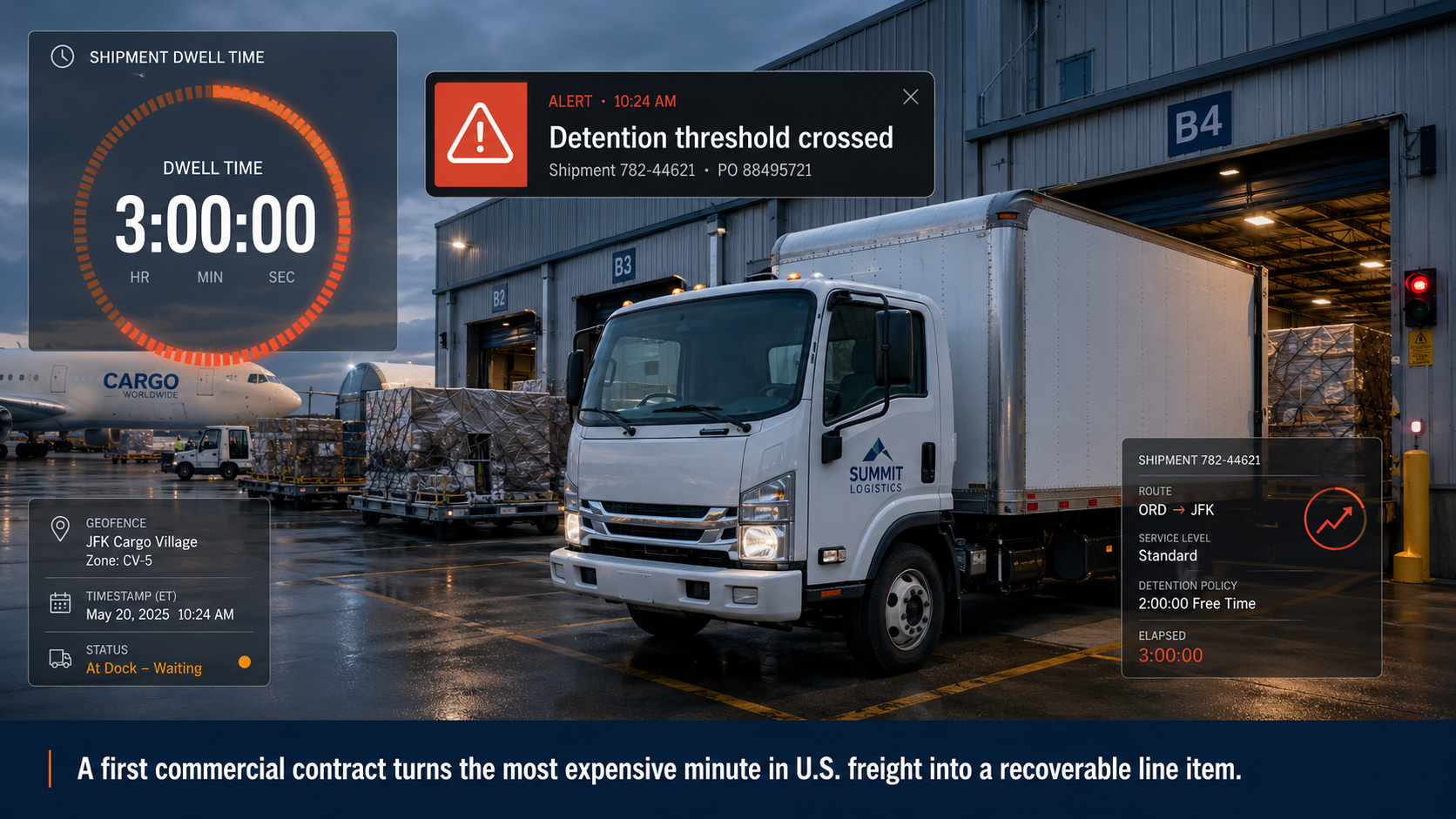
A first commercial deployment converts driver detention from a soft cost into a recoverable, audit-trailed, federally-aligned line item, with rollout phased across a five-state U.S. footprint.
EdgeTrack Solutions LLC, a Lexington, Kentucky edge-computing freight intelligence company, has signed its first commercial contract. Worth more than $600,000 over its initial three-year term, the agreement brings EdgeTrack’s patent-pending edge-AI freight intelligence platform into production with a U.S. regional carrier operating a multi-hub, time-sensitive specialty logistics network. The deployment spans seven U.S. hub locations across Kentucky, California, Washington, Massachusetts, and Oregon. The contract moves EdgeTrack from a validated pilot record into commercial production, and converts driver detention, an industry cost category that has eluded measurement for more than a decade, into an itemized, audit-trailed, federally-aligned line item.
The contract is structured around a one-time hardware purchase of EdgeTrack’s on-vehicle edge-AI devices and a recurring per-Device Premium Subscription that covers continuous hosted platform access, AI-classified telemetry, weekly Detention Compensation Reports with alert artifacts attached, weekly Time-Sensitivity Delay Reports, hardware warranty, firmware and AI-model updates, and tiered technical support. Deployment is phased across the seven hubs over the contract’s opening months, ramping from a single-hub launch phase into the full multi-hub footprint thereafter.
What the Carrier Is Actually Paying For
What the carrier is paying for, and what the contract memorializes in operational detail, is something the U.S. freight industry has had a measurement gap on for more than a decade: time-stamped, geocoded, AI-classified records of driver-detention events at airport-cargo facilities, drop-box pickup sites, lab destinations, and international-carrier handoff facilities, in a form sufficient to support detention-compensation invoicing under the carrier’s upstream master services agreement.
The instrument is the same across every hub. The on-vehicle edge-AI device combines one-second GNSS telemetry, an inertial-measurement unit, and an AI-enabled camera with on-device neural-network inference. The platform geofences every relevant facility category and distinguishes in real time among delivery, detention, idle, congestion, and rest. It time-stamps facility entry and exit at one-second resolution. It flags the moment vehicle dwell crosses a contractually defined detention threshold, typically thirty minutes at an airport-cargo facility, fifteen minutes at a drop-box site, twenty minutes at a delivery destination.
The notification framework is itself an explicit contract deliverable. At threshold-crossing, the platform dispatches a contemporaneous alert to the facility operations team and the customer account team, advising that the detention threshold has been reached and that detention-compensation accrual has commenced under the carrier’s upstream agreement. The alert is time-stamped, cryptographically signed, and audit-trailed. Aggregated into weekly Detention Compensation Reports, with the underlying GNSS coordinates and the classification-model version preserved, the artifacts become evidence the carrier can use in invoicing without dispute, and the shipper can review with confidence.
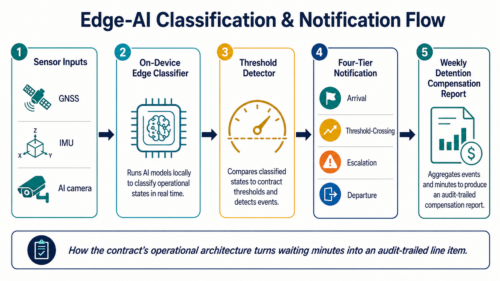
How the contract’s operational architecture turns waiting minutes into an audit-trailed line item.
Why a $600,000+ Contract for This: The $15.1 Billion Problem
The reason such a contract exists is that detention is the single largest avoidable cost category in U.S. trucking, and it has persisted for decades not because the industry tolerates it but because the operational evidence to charge it has been missing. American Transportation Research Institute (ATRI) research has estimated U.S. driver-detention costs on the order of $15.1 billion annually.
The U.S. Department of Transportation, through its National Freight Strategic Plan and the September 2025 Federal Register Cargo Theft Request for Information, has separately recognized the structural problem as one of operational visibility, not industry awareness. Until the granular, per-vehicle, per-stop, AI-classified record exists, a detention claim is anecdotal. With it, the claim is contractual.
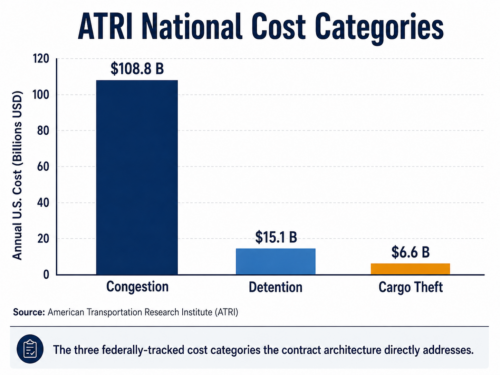
The three federally-tracked cost categories the contract architecture directly addresses. Source: American Transportation Research Institute
From Cost Center to Line Item
Once detention is measurable at the per-stop level, with timestamps, geofence coordinates, and classification-confidence scores, it ceases to be a soft cost. It becomes a chargeable category. A carrier negotiating with a shipper or a third-party logistics provider can specify the detention threshold per facility category inside the master services agreement itself. It can require contemporaneous notification at threshold-crossing. It can invoice weekly against an objective record. And it can use the same record to defend against time-sensitivity-based delay-liability allegations: a missed lab-arrival window in a time-sensitive specialty logistics network is no longer pre-attributed to carrier dispatch failure. The delay-attribution code in the record distinguishes among detention-driven, congestion-driven, carrier-handoff, and dispatch sources. The shipper sees the distinction. The negotiation moves from accusation to attribution.
The buyer side reshapes in parallel. The historical posture toward detention has been to underwrite it implicitly, through inflated carrier rates and padded transit allowances. With audit-trailed weekly reports, the underwriting becomes itemized. Procurement teams renegotiate detention thresholds at the facility-category level. Operations teams remediate at the facility or reprice the lane. Detention stops being a budget assumption and starts being a managed line, like any other cost of doing business.
The Federal Connection: A Continuing Contribution to FLOW
The same operational data that solves the private-side problem solves a federal-side data-infrastructure problem. The U.S. Department of Transportation, through the Bureau of Transportation Statistics, established the Freight Logistics Optimization Works (FLOW) initiative in March 2022 as a public-private data-sharing partnership designed to “pool freight information from across the supply chain into a shared, common picture of supply chain conditions.” FLOW’s declared input categories, container availability, throughput, dwell-time, and route performance, are exactly the data categories that AI-classified edge telemetry produces continuously on every deployed fleet vehicle.
The current contract reflects this federal-alignment posture directly. EdgeTrack retains a limited consent from the carrier to contribute de-identified, aggregated operational data from the deployed fleet to FLOW on a CIPSEA-compliant basis. The continuing federal benefit is measurable year-over-year against ATRI’s quantified national cost categories: traffic congestion at $108.8 billion annually, detention at $15.1 billion, cargo theft at $6.6 billion annualized. The deployment converts each new fleet vehicle into a higher-fidelity data source for the public infrastructure designed to measure the very cost categories the deployment also addresses privately.
Looking Ahead
The deployment sequence unfolds across the contract’s opening months. A launch-hub phase brings the platform live and produces the first weekly Detention Compensation Reports. A subsequent multi-hub phase extends the platform across the remaining hubs on a weekly cadence, completing the seven-hub footprint within the contract’s opening quarter. From that point, the data flow forward in three directions simultaneously: to the carrier as invoice-grade detention records, to the shipper as time-sensitivity delay attribution, and to the federal FLOW partnership as aggregated public-benefit visibility data.
The black box becomes a line item. The line item becomes a federally-aligned data infrastructure. The first commercial contract is the inflection point between the two.
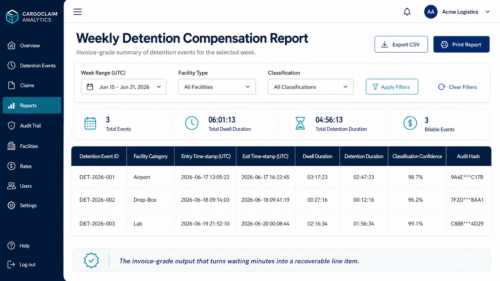
The invoice-grade output that turns waiting minutes into a recoverable line item.
________________________________________________________________________________
About the Authors
Eric Wambua and Shem Odhiambo are the Co-Founders of EdgeTrack Solutions LLC, a Lexington, Kentucky-based edge-computing freight intelligence company. Both are graduates of the University of Kentucky Master of Science in Supply Chain Management program. Eric serves as Chief Operating Officer and Chief Financial Officer, and is the lead innovator and a named inventor on EdgeTrack’s patent-pending edge-AI freight intelligence platform. Shem serves as Chief Executive Officer. Eric and Shem are the co-authors of the March 2026 Inbound Logistics commentary, “Seeing Around the Next Bend,” published in the Supply Chain Visibility section.
Contact: [email protected] | [email protected]
PUBLICATION COMPLIANCE NOTE
This article does not name, and does not include any identifying address, route, vehicle count, unit-price, monthly-subscription dollar amount, or other commercially sensitive metric of, any specific EdgeTrack customer, sub-contracting carrier, or end customer. Operational descriptions are conceptual and architecture-level. The framework references, multi-hub U.S. logistics, drop-box pickup, airport-cargo handoff, time-sensitive specialty delivery, are presented as operational categories rather than as identifiable arrangements. This compliance posture mirrors the publication safeguards set forth in EdgeTrack’s commercial agreement with the relevant carrier, and the article is being submitted to that carrier and the relevant end-customer for concurrent prior-review under the timing schedule those agreements require.