
Corral Your Freight Data with the Right FBAP Provider
Freight spend and inefficiency have you at the end of your rope? These freight bill audit and payment companies can help lasso your process with intelligence and precision.
The freight bill audit and payment (FBAP) process has become analogous to printer paper. “It still has to be a quality process, but it’s just a given,” says Craig Cameron, chief marketing officer with A3 Freight Payment. Shippers now look for providers that offer quality audits and also help them operate more effectively.
Savvy organizations are using the information generated by the FBAP process to improve their financial controls, support negotiations with transportation providers, and better understand the activities that are driving traninsportation costs, says Luther M. Brown, chief executive officer with nVision Global.
“Freight audit and payment is becoming less about simply processing what happened and more about using the information to understand why it happened, what it means to the business, and what should happen next,” he says.
Automation has also become an expectation. Organizations look for providers that can offer technology solutions that reduce the need for manual interventions.
As shippers look to boost efficiency and fully connect the process, they’re also more interested in having their providers close the loop by making the actual payment, says Tony Urban, executive vice president and president of Transportation Information Services, a division of Cass Information Systems.
By leveraging a payment processing service, shippers can pay one FBAP provider rather than multiple carriers. They also gain more reliable timing of carrier payments and increased invoicing fraud controls.
One reason that more is being asked of FBAP providers lies in the data and insight an audit process can uncover. “The freight audit offers a beautiful, data-rich goldmine,” says Hannah Testani, chief executive officer with Intelligent Audit.
Many shippers leverage multiple transportation, order, and warehouse management solutions. The FBAP process becomes “the melting pot in the middle,” Testani says. No matter the systems a shipper uses, nor the data format, the audit team will take the information and make it useful.
Rounding Up Data Sources
Freight audit data provides an independent record of all that’s occurring within a transportation network, says Ron Dodig, senior vice president, sales and solutions, with CT Logistics. A transportation management system (TMS) may show what was planned, a carrier system what was billed, and an ERP what was paid.
“The FBAP provider is in a unique position to connect and validate those records,” he says. When the information is properly captured, normalized, and analyzed, it can influence decisions beyond accounts payable, including carrier negotiations, network design, and operational compliance.
The broader business and geopolitical changes are also prompting organizations to demand more. “Tariffs, geopolitical uncertainty, changing sourcing patterns, carrier surcharges, and increasingly complex global transactions create more variables that need to be validated,” Dodig says. This combination makes the clean, normalized transportation data developed during a freight audit more important, he says.
Also coming into play is the increase in digital and country-specific regulatory requirements. For example, starting in 2030, the European Union’s VAT in the Digital Age (ViDA) initiative will progressively expand digital reporting and e-invoicing requirements, Brown says.
For global organizations, the ability to receive, normalize, and govern transportation financial information across different countries, currencies, tax structures, and invoice standards will become more important and complicated. Not surprisingly, requests for FBAP services that can handle international transactions and operations are increasing.
Technology is another catalyst for change, says Scott Burglechner, senior vice president and head of freight payment product management with U.S. Bank. Demand is growing for APIs, cloud-based connectivity, advanced analytics, and AI-powered capabilities that can help organizations modernize legacy processes and reduce dependence on manual workflows, he says.
In particular, artificial intelligence (AI) has been capturing attention. Freight audit has traditionally depended on structured data, OCR, and significant manual intervention to capture and validate transportation information, Brown says.
That’s changing as AI and intelligent document technologies are making it possible to work with information from a wider range of data sources, such as information that arrives as PDFs, emails, and other less-structured formats.
The Model Context Protocol (MCP) is a standardized framework that enables AI models to connect with external tools and data sources, providing secure, scalable, and real-time access without custom integrations. Machine learning can take quantities of data and quickly find the “needle in the haystack and the patterns that humans might not catch,” Testani says. Predictive analytics and AI solutions can then group data into patterns, and from within each pattern, forecast future shipments. When an event falls outside the predictions, it is highlighted.
Data Rules the Roost
This isn’t to suggest any technology, including AI, is a panacea. To start, poor data will stymie efforts to leverage technology solutions, Cameron says.
Data security also is a growing concern, given the increasingly digital nature of freight transactions, the volume of sensitive data and money inherent in the freight audit process, and the rise of cargo theft and fraud. “It’s the wild, wild west out there,” says Ross Harris, chief executive officer with A3. Most shippers prefer safety and security, and are requesting additional security measures, such as penetration testing or SOC II testing.
Shippers also are becoming more discerning, Dodig says. They want to know where AI is truly improving accuracy or efficiency, how decisions are validated, and what controls are in place.
Although AI is a game changer, human expertise remains critical, says Brad McBride, chief executive officer of FreightOptics. The audit process still benefits from human oversight and its ability to catch anomalies or other data that the models may miss.
Spurring Business Performance
Even as the roles of technology and regulatory compliance in the FBAP process evolve, it’s clear the FBAP function has become a critical, adaptive source of data for strategic decision-making. The information captured through the audit and payment process now feeds analytics, sourcing, intelligence, and forecasting tools, to provide clients with the visibility and insights they need to make informed business decisions, says Lucille Lepez, vice president, APAC & EMEA operations with CTSI-Global.
Similarly, clients increasingly view FBAP providers as experts across multiple supply chain and logistics areas. “They’re seen as partners who can help advance their business and bring greater efficiency to their operations,” Lepez says.
The companies highlighted here are helping shippers wrangle with and improve their operations.
A3 Freight Payment: Different Approach, Better Result
Many FBAP customers and prospects are “absolutely maxed out,” Harris says. The uncertainty around tariffs and geopolitical tension has added more work to employees who were already overextended.
Few organizations have the budget to hire additional resources. Instead, they ask A3 to bring suggestions for saving money and operating more effectively.
Fortunately, A3’s forte is transportation spend management. When working with a shipper, the company conducts in-depth analyses of their freight invoices, gaining critical insight into their operations. Artificial intelligence helps A3’s auditors aggregate information on industry and fuel trends that can boost forecast accuracy, Cameron says.
By tapping into both employees’ expertise and technology, A3 can help shippers reduce expenses and increase efficiency through evaluations of their routes, freight classes, modes, and other data.
Moreover, A3 conducts pre-payment audits, and will pause them if discrepancies are uncovered. “We want to understand and try to resolve the discrepancies before the invoices settle,” Cameron says.
The bankruptcy-remote structure A3 has established ensures customer funds are kept apart from the company’s operating funds, Cameron says. In the unlikely event A3 would run into financial trouble, customers’ funds would be prevented from entering the bankruptcy estate.
As an additional safeguard, A3 has also successfully completed a Systems and Organization (SOC) 1 audit. SOC audits focus on the controls related to financial reporting. Customers can be confident that A3’s financial controls are effective.
Recently, A3 launched an international payment settlement solution. It’s one of a few independent FBAP providers to offer this service, possibly because ensuring compliance with the stringent, anti-money laundering regulations that govern cross-border transactions is a daunting endeavor. A3 meticulously addresses the regulations and now serves customers in multiple currencies, offering them visibility to their international transactions, Harris says.
Cass Information Systems: Single Platform Visibility to Global Freight Spend
Shippers often turn to Cass Information Systems for its comprehensive and global freight bill audit and payment services. “We cover all modes, all geographies, and an increasing breadth of cost types, such as tariffs and warehousing. Clients gain single-platform visibility to their global freight spend, rather than a patchwork of regional or modal reporting,” Urban says.
This unified view offers multiple benefits, Urban says. These include more consistent compliance and governance across the globe, stronger negotiating leverage with carriers because the data isn’t fragmented, faster identification of cost drivers and anomalies, and informed forecasting ability rather than guesswork.
The payment services offered by Cass are managed through Cass Commercial Bank, a fully integrated and wholly owned banking subsidiary. Shippers can have confidence in the process and the safety of their funds. Cass Information Systems, as owner of Cass Commercial Bank, is regulated by both the SEC and the Federal Reserve. “This combination makes Cass a uniquely qualified payment provider,” Urban says.
Annually, Cass manages about $94 billion in disbursements, and processes and pays about 51 million invoices, covering 185 countries.
Another point of differentiation is Cass’s ability to help its clients optimize working capital. Urban notes that transportation spending is notoriously difficult to include in traditional working capital programs, many of which concentrate on materials purchases, even though transportation often is a top expense.
Cass Amplify™ fills this gap by helping shippers safely extend payment terms while offering carriers attractive early payment options. “Both parties improve financial outcomes by increasing their working capital,” he says.
An exclusive partnership with SONAR, a provider of global freight market intelligence, enables Cass to deliver additional value to its clients. Pairing a shipper’s own transactional data with SONAR’s market intelligence enables shippers to see how their rates compare to the market, and which of their lanes and markets are experiencing the most tender rejects.
This insight can be paired with underpriced lanes to identify capacity that’s at risk, enabling clients to work with their carriers to ensure service continuity. “Shippers improve their ability to respond to capacity and rate conditions at the city or lane level, gain access to analysts, and elevate their procurement strategy,” Urban says, adding that this partnership turns the freight audit and payment relationship into an ongoing source of competitive intelligence.
Cass helped a national retailer turn last-mile complexity into significant savings by identifying duplicate invoices; validating invoices against shipments to ensure financial accuracy; organizing cost allocations across carriers, truck types, and regions for actionable insight; and enhancing its ERP data to flag delays, various inconsistencies, and carrier performance issues. In the first two years of this partnership, Cass helped the retailer avoid $63 million in duplicate payments.
Cass will continue to evaluate and invest in opportunities that align with its guiding principles: reduce friction, fuel smarter decisions, and unleash capital. “All of our investments support one or more of those goals,” Urban says.
CT Logistics: Capitalizing on More Than A Century of Experience
Rather than assume that one audit configuration can work for every organization, CT Logistics (CTL) starts each engagement by working to understand how the company buys, manages, allocates, and pays for transportation. Based on this information, the CTL team structures the audit to account for the shipper’s carrier agreements, modes, locations, business rules, accounting requirements, and payment processes.
From there, team members capture and standardize invoice data, validate the charges, manage exceptions, produce approved payment information, and provide shippers with detailed visibility into the entire process. Because transportation networks and carrier agreements continually change, an experienced account team continues to work with the client after implementation.
“A quality FBAP solution requires ongoing maintenance, communication, and analysis,” Dodig says.
To provide shippers with a reliable transportation spend database, CT Logistics consolidates information that often had been scattered across carriers’ websites, spreadsheets, and transportation and other systems.
Once consolidated, this information can guide multiple functions, including budgeting, carrier management, and strategic sourcing. It can also help identify recurring accessorial charges, incorrect shipping practices, carrier performance concerns, and other issues that might otherwise remain hidden, Dodig says.
Clients typically see fewer overpayments while preventing more duplicate payments, boosting contract compliance, and gaining greater consistency in the review and allocation of freight costs. The administrative work required of their transportation and accounts payable teams is generally reduced, as well.
FreitRater®, CT Logistics’ proprietary freight audit and rating platform, can apply customized audit rules and policies across transportation modes. This includes contracted rates, discounts, and minimum charges, among other information.
Shippers can also use interactive dashboards and flexible reporting tools to analyze their transportation expenses by carrier, mode, location, business unit, lane, accessorial, and other dimensions.
“The objective is not simply to provide reports, but to make the underlying freight data usable throughout the organization,” Dodig says.
When a regional freight audit provider for a global medical device company struggled to manage the complexity of the company’s international transportation activity, the company turned to CT Logistics. The team at CTL evaluated the existing freight audit processes, identified gaps in the data and invoice workflows, and configured reporting around the client’s specific requirements. A dedicated CTL account team remained in place to manage the program and identify ongoing opportunities.
The client saw immediate, meaningful, and ongoing improvement in duplicate payments and billing errors, gained greater visibility into transportation spend across all regions, and improved its ability to use freight data for cost control and decision making.
CTL leadership plans to continue modernizing its capabilities in freight audit, payment, transportation management, and business intelligence, Dodig says. This includes API-first connectivity, intelligent document capture, automated validation, configurable workflows, and AI-assisted exception handling. These technologies reduce manual effort and accelerate processing while keeping appropriate controls and human review in place.
To drive even greater value, CT Logistics plans to leverage opportunities to connect freight audit data with related functions, including transportation procurement and contract management.
“Our objective is to combine our depth of experience with leading technology, while maintaining the flexibility and personal accountability our clients expect,” Dodig says.
CTSI-Global: Global System, Local Approach
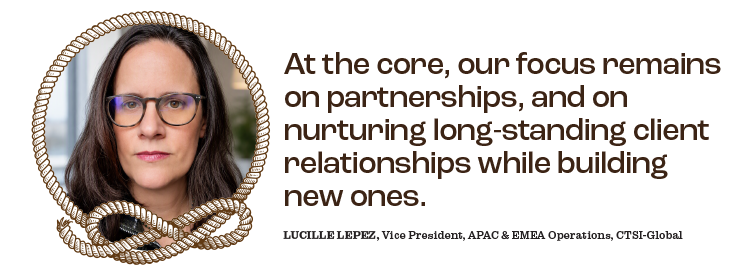
The key to a successful global implementation of a freight bill audit and payment provider is finding the right balance between global consistency and local flexibility, Lepez says.
Since its founding in 1957, CTSI-Global has gained the expertise needed to find this balance. As a strategic partner, the company combines deep global industry expertise, a local approach, advanced technology, and a consultative mindset to help clients manage their transportation spend more effectively.
By working with CTSI-Global, shippers gain standardized processes while still meeting local requirements. Experienced, consultative support teams can provide guidance, share best practices, and help clients navigate complex logistics challenges. End-to-end process management means freight invoices move seamlessly through the audit and payment process with little to no manual intervention.
These strengths help explain why CTSI-Global now processes $32 billion in transportation spend annually, supports clients in more than 120 countries, and operates in more than 17 languages.
The thoughtful application of technology and automation enables CTSI-Global to help its clients improve efficiency, increase visibility, reduce administrative effort, and support better decision-making, Lepez says. A key aspect of this technology offering is CTSI-Global’s proprietary transportation management system, which integrates with freight bill audit and payment services, including carrier selection tools, spot quote solutions, and business intelligence platforms.
For example, Honeybee TMS from CTSI-Global aggregates data from disparate enterprise systems and transportation service providers to provide simple, cost-effective transportation management solutions. The result is improved efficiency, more effective control, and significant ongoing savings.
CTSI-Global worked with a multinational semiconductor company to implement a structured freight bill audit and payment solution at the regional level, while maintaining global synergies. This engagement required onboarding 43 legal entities across 27 countries in three regions, moving more than 150 suppliers to an electronic invoice format, and integrating with multiple ERP systems.
The hard work is paying off. Now, 98% of invoices are coded with no intervention, while 99% of shipments are audited against rate cards. By educating carriers to bill correctly and reduce their rejection or duplicate volume, more invoices are smoothly processed.
“CTSI-Global is also making significant investments in AI and is actively working on a range of initiatives,” Lepez says. These are designed to further enhance systems, improve automation, increase efficiency, and deliver greater value to the company’s clients, she adds.
One focus of investment is stronger data analytics, particularly for parcel shipments. Another is the expansion of AI-driven workflows throughout the FBAP process to create a more seamless experience, Lepez says.
Management is also exploring opportunities to extend the company’s footprint into new markets as client needs evolve globally. “At the core, our focus remains on partnerships, and on nurturing long-standing client relationships while building new ones,” Lepez says. “The goal is to be viewed not just as a vendor, but as a strategic partner who drives efficiency, reduces costs, and gives clients real visibility into their operations through data.”
FORTIGO: Guaranteed Freight Audit Accuracy
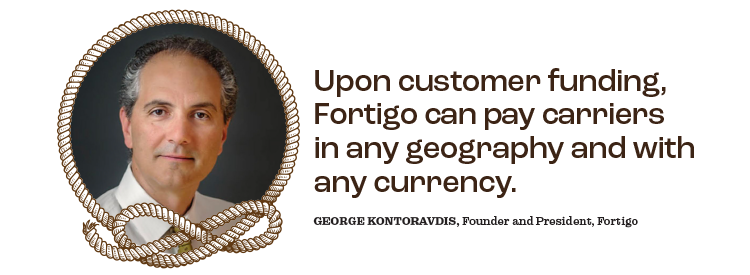
For companies striving to reduce costs, improve customer satisfaction, and increase profitability, Fortigo serves as a partner to help them achieve these goals.
Fortigo automates, optimizes, and audits logistics decisions. Its solutions plug into established supply chain applications and can provide a rapid return on investment by optimizing and deploying closed-loop logistics processes, minimizing ship-to-order times, and streamlining collaboration with logistics providers. Since its founding in 2000, Fortigo has been led by a team of experts in logistics optimization and enterprise web-based software.
Fortigo helps companies drive down operating costs. Process automation eliminates duplicate data entry and streamlines operations. Shipment optimization minimizes ad hoc carrier and service level selection at the shipping dock, while enhanced visibility and proactive exception management reduce manual shipment tracking and improve customer service.
The Freight Audit solution offered by Fortigo reviews freight bills and identifies incorrect charges based on multiple criteria, including carrier service level agreements, negotiated rate sheets, and volume discounts.
To weed out duplicate invoices, the solution matches shipments to the original order number or purchase order. Built-in carrier performance reports identify any deviations from service level agreements and can be leveraged during contract negotiation. A carrier compliance audit ensures accurate billing.
By mixing and matching different Fortigo modules to address key pain points, many organizations can cut logistics costs by approximately 5% to 15%, the company says. In addition, the managed service delivery mode, when coupled with Fortigo’s On Demand technology, dramatically reduces the need to rely on in-house IT resources.
Logistics providers and carriers that work with Fortigo often are better positioned to win enterprise accounts, as they can provide the technology platform and integration required by many large organizations.
The consulting services team at Fortigo can help shippers analyze their processes and identify areas for improvement. Shippers can then develop a plan to address any inefficiencies and any necessary process reengineering steps. They also can establish metrics to help accurately assess the impact of the changes.
Fortigo’s On Demand TMS automates, optimizes, and audits logistics processes across the supply chain. This helps to ensure the right product arrives at the right place at the right time, while incurring the lowest possible cost. This can drive down operating costs, improve access to logistics information, reduce freight costs, and shorten the accounts receivable cycle.
FreightOptics: AI That Puts Shippers in Command of Transportation Spend

Most shippers have plenty of transportation data, spread across carriers, systems, and formats. FreightOptics is the AI platform that gives shippers total command of their transportation spend, McBride says.
It brings carrier, contract, invoice, and shipment data into one system, where AI monitors for discrepancies a busy team might miss. The platform covers parcel, LTL, truckload, ocean, and air freight, and behind the software sits more than $1.7 billion in verified savings over 23 years.
That intelligence goes to work on the freight bill, where the platform checks carrier invoices against the contracts behind them and flags errors before payment. It does not stop at flagging, either. The platform manages the exceptions through to resolution, and clients typically recover 4% to 8% of their total freight spend. They see the patterns behind the errors too: recurring cost drivers, contract drift, surcharges that quietly creep.
The audit is only part of the job. The platform also pays carriers, runs transportation management, and handles rate negotiations and freight claims from the same audited data, so a shipper that finds an overcharge can also fix the pricing that caused it. And rather than digging for answers, teams can ask IRIS, the platform’s AI agent, where spend is climbing or what’s driving it. IRIS answers in plain language with the charts, invoices, and reports behind the number, and it can chase an exception down to a likely root cause and hand the result to the team for review.
The same scrutiny extends inside the warehouse through 3PL Audit. This solution within the FreightOptics platform reviews warehouse and fulfillment invoices from third-party logistics providers rather than carrier freight bills.
“The industry has always been missing visibility into the operations inside the four walls,” McBride says, such as pick, pack, storage, and fulfillment. Invoices from 3PL partners often arrive as lengthy PDF documents, making it difficult to check each charge. The software extracts those line items and organizes them by location and charge type, so shippers can compare costs across logistics partners.
“This brings visibility to the customer’s fingertips,” McBride says, adding that the capability is becoming more valuable not just to ecommerce firms, but to the many other companies using 3PLs.
The Art of the Audit
In 2025, FreightOptics won The Supply Chain Innovation Award from Supply Chain Excellence for its work with a global art dealer. The client had relied on spot quotes, consistently paying above-market rates rather than contract pricing. Without a systematic audit, it couldn’t see substantial overcharges. Fuel surcharge errors went unnoticed. Auditing invoices and entering shipment data was slow, manual work.
The audit recovered more than $37,000 in fuel surcharge overcharges and also documented where invoiced rates strayed from contracts. This evidence anchored negotiations with the client’s incumbent carriers, replacing spot quotes with competitive, market-aligned contract rates. A transportation management system deployment, then automated rate application, cut manual work, and gave the logistics team real-time visibility into its network. All told, the work produced an estimated $3.5 million in annual freight savings, with $5.5 million projected.
The goal now is to push that intelligence beyond the transportation department, into finance and warehouse operations. “These have all operated in silos,” McBride says. Connecting them lets shippers use data from across the enterprise to improve efficiency and savings. “We give shippers command of their transportation spend,” he says.
Intelligent Audit: Expertise Meets Innovation

When conducting a freight audit, Intelligent Audit examines more than 200 data points across all modes, regions, and currencies around the globe. By leveraging powerful, proprietary technology as well as deep industry expertise, Intelligent Audit helps shippers realize the full potential of their transportation data, so they can achieve more efficient, cost-effective supply chains.
“We’re of the mindset that technology is amazing, but technology without insight just results in data that you don’t know how to capitalize,” Testani says. By combining quality technology and the expertise from an industry leading team, Intelligent Audit helps organizations significantly improve their operations.
This is especially valuable in the current business environment, given the ongoing disruptions that are impacting supply chains. To try to stay in front of the upheaval, many shippers address challenges quickly, but not always efficiently or effectively.
Intelligent Audit can help shippers more effectively face these challenges and better position themselves for success, whether in terms of cost, customer experience, or overall efficiency. It does this by augmenting its technology, including its DeepDetect AI solution, with its skilled data science team.
“They know how to connect the pieces and make sure the results are accurate and insightful,” Testani says.
For example, Intelligent Audit might find that if a shipper tweaks one process, the volume of general ledger coding exceptions drops significantly. “We’re able to say, ‘Based on the data, here’s how you can improve,’” Testani says. Because the recommendation is grounded in data, it’s generally received with less emotion, she adds.
In some cases, a single employee might request to approve, for instance, any liftgate fee from a specific carrier. The Intelligent Audit team can use its technology to efficiently examine these fees and any changes that were made to them as a result of the approval process.
If it becomes clear that the company is expending a great deal of effort to review these records, but is only changing a handful, they can point this out. “Again, using the data, we can say, ‘Here’s a better way to invest your resources,’” Testani says.
A Unified Platform
A global manufacturer that operated 12 business units, nine fiscal entities, and multiple ERP and TMS platforms struggled with a highly fragmented freight environment. Disconnected systems and inconsistent processes kept management from gaining a unified view of the company’s total global transportation spend.
In addition, inconsistent audit rules across regions and systems hindered overall visibility and accuracy.
Intelligent Audit’s unified freight audit and reporting platform consolidated data across all the company’s systems, enabling consistent and global freight governance while preserving local requirements and operations.
For the first time, the manufacturer gained complete visibility to all its freight spending. As a result, it was able to cut freight cost leakage by 7.8%, while slashing the work required to complete the finance reconciliation by 40%.
Because Intelligent Audit is not backed by a capital partner that’s focused only on cost-cutting, its leadership team can innovate and invest in technology and their people.
“This helps us remain focused on creating wins for our customers, for the carriers, and for our organization,” Testani says.
nVision Global: Global by Design, Governed by Intelligence, Measured by Results

The best FBAP providers do more than help clients recover or avoid unnecessary freight costs, although those are important. “They also help transform transportation transactions into reliable financial intelligence that can improve procurement, transportation provider negotiations, operational performance, working capital, and broader business decision-making,” Brown says.
This is what nVision is striving toward. “We help clients gain greater visibility and financial control over transportation spend, as well as greater automation and operational efficiency,” Brown says. Each year, nVision Global processes billions of dollars in freight spend and millions of shipments, supporting transportation activity across more than 180 countries and in more than 35 currencies.
nVision’s Transportation Information Gateway provides a single, secure entry point for information, whether it’s transmitted through EDI, PDFs, email, or other sources. Then, nSure AI uses artificial intelligence, machine learning, and intelligent optical character recognition (OCR) to classify, extract, validate, enrich, and standardize the data.
It also detects duplicates, matches reference data, and verifies supporting documents, among other roles. “nSure AI is the intelligence layer that transforms fragmented transportation data into reliable, validated information,” Brown says.
Also key are nVision’s Transportation Data Governance and Transportation Financial Processing Framework. “Governance doesn’t occur only at the end of the audit. It is built throughout the transportation information lifecycle,” Brown says. Business rules, data-quality controls, and other measures are applied consistently as transactions move through the audit process.
The result is a financially complete, governed, and auditable record of transactions. This helps clients strengthen financial controls, boost accuracy and compliance, and create a more reliable connection between transportation operations and the financial organization.
nVision’s Transportation Financial Intelligence, powered by nSight BI, helps clients analyze transportation provider performance, benchmark costs, and identify cost drivers, among other functions.
All these capabilities operate as one connected ecosystem, Brown says. nVision captures transportation information from virtually any source, uses intelligence and governance to ensure that it’s credible and financially accurate, processes the transaction through the freight audit and payment lifecycle, and then transforms the resulting data into intelligence that clients can use to make better decisions.
For example, nVision worked with a global consumer products company whose logistics network included multiple transportation modes and logistics providers, regional finance organizations, and various freight audit companies and enterprise information systems.
Customer orders, shipment tenders, packing lists, and other records were transmitted through multiple submission protocols. As a result, different parties often held different pieces of information about each shipment. By the time the transportation information had been consolidated into reports, many operational decisions had already been made.
nVision Global worked with the company to implement a Transportation Financial Intelligence™ strategy, including its Transportation Information Gateway™ and Transportation Data Governance™ solution. The initiative reduced manual document handling and exception management, while providing speedier and more consistent invoice processing. Management gained earlier access to meaningful transportation financial intelligence that it could use to refine decisions.
Now, nVision is heading toward a model in which freight audit and payment becomes one component of the larger financial intelligence ecosystem. “We want to help clients convert transportation data to trusted financial information that can lead to better business decisions,” Brown adds.
U.S. Bank Freight Audit and Payment: Engineered for Certainty
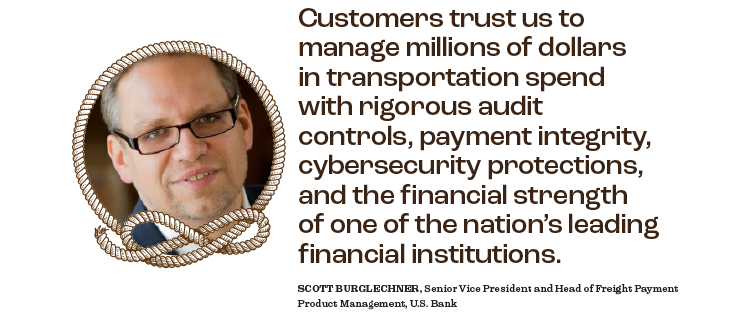
In its approach to freight bill audit and payment services, U.S. Bank focuses on helping customers gain greater control, confidence, and value from their transportation spend. “This helps organizations improve financial accuracy, reduce risk, optimize working capital, and make better transportation decisions,” Burglechner says.
Several capabilities differentiate U.S. Bank’s freight payment services, Burglechner says. One is the fact that it’s a bank. “Customers trust us to manage millions of dollars in transportation spend with rigorous audit controls, payment integrity, cybersecurity protections, and the financial strength of one of the nation’s leading financial institutions,” he adds.
In 2025, U.S. Bank processed more than $46 billion in freight payments on behalf of hundreds of its customers and nearly 20,000 carrier payees across more than 200 countries and 100 currencies. More than 99% of payments are handled electronically.
U.S. Bank’s capabilities extend beyond removing payment friction. “Our ability to bring freight audit, payment, and working capital solutions together through a single provider allows shippers to optimize cash flow while providing carriers with more predictable access to payments,” Burglechner says. This strengthens the connection between parties by creating transparent processes and access to data.
“We’re proud to invest equally in both sides, creating a rising tide that moves the flow of money and business forward,” he says.
Because U.S. Bank believes in hands-on partnerships, customers are supported by transportation experts who help them continuously improve processes, resolve issues, and uncover opportunities for greater efficiency.
“Combined with actionable analytics that help customers identify trends and make smarter transportation decisions, we help organizations advance success, not simply process invoices,” Burglechner says.
By combining freight audit with payment solutions and automation, U.S. Bank helps organizations reduce manual effort, streamline processes, and allocate resources to higher-value initiatives.
U.S. Bank recently worked with a distributor of industrial and other products whose distribution network had grown in scale and complexity. The company’s hybrid freight audit and payment approach could no longer provide the consistency, visibility, and control that management needed to support a rapidly expanding transportation operation.
U.S. Bank Freight Payment helped the company build a more scalable foundation across its truckload, LTL, and global transportation modes. Through independent freight audit services, system integrations, and automated workflows, the teams strengthened financial controls, supported SOX compliance efforts, reduced manual work, and improved visibility across the freight payment lifecycle.
Delivering Tangible Value
When considering technology investments, U.S. Bank focuses on practical applications that deliver tangible value. One example is its ongoing initiative evaluating AI solutions for proof of delivery processing. Here, the technology can help validate invoice-related information and potentially identify signs of document manipulation or fraud before payment occurs, Burglechner says.
Many companies will continue seeking FBAP partners that can combine innovation with the financial strength, compliance standards, and operational expertise necessary to support mission-critical transportation payment processes, Burglechner says. U.S. Bank more than meets these requirements.
Howdy, Partner?
Before signing with a freight bill audit and payment provider, shippers will want to confirm that the company is legitimate, stable, secure, and can provide the services needed. The following questions can help them determine this.
How do you measure and prove results? Providers should be able to explain their audit methodology, accuracy levels, automation rates, identified savings, payment controls, and service performance, says nVision’s Luther Brown. Clients should understand how savings are calculated. If the provider uses AI, it should be able to discuss the improvements it has produced.
Shippers will want to be wary of any provider that emphasizes a low transaction price without clearly defining the scope of the audit and the level of service included, says Ron Dodig, CT Logistics.
How do you use technology? Shippers should know how their transportation information will be received and captured, and how much manual intervention is required during the audit process. They also should understand the provider’s ability to handle different data formats, such as PDFs and emails, Brown says.
What is the pricing model? This might be a monthly subscription, a per-transaction fee, or a small contingency for parcel audit, says Brad McBride of FreightOptics. It makes sense to understand the calculation before working with a provider.
How granular is the data? Ideally, the provider will offer lane-level data in a format that allows for analysis and comparison against industry averages, McBride says.
What safeguards are in place? As supply chains become increasingly digital, organizations face rising threats of cargo theft, data breaches, ransomware attacks, and other forms of cybercrime, says Scott Burglechner of U.S. Bank. Because freight payment providers manage both sensitive data and financial transactions, companies should evaluate the security controls, compliance standards, financial safeguards, and operational resiliency in place.
This includes assessing providers’ risk management protocols, as evidenced in their SOC 1 and 2 reports, business continuity/disaster recovery plans, third-party security audits, as well as the company’s financial infrastructure, says Tony Urban, Cass Information Systems.
How can our company improve? Most shippers know their business but may not fully understand what an effective FBAP process looks like. “A strong FBAP partner will ask difficult questions, challenge assumptions, and offer alternative approaches when they believe there is a better solution,” says CTSI-Global’s Lepez.