
Back to the Future: Deconstructing Processes and Reconstructing Roles in an AI-native Supply Chain

Everything old is new again. It has become a common refrain as digital transformation wends its way through consumer supply chains. Take the path to purchase, for example. Recommerce is returning to vogue as consumers value more sustainable and economical options. Cost-conscious shoppers are also turning to generic, private label brands, eschewing the premiumization fad that consumed CPG for much of the early 2000s.
Even the General Store concept (corner shop, Kirana, pulperias in different parts of the world) is a latter-day trend making a comeback as locally sourced community hubs lure digitally addled consumers looking for convenience, quality, and “social commerce.”
The alacrity with which artificial intelligence (AI) is upending tech architecture, business processes, and decision making in the supply chain is also cause for pause.
Generative AI (GenAI), notably, is creating a “best-of-breed bleed” in the technology marketplace. Visibility, risk management, network design/optimization, and planning vendors are innovating new simulation and scenario planning features that are converging with one another. Traditional point solutions are becoming less pointed, more utilitarian. Supply chain and IT leaders need to take a pulse check of their tech architecture. How will legacy systems play in an AI-native world? What is core? What is proprietary? And what is plug and play?
It is also imperative that leaders consider the future roles of supply chain practitioners. Enterprises experimenting with AI-enabled processes need to understand the impact to organizational culture. “It’s easier to predict the trajectory of a technology than to predict the human usage of that technology,” suggests Gartner Research VP Mary Mesaglio.¹
Indeed, given investment and time, technology will happen. Less certain is how people will respond to change. Solutions are becoming less specialized and more adaptable. Supply chain talent should follow suit.
TPS and Demand-Driven Labor
A demand-driven approach to talent development embraces skillset diversity and flexibility. The past serves up inspiration. Toyota’s Taiichi Ohno recognized the importance of cross-training factory workers to manage myriad production processes and thereby level-set demand. It became a hallmark of the Toyota Production System in the post-WWII era.
U-shaped manufacturing cells empowered workers to manage multiple machines and processes just in time, matching supply (labor) to demand and eliminating waste (material and time).² Ohno made human-in-the-loop fashionable.
This is the essence of demand-driven supply chains. Multiskilled practitioners dynamically respond to changing demand signals—similar to how software development moves in agile sprints or 3PLs cross-train warehouse labor to flex with the demands of the day. Today’s binary talent taxonomy of specialists and generalists is not elastic enough for what’s coming down the AI pipeline.
Industry is swiftly moving toward a future state where AI-orchestrated supply chain processes—digital twins and Agentic AI—augment and eventually automate human decision-making based on specified parameters, what-if decision trees, business priorities, and countless other variables. With reinforced improvement, AI will understand past behaviors and outputs, sentiently making the right decisions.
In addition to skillset diversity, future-fit logisticians will need a more well-rounded knowledge of Plan-Source-Make-Deliver to understand upstream and downstream trade-offs as they make more strategic decisions.
Back to the Future of AI

CPG manufacturer Procter & Gamble is transforming its decision-making by re-engineering its supply chain, streamlining 35 processes down to 20 through a touchless, AI-enabled platform.
The “versatilist” is not a novel concept, either. In the context of the workplace, Gartner coined the term nearly 20 years ago.³
While there will still be demand for specialization, AI decision-making warrants a different kind of professional, shaped by new ways of working.
P&G offers insight into this new reckoning. Apart from collaborating with OMP’s Unyson platform to pioneer touchless, AI-enabled supply chain planning, the CPG manufacturer is re-engineering processes and roles. At the 2026 Gartner Symposium/Xpo, Daniela Cima, SVP One Supply Transformation, documented the step-change shift in thinking.
P&G has streamlined 35 processes to 20, while creating two new planning roles—supply flow analyst and supply flow engineer. These positions have been redesigned around decision-making that requires human intervention, less so data manipulation.
And, importantly, the analyst and engineer own the end-to-end executed plan instead of handing off to others.4
While AI has demonstrated productivity for specific roles and tasks, sustained value will only occur when work flows are redesigned across functions. In other words, AI is not a silver bullet solution—yet.
Effort is required to re-engineer process frameworks, decision-making, and roles to optimize impact. It requires a more thoughtful, holistic, and strategic plan. This explains why only 36% of chief procurement officers (CPOs) are very confident in their ability to redesign roles and processes around AI, according to recent Gartner Research.5
Accordingly, here are four ideas enterprises should consider as they conceive their AI scaling strategy:
1. Deconstruct and co-create. While it’s easy to get caught up in current FOMO regarding AI and other digital technologies, taking a measured approach is prudent. Tech laggards have one advantage over “bleeding edge” peers: there’s a wealth of literature and knowledge to learn from as they plan their AI journey.
Sequencing innovation is an important consideration as companies kickstart workstreams. AI, like other digital technologies such as blockchain, requires a litany of prerequisites before supply chains can even entertain mainstream adoption:
- How mature is the company’s data culture and governance?
- Has there been a comprehensive data assessment to suss out latency and visibility gaps?
- Is there a developmental pipeline for training analysts, engineers, scientists, and translators?
Keeping humans in the loop starts at the beginning of the AI feasibility process. As enterprises scope viable use cases, they should take a page out of Design Thinking and Agile playbooks. How well are current processes documented? Conduct an Agile Retrospective with analysts and managers. The 4L model (Liked, Learned, Lacked, Longed for) is a good place to begin.
Deconstruct the process into tasks and decision-making choices, keeping the human at the center of the conversation. What parts of the work are tedious, mundane, repetitive and can be automated? How can technology help the worker be more efficient and positively impact their quality of life?
Process mining and task discovery tools provide valuable data and insights about work dynamics and opportunities to streamline actions. Some automation companies can even build digital twins of processes—a building block toward Agentic AI.
Importantly, top-down mandates risk alienating employees, especially with AI. Leadership should empower bottom-up decision-making as well. Meeting in the middle and encouraging the rank and file to have a voice in co-creating new ways of working is a critical success factor in change management.
Also, communication starts listening. It’s essential that HR and business stakeholders create feedback loops so learnings are captured, communicated, and acted upon as necessary. Everyone knows when something goes well. Rarely do people readily share when work goes awry.
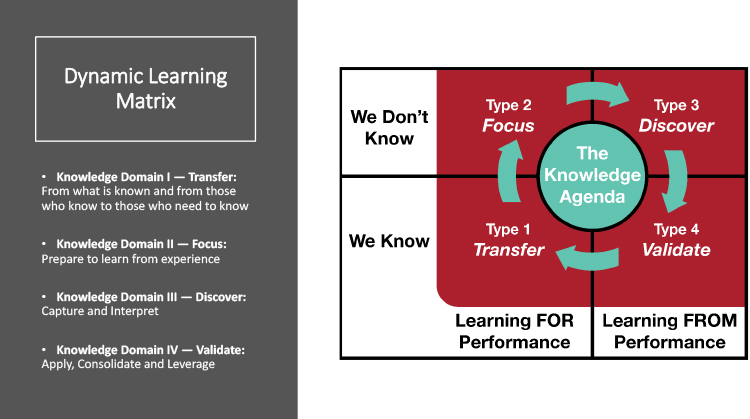
As supply chain organizations experiment with AI, it’s important they have a framework for capturing and sharing learnings from both success and failure, what is known and unknown. Boston University’s Dynamic Learning Matrix is an apt paradigm for better understanding knowledge sufficiencies and deficits.
2. Partner with academia. Higher Education is at a crossroads as the “admissions apocalypse” and declining enrollment pressure universities and colleges to seek alternative revenue streams. Executive and enterprise education is a ripe area for growth.
Also, with few exceptions, corporate HR should not be in the business of creating curriculum. Rather, it should be focusing resources on curating the wealth of learning and development content that exists outside the enterprise.
Beyond education, universities are good partners to help beta test versatility in an AI-native world. Future-fit skills include cross-functional collaboration, Critical Thinking, Design Thinking, Agile, Data literacy, Change Management, and AI engineering/fluency among others. Role-playing real-world, future ways of working is a win-win opportunity for both academia and corporate supply chains.
What better way to develop future-fit capabilities than before prospective recruits enter the workforce? Internships and Co-ops are great “feedback loops” to test, learn, and iterate with AI in mind.
The next time your organization engages a university for recruiting or a job fair, go deeper and explore collaboration opportunities around the future of work.
3. Create an internal gig economy. Structured learning (courses, certificates, degrees) builds literacy. But for employees to develop skillset fluency and mastery, they need a space to apply learning on the job in a real-world environment.
Resource constraints remain an innovation challenge within many supply chain organizations. It’s a nature of the function. Supply chain has traditionally been viewed as a back-office cost center. Success was predicated on process optimization and defect elimination. Roles were specialized and static. There was an aversion to experimentation and failure.
Times are changing. As digital transformation reshapes legacy systems and processes, supply chain functions need to become more innovation-oriented. How do you meet the day-to-day needs of the business while allowing time for employees to grow and develop future-fit skills? Or train for new roles?
Oftentimes enterprises will outsource special projects to third-party consultants, thereby losing valuable on-the-job learning experiences, and failing to address the root cause problem.
Instead, organizations should develop “bifocal” supply chain practitioners—versatilists who can manage work up close and personal day-to-day, then flip the switch after “end of quarter” and support other forward-looking projects.
For inspiration, they should look at how data culture has evolved. Analysts, engineers, scientists, and translators/journalists often double hat, flowing to work and need.
Incentivizing employees to stretch roles is key. As one example, CPG manufacturer Unilever created an internal job marketplace to help individuals develop new skills. Teams in need of flexible resourcing created specific roles/tasks. Employees with extra bandwidth could apply for “gigs” and expand their developmental goals.
The challenge with this type of program is administrative. Leadership needs to buy into the idea employees are not contributing 100% to one role.
Similarly, key performance indicators (KPIs) have to be aligned to encourage double-hatting. And lastly, HR needs to identify ways to track and measure performance across multiple teams, projects, functions, and managers.
4. Build a community of practice around AI and innovation. Articulating the What, Why, and How is the cornerstone of any change management endeavor. Rather than hide behind guarded language (co-pilot, human-in-the-loop, hybrid intelligence) and fears of job displacement, enterprises can embrace a future with AI by creating communities of practice where employees openly learn with and educate one another. This dovetails with the bottoms-up meets top-down co-creation approach.
Employee experience platforms such as Microsoft 365 and Salesforce’s Slack provide space where employees can crowdsource and chat about news and trends. Candid conversations and dialog about AI and future use cases can allay employee concerns. It similarly serves as a feedback loop for leadership and HR to better understand concerns and identify new ideas for exploration.
Building social communities of practice also helps underscore the importance of upskilling. Employees should be encouraged to share their experiences, helping to validate the best learning and training curricula. In a positive way, peer pressure can sway others to want to learn.
Much of what Taiichi Ohno created in the Toyota Production System was inspired by others: learnings from his predecessor Sakichi Toyoda’s auto-activated textile weaving machine as well as Henry Ford’s moving assembly line. He was a bricoleur who borrowed from the past to drive a new vision for the future.
The impact of AI on business culture is at the forefront of today’s corporate conundrum: Do enterprises react to how technology changes the way they do business? Or do they proactively shape new ways of working in concert with AI?
It’s not a simple answer. One might argue organizations need to react first, capture learnings, then proactively rethink processes, roles, and ways of working before mainstream scaling. This follows the sequencing innovation paradigm.
Again, perhaps the past portends the future. Ohno’s view of Jidoka (Autonomation) was both reactive and proactive. It’s a principle that translates to “automation with a human touch.” Sound familiar? Technology detects errors, then humans intervene and course correct before those mistakes are replicated down the line.
AI will no doubt supersede Ohno’s elegantly simple ideals. But his instructions are worth reflection. Human-in-the-loop AI presents a burning platform to transform supply chain culture. What is culture? It’s the instinct to behave and act in a certain way without thinking about it.
Like Jidoka, enterprises that take the time early on to learn, iterate, and recalibrate with the human at the center of their AI designs will realize sustaining value in the long run.
Rethinking AI
Supply chain organizations should take a page from the past and re-think talent, processes, and culture around Artificial intelligence, focusing on human-centered change management rather than simply reacting to technology deployments.
Recommendations:
Keeping humans in the loop starts at the beginning of AI scoping and feasibility. Use Design Thinking and Agile principles to deconstruct processes, identifying tasks and decision-making that can be easily automated while prioritizing human intervention.
Develop flexible, cross-functional talent and build broader Plan-Source-Make-Deliver knowledge. Future-fit versatilists will flow to work in AI-enabled, demand-driven supply chains.
Leadership should have a framework for action but empower bottom-up decision-making. Meeting in the middle and encouraging workers to have a voice in co-creating new ways of working is a critical success factor in change management.
Build organizational mechanisms for continuous on-the-job learning, including:
- Internal gig marketplaces
- Market intelligence communities of practice
- University partnerships
- Peer-learning networks
Footnotes
1. Gartner, Gartner Says AI Ambition and AI-Ready Scenarios Must Be a Top Priority for CIOs for Next 12-24 Months (2023)
2. Joe O’Reilly, The Evolution of Inbound Logistics (Inbound Logistics, 2008)
3. Gartner, Inside the Concept of Versatilists: What Are They and How Do CIOs Develop Them? (2008)
4. OMP, How P&G is building the supply chain of the future, one decision at a time (2026)
5. Gartner, Survey Shows Just 36% of Chief Procurement Officers Are Very Confident in Ability to Redesign Function for AI (2026)