
Dimerco’s Jeffrey Shih on Navigating Cargo Risk, Geopolitics, and Next-Gen Logistics
October 8, 2026 | By Amy Roach
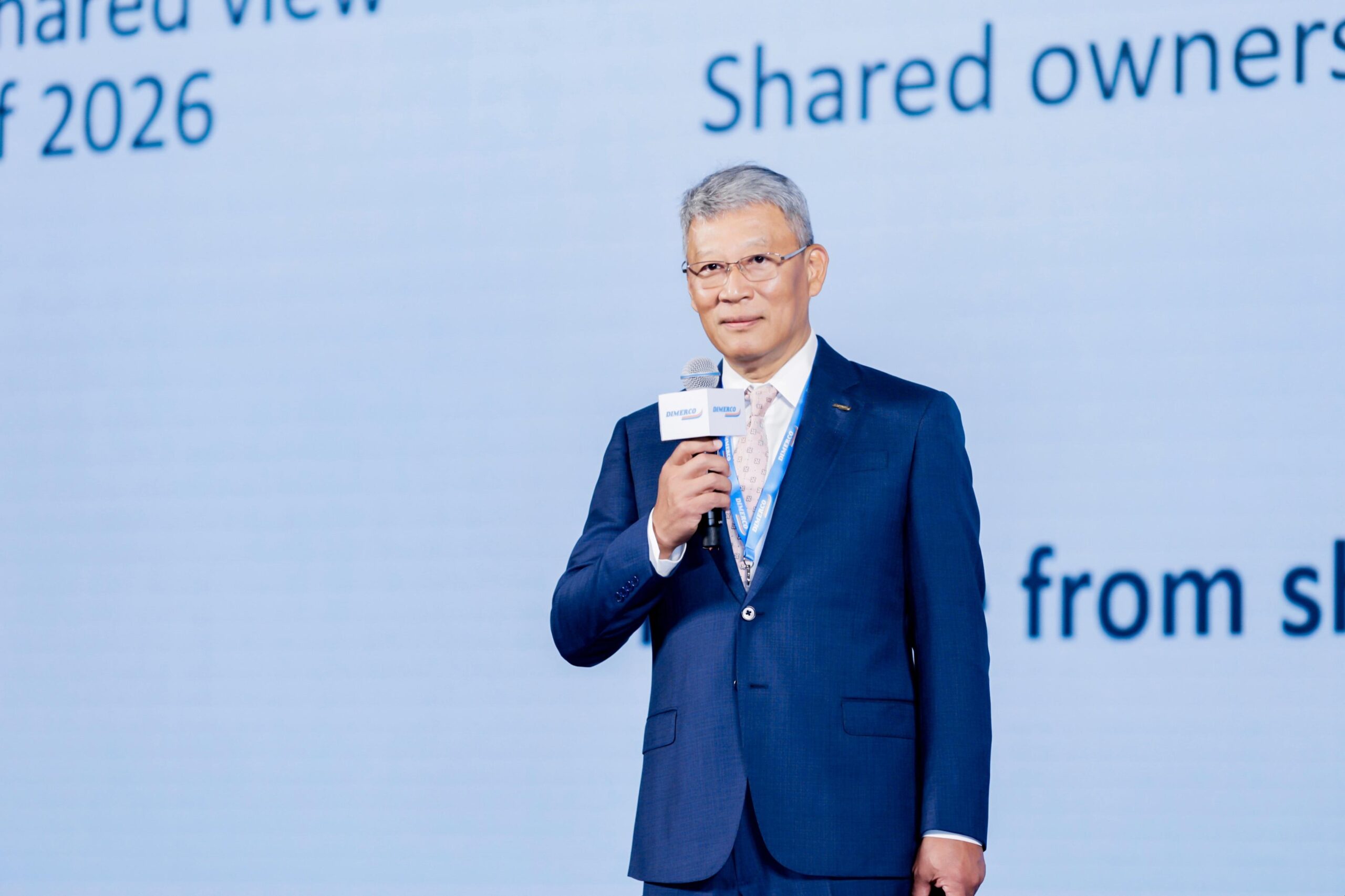
 When Dimerco Express Group CEO Jeffrey Shih speaks about global trade, he does so with the perspective of someone who has spent decades on its front lines, having joined Dimerco in 1988. Speaking directly to Inbound Logistics on the sidelines of the ASCM CHAINge conference last week in Long Beach, Shih shared his take on the current operating environment, high-tech cargo security, tariff maneuvering, and how freight forwarders are leveraging technology to protect their bottom lines.
Here are some key takeaways from our conversation.
The Evolution of Scale and Automation
Reflecting on the conference’s underlying theme—turning complexity into capability—Shih views today’s ocean shipping landscape through a lens of historical scale.
“Thirty years ago, a container ship carried 4,000 to 6,000 TEUs. Today, we are looking at vessels carrying 16,000 to 24,000 TEUs,” Shih noted. “If you don’t have automation and efficiency, you simply can’t handle that volume without continuous port congestion.”
Recalling his early days observing port operations in Oakland during the early 1990s, Shih pointed out that experienced crews working manually could unload roughly 24 to 28 containers an hour. Today, automated terminals regularly push past 35 containers per hour. Pointing to mega-hubs like Shanghai’s Yangshan Port and Singapore, Shih stressed that automation is now required to keep global trade moving.
High-Value Cargo in the Crosshairs
With high-tech and semiconductor logistics accounting for roughly half of Dimerco’s customer base, Shih highlights cargo theft as one of the most urgent operational risks facing shippers today.
In the U.S. alone, cargo theft has surged, averaging more than 200 reported cases per month, with California and Texas representing the heavy majority of incidents. Electronics remain the top target.
“The stakes are higher now because the value density of tech cargo has skyrocketed,” Shih explained. “A single crate of AI server infrastructure—like Nvidia’s Blackwell architecture—can run around $3 million. Next-generation units like the Vera Rubin lines are estimated at over $7 million per crate. If something goes missing, it’s a massive loss.”
To counter this, forwarders and shippers are embedding covert IoT tracking devices inside crates and pallets rather than just tracking the truck. These sensors allow real-time monitoring of route deviations and strict stop limits. “If a driver stops for more than 10 minutes outside an approved zone, the system alerts the team immediately so law enforcement can be notified,” Shih said.
Realignment Beyond “China Plus One”
Addressing the trade friction and tariff structures lingering between the U.S. and China, Shih takes a pragmatic view. “China Plus One” strategies have pushed manufacturing into Southeast Asian nations like Vietnam, Thailand, Malaysia, and Indonesia, and trade lanes have adapted into multi-node supply networks.
Shih noted that shippers routinely route components through hubs like Singapore or Indonesia for secondary processing or final assembly before shipping to North America, helping optimize import duties legally through local value-add production.
Meanwhile, India is rapidly stepping into a primary role. “In the past, people referred to China as the dragon and India as the elephant because things moved slowly,” Shih said. “Now, major semiconductor and hardware cooling suppliers are expanding rapidly across India. It will be a major engine for global growth.”
Despite geopolitical headlines, Shih remains confident in the core commercial ties between the world’s two largest economies. “They compete, but they also must cooperate,” he said of China and the U.S. “Over 50% of the revenue for many top American high-tech companies comes from Asia. The interdependence is real.”
Using AI to Manage Currency and Financial Risk
Shih is bullish on AI, seeing its most critical near-term application inside the freight forwarder’s “financial nerve center.”
In international logistics, currency fluctuations present constant exposure. U.S. clients typically pay in U.S. dollars, but local terminal fees, road freight, and origin costs must be settled in local Asian currencies, he explained.
“When you are handling major accounts spread across Singapore, Taiwan, Korea, Malaysia, and China, you are dealing with five different currencies simultaneously,” Shih pointed out. “A well-managed currency hedge can save a million dollars a year, but a sudden shift or delayed payment can quickly turn into a loss.”
Dimerco is applying AI algorithms to track real-time credit limits, customer payment trends, and cross-border currency exposures automatically. By flagging risk before it impacts margins, executives can decide whether to adjust credit terms or rebalance local currency holdings before a loss occurs.
Strategic Partnerships Take Precedence
“Traditionally, logistics was transactional—you ask for a rate, we quote a rate,” Shih said. “But with today’s supply chain complexity, shippers need true strategic partners who understand end-to-end duty mitigation, compliance, FTZ warehousing, and secure last-mile delivery. Saving 1% on duty or avoiding a single high-value theft event saves far more money than shaving a few dollars off a freight rate.”