
2026 Peak Season Tips and Takeaways

Peak season 2026 is upon us. Using lessons from this holiday season can help retailers build more resilient supply chains year-round.
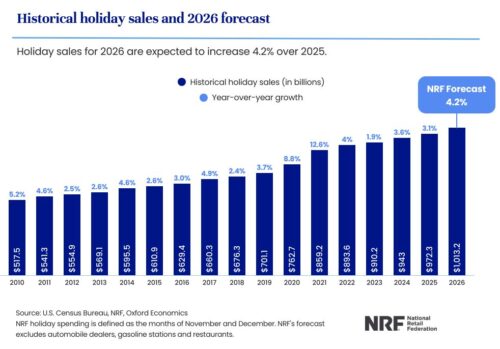
Retail sales in November and December 2026 will grow 4.2% over 2025, predicts the National Retail Federation in its annual holiday forecast.
That translates to total spending of $1.013 trillion. By comparison, last year’s holiday sales rose 3.1% over 2024, totaling $972 billion.
“Retailers are prepared to meet that demand with competitive prices, value, and choices for every budget,” says NRF President and CEO Matthew Shay.
Similar to 2025, retailers remain cautious amid higher gas prices, persistent inflation, higher interest rates, and elevated consumer debt, resulting in a measured approach to seasonal hiring.
For etailers, on-time delivery tops the list of peak season priorities. Supply chain decision intelligence provider project44 found that more than half (54%) of the 2,470 consumers it surveyed for its 2026 State of Consumer Holiday Shopping Report would pay higher prices to guarantee their gifts arrive in time for the holidays.
On-time delivery can present a challenge, with 39% of shoppers telling project44 they plan to start holiday shopping in mid-November or later. Additionally, most (76%) plan to select home delivery, 33% a locker or pickup location, and 29% buy online, pick up in store. (Shoppers could choose more than one option in the survey.)
Here are some tips for retailers navigating the holiday season:
[ ] Make promises supported by data.
“Great customer experience is a promise kept.
The holiday season is a significant opportunity for retailers to win new revenue and earn loyalty. That starts with seeing the risk before the customer does: the exception, the carrier running behind, the condition the order arrives in. My advice for the next few weeks: promise only the dates the data supports, and act before the customer feels it.”
–Jett McCandless, Founder and CEO, project44
[ ] Diversify your carrier mix and optimize contracts.
“First, have a second (or third) carrier that is integrated with your systems and already handling a steady share of daily volume. Then, scaling it up in November is a routing change, not an onboarding project. Regional carriers and USPS often handle residential lanes for less than the national carriers.
Some national carrier peak programs also tie surcharges to how far your volume rises above your own baseline, so spreading growth across carriers can keep you under the thresholds that trigger the steepest charges. None of that helps if you wait because a carrier you’ve never shipped with won’t find capacity for you in week 47.
Second, read your contract before you move a single package. Most parcel agreements tie earned discounts to rolling spend. Shift a meaningful percentage of volume to a regional carrier, and you can drop into a lower tier with your primary, which can erase the savings you went looking for. Model that before you act.
Next, negotiate the terms that matter. Ask for tier protection while you test new carriers. Push for caps or waivers on peak and demand surcharges. Accessorials like residential, delivery area, and additional handling charges are where peak invoices grow, and they get far less negotiating attention than the base discount.
Last, audit every invoice through the season. Surcharge billing errors rise when networks are strained or pricing changes go into effect, and most shipping teams are too busy in December to catch them. Recovering those dollars is the cheapest savings available all year.”
–Matt Huckeba, Chief Strategy Officer, Evans Transportation
[ ] Leverage supplier data to identify risks that could disrupt production during peak demand.
“Supply chain risk management shouldn’t end when the holiday rush does. Once peak season subsides, brands should assess supplier delays, capacity constraints, and compliance issues to identify vulnerabilities exposed by increased demand.
This is also an opportunity to update supplier data, reevaluate sourcing dependencies, and strengthen contingency plans for the year ahead. Using lessons from peak season can help retailers build more resilient supply chains year-round.”
–Brittany Sizemore, Senior Vice President, Transparency-One, an ISN company