
2026 Inbound Logistics Perspectives 3PL Market Research Report
The 21st annual 3PL market survey breaks the news about how third-party logistics providers and the shippers they serve navigate headline-making trends and developments in the sector.
Each year, the Inbound Logistics 3PL Perspectives report captures the state of outsourced logistics and reveals how both third-party logistics providers and their shipper customers view the most important trends, challenges, and opportunities in the field.
The big scoop for this year’s report is that 3PLs thrived as sales, profits, and customer bases all grew at healthy rates—and for some providers, that growth was robust.
The fine print reveals that rising revenue is more evidence of the growing importance of 3PL partnerships for shippers. When breaking news signals closures or disruptions, 3PLs ensure shippers’ operational continuity, rather than shutdowns and blown deadlines, is their top story.
Also, in the headlines on the 3PL beat, the survey reveals that many of the same challenges that have consumed 3PLs remain firmly in place while others appear to have shifted.
In particular, 3PLs continue to battle to manage upward pressure on operational costs, leading them to prioritize efficiency. Meanwhile, capacity issues and compliance burdens emerged from the back pages to take a more prominent place among the challenges on the minds of 3PL leaders. Fortunately, 3PLs indicate that the issues that they have had for years finding, training, and retaining labor are no longer as daunting.
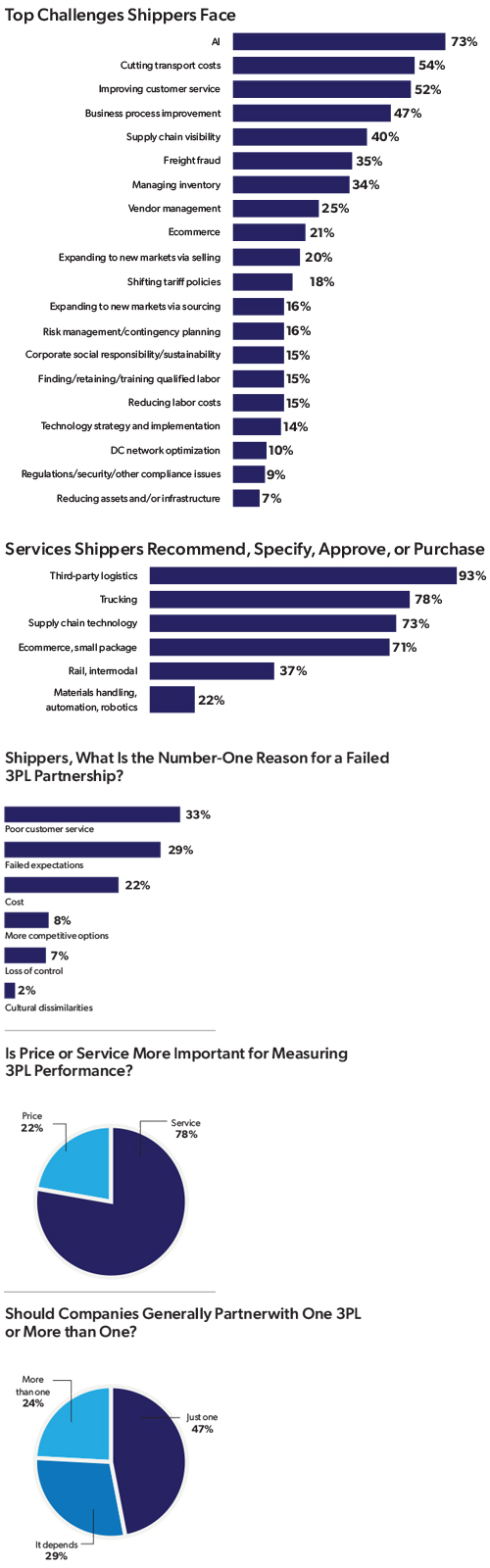
Meanwhile, artificial intelligence and the push for visibility-enhancing technology solutions solidified their place on the front page. In fact, the lead takeaway from shipper respondents may be that they view deploying AI as the most important challenge they face today, though cutting transport costs and improving customer service also loom large.
In comparison, 3PLs indicate AI is the top disruptive innovation but on their list of challenges, they assign it a less prominent spot with only 50% citing it as a challenge, indicating optimism about the technology. One thing is for sure: Strategic foresight and flexibility are necessary to navigate a supply chain landscape that is never settled.
ABOUT THE 3PL RESPONDENTS
After you read this report, take a look at the list of the Top 100 3PLs for 2026 to learn more about the leading providers in the industry and the variety of ways they guide shippers through the ever-increasing complexity of the modern supply chain.
The Story Behind The Profit Picture
One 3PL respondent that had enviable growth of more than 20% in both sales and its customer base reports a healthy but lighter increase of approximately 15% in profits, shedding light on bottom-line pressures.
“From a top-line perspective, we have continued to add new clients and expand relationships with existing customers, particularly those with complex fulfillment needs,” a company representative revealed in our survey. “This has led to consistent increases in order volume and overall sales throughput. At the same time, the broader parcel shipping environment has introduced meaningful cost volatility—most notably through rising fuel surcharges. Because fuel surcharges apply not only to base transportation but also to accessorial fees, the total cost impact is amplified.”
About the 3PL Survey Takers
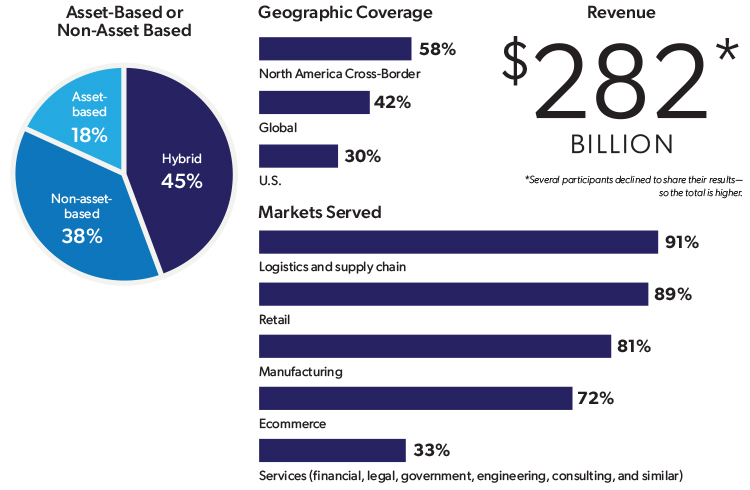
In this year’s 3PL respondents group, 45% are both asset-based and non-asset-based—a notable change from 2025 when 57% of respondents represented that hybrid category.
Meanwhile, 38% were non-asset-based and 18% were solely asset-based. In terms of geographic reach, most respondents (58%) have cross-border coverage in North America, while 42% are global and 30% focus on the United States.
The top market for our survey’s providers was logistics and supply chain as 91% of respondents serve that category. Retail (89%, up 6 percentage points from 2025) and manufacturing (81%) remain popular areas of business for 3PLs, and ecommerce is entrenched in the fourth spot at 72%. The services market (financial, legal, government, engineering, and consulting) represents a smaller niche for 3PLs, as just 33% of survey respondents report working with companies in this category.
Covering a Wide Range of Services
3PL Offerings
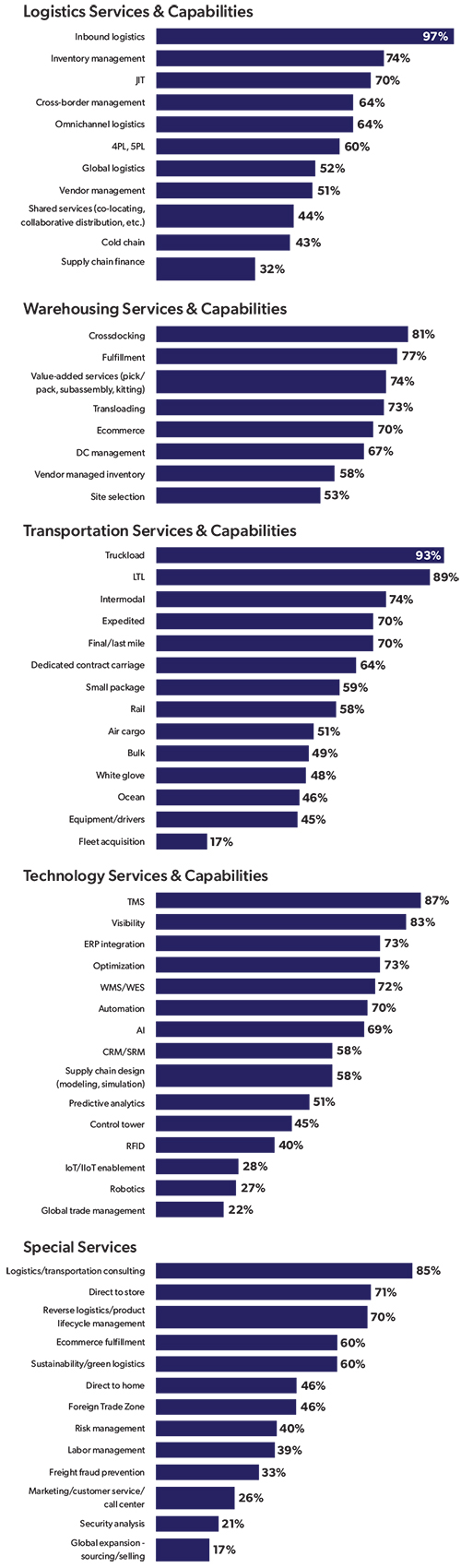 The logistics services and capabilities offered by the 3PLs surveyed vary widely, but they start with some foundational offerings . In particular, 97% of respondents provide inbound logistics for clients. Inventory management (74%) and just-in-time support (70%) are the other services most frequently cited.
Services that are not as widely available include shared services (co-locating, collaborative distribution, etc.) at 44%, cold chain at 43%, and supply chain finance (payment auditing/processing claims) at 32%, suggesting they currently are more specialized offerings.
Among warehousing services and capabilities, the top offering is crossdocking at 81%. At least two-thirds of respondents include fulfillment (77%), value-added services (74%), transloading (73%), ecommerce (70%), and distribution center management (67%) among the services they provide.
Truckload (93%) and LTL (89%) are the top transportation services and capabilities of participating 3PLs. Intermodal (74%), expedited (70%), and last mile/final mile (70%) round out the top 5. A much rarer service to find was fleet acquisition, which only 17% of respondents say they provide.
Technology services and capabilities are an integral component of 3PLs’ work these days, and their most popular tech offerings are TMS (87%) and visibility (83%) with ERP integration (73%), optimization (73%), and WMS/WES (72%) making up the rest of the top 5.
Interestingly, sustainability/green logistics, which had seen a decline of 12 percentage points in the 2025 survey, seemed to regain its footing among providers, rising 6 points to 60% to be locked in a tie with ecommerce fulfillment for fourth in the special services category.
Rising Revenues For Most Respondents
3PL Financial Picture
During your last measurement period,
were the following up or down?
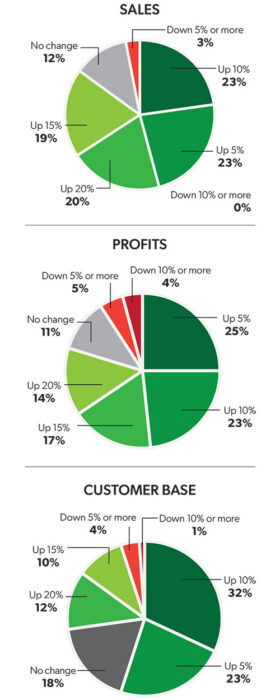
Third-party logistics providers enjoyed healthy growth and financial returns, according to our respondents.
In their most recent measurement period, 84% say they experienced sales growth, including 62% saying their sales rose 10% or more. This is a sharp increase from one year ago when 70% enjoyed growth in sales, including just 47% seeing at least 10% growth.
Profits are similarly strong, though are held back by increased costs in some areas as nearly 80% report profit growth, including 54% that topped 10%. This again reflects a marked improvement from 2025 when 69% surveyed had enjoyed an increase in profit, of which just 38% crossed the 10% mark.
What’s more, sales and profit growth aligned closely with providers taking on more clients. Seventy-seven percent of respondents grew their customer bases during their most recent measurement period, including 54% of providers adding at least 10% more customers.
One 3PL in the 10% or more growth in sales and profits categories says that what they called a market recovery had allowed their sales efforts from 2024 to come to fruition in 2025.
Another 3PL that had seen similar growth says it expanded more services in the end-to-end supply chain continuum and added markets. “This includes the addition of parcel program management, enhanced transportation management, and a new, state-of-the-art facility,” they said.
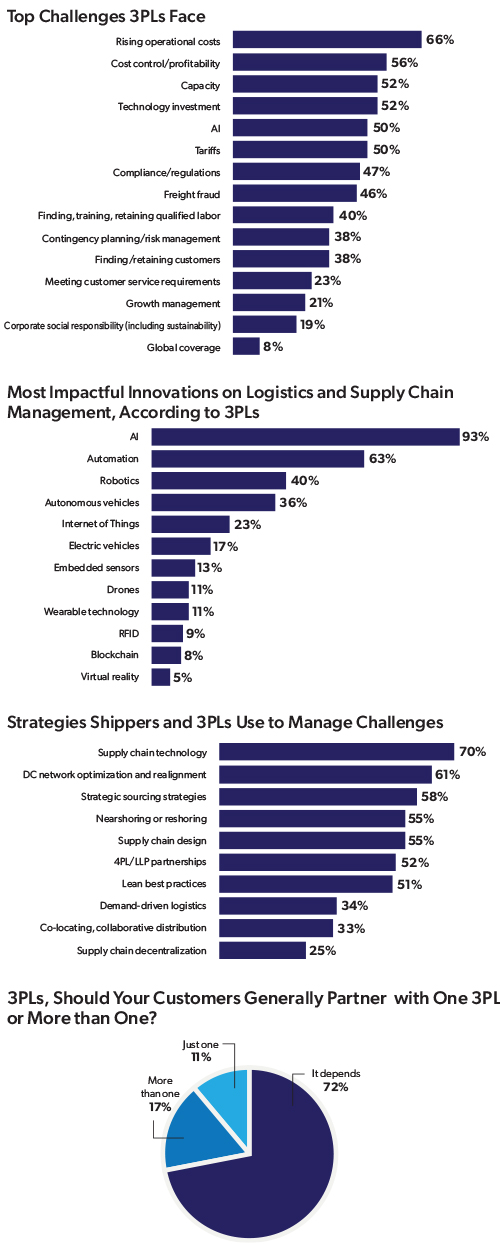 3PLs agree that rising operational costs are among their chief challenges with 66% of respondents citing it as a top concern (see Challenges chart on page 86). That’s a rosier view than one year ago, though, when 72% of those surveyed listed it. At least half of providers also see cost control/profitability (56%), capacity (52%), technology investment (52%), AI (50%), and tariffs (50%) as major challenges for the sector.
Particularly noteworthy is capacity’s arrival in the top 5 as one year ago just 31% of those surveyed identified it as a key challenge. Also, compliance burdens emerged as a bigger challenge in the field. In 2024 and 2025, 40% and 43% of respondents, respectively, cited regulations as a concern, and this year that number grew to 46%.
Heading in the other direction, finding, training, and retaining labor has been a major talking point in the industry in recent years, but this year’s survey has some positive signs as 40% of respondents call it an important challenge—down 6 points from 2025 and nearly 20 points overall since 2023.
How do 3PLs and shippers contend with these and other current market challenges? Most 3PL respondents (70%) point to supply chain technology as an important part of the solution. DC network optimization (61%) also is a popular pick. On the other end of the spectrum, only 25% of respondents view supply chain decentralization as a go-to approach for today’s challenges.
Shipper Side Survey Results
 Surprising no one is that artificial intelligence at 93% is again the overwhelming frontrunner as the disruptive innovation poised to have the greatest impact on logistics and supply chain management, according to 3PL respondents. Automation also is a resounding pick at 63%.
Autonomous vehicles, meanwhile, are not on respondents’ minds as prominently as one year ago with 36% indicating they are among the innovations likely to have the greatest impact, a decline of 10 percentage points from one year ago. Also taking a step back is blockchain, which dropped 10 points to 8% from 2025 and is now down 20 points over the past two years.
For shippers, implementing AI is the most important challenge they face today with 73% of shipper respondents citing it. Cutting transport costs (54%), improving customer service (52%), business process improvement (47%), and supply chain visibility (40%) are other pressing challenges that shipper respondents note. “Mid-market shippers are under sustained pressure from volatile capacity, rising operating costs, and tariff-driven sourcing shifts,” one 3PL respondent observes.
Shippers continue to prioritize service over price with 78% of respondents pointing to service as more important when measuring 3PL performance. The top reason shippers list for a failed 3PL partnership is poor customer service (33%) with failed expectations (29%) again close behind in second place—further highlighting the value that shippers place on service from 3PLs.