
2026 Perspectives and Market Research: Logistics IT Accelerates

In IL’s latest survey, technology providers reveal demand for their services continues to ramp up and AI’s role in their offerings grows more powerful.
The appetite for advanced supply chain and logistics technology solutions continues to be ravenous with no sign of easing in sight as shippers and their partners seek the tools to manage an increasingly complex and rapidly evolving world.
Inbound Logistics’ latest survey of the supply chain and logistics technology market shows an industry that is enjoying enviable demand for their services. For instance, 65% of respondents report sales growth of 10% or more year-over-year, and 52% saw their customer base grow by 10% or more.
The trends fueling that growth are multifaceted.
“The demand for advanced supply chain, logistics, and transportation technology is accelerating as organizations confront persistent labor shortages, supply disruptions, sustainability pressures, and rising customer expectations,” says Lucy Griffiths, senior marketing manager for Blue Yonder, a provider of supply chain management solutions with headquarters in Scottsdale, Arizona. “These challenges expose the limits of fragmented, function-specific systems and underscore the need for end-to-end, AI-driven platforms that connect planning, execution, and the extended supply chain network in real time.”
The convergence of the B2C, B2B, and omnichannel fulfillment models increasingly drives the logistics sector’s growth, says Bobby Kaemmer, vice president of supply chain services for Cadre Technologies, a provider of warehouse management solutions and supply chain visibility tools based in Denver, Colorado.
“As customer expectations rise and order profiles become more complex, shippers and 3PLs are investing in flexible warehouse operations capable of scaling quickly while maintaining accuracy and efficiency,” Kaemmer says. “This shift is pushing many 3PLs beyond traditional B2B models and accelerating demand for advanced warehouse management solutions, automation and intelligent tools that support evolving workflows, and data-driven decision-making.”
Meanwhile, the current era has been marked by a series of disruptions that affect supply chains across the world and prompt companies involved in the field to turn to technology for help.
“Global volatility continues to drive interest in technologies that support scenario analysis and network adjustments,” notes Matt Waldman, senior marketing manager for Americold, an Atlanta-based temperature-controlled warehousing and distribution services provider.
The increasing availability and capabilities of artificial intelligence is at the center of it all.
“Artificial intelligence is now foundational, enabling innovations in network-level orchestration, transportation optimization, warehouse automation, and intelligent order fulfillment, all grounded in a single data model and shared source of truth,” Griffiths says.
IL’s annual survey of a broad assortment of logistics and supply chain technology providers offers a revealing look at their current views of the marketplace. We compile and analyze their responses to yield insights that can help to inform you about the technologies that can bring your operations to new heights—and to learn what is coming next.
Here are some notable results from the 2026 survey.
INDUSTRY
What industries/verticals do your solutions serve?
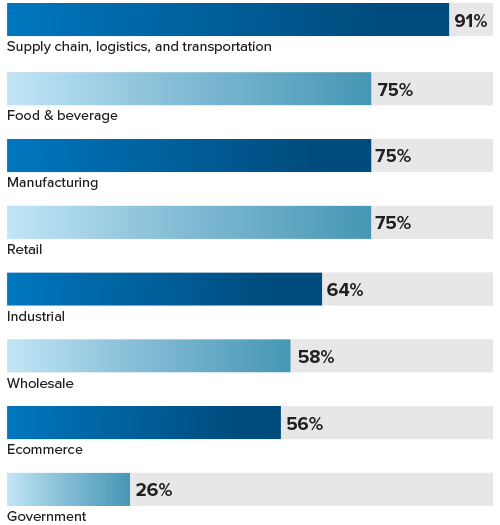 Supply chain, logistics, and transportation continues to hold steady as the vertical category that vendors most frequently serve, with 91% of survey participants saying they work with that industry, the same percentage as last year.
In general, the industries served by vendors appear to have remained fairly consistent in recent years. Food and beverage rose 2 percentage points to 75% this year to move into a tie for second with manufacturing (down 6 points) and retail (down 3 points).
The next tier of industries/verticals features industrial (64%, down 3 points from last year), wholesale (58%, down 3 points), and ecommerce, which dropped 8 points to 56% and notably has fallen 10 points over the past two years even as the overall ecommerce market has continued to grow.
At just 26%, government remained a distant eighth among the industries, as it has been each of the past two years.
SOLUTIONS
What logistics and supply chain solutions do you offer?
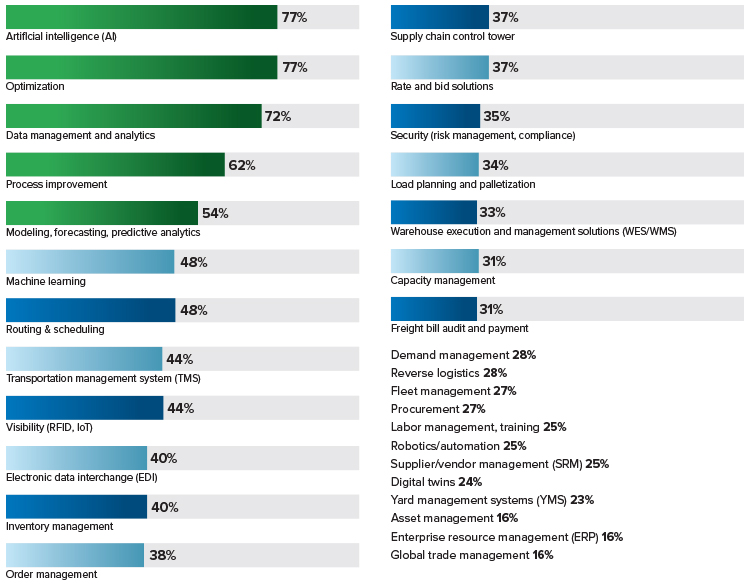
Artificial intelligence solidified its hold on the industry in the past year, and 77% of respondents now say they offer AI solutions—up 6 points from last year and 27 points from just two years ago. Optimization also gained 6 points, keeping it in a tie at the top with AI among solutions for another year. Data management and analytics, which gained one point to 72%, fell from that three-way tie in first into a solitary third place, but still is up 9 points in two years.
That growth over the past two years is in alignment with AI’s growth, too.
“Data management and cybersecurity is increasingly important, especially as companies navigate the evolving role of AI,” says Trevor Read, president of Agistix, a supply chain technology provider based in San Mateo, California. “Whether building custom AI tools or integrating existing tools into supply chain workflows, managing data security protocols is essential.”
Some of the other most prominent solutions also gained a growing foothold in the field in the past year. For instance, process improvement gained 5 points to 62% to remain in fourth place; modeling, forecasting, and predictive analytics gained 7 points to 54% and fifth place; and machine learning (a subset of artificial intelligence) jumped 7 points to 48% and a tie for sixth place with routing and scheduling (up 2 points).
Still lower down the list, security (risk management, compliance, etc.) jumped 15 percentage points to 35% over the past year, the largest increase of any of the solutions, reflecting an expanding focus on that area for the supply chain and logistics field. Less dramatically, supply chain control tower grew 6 points to 37%, demand management grew 5 points to 28%, procurement grew 6 points to 27%, and labor management and training grew 5 points to 25%.
“Demand is rising fastest for technologies that reduce fragmentation and improve execution across the supply chain,” says Alex Rigo, senior sales director for Banyan Technology, an Ohio-based provider of freight management software. “By function, the strongest growth is in transportation execution and visibility, AI-enabled planning, warehouse automation and integration infrastructure that connects disconnected systems.”
Technology vendors are not simply adding solutions to their offerings. Some solutions are being cut because of a lack of demand or not offering vendors enough bang for their buck as they shift in other directions. For instance, in a tie for eighth among offered solutions, transportation management systems fell 7 points to 44% in this year’s survey, and visibility (RFID, IoT, etc.) has plunged 22 points from 2023 to 44%.
Also seeing a precipitous fall over the past two years is order management. Two years ago, it was the fifth most-offered solution at 54%, but it has fallen 16 percentage points since then and now sits in 12th place with 38% of vendors offering it.
Others to see a notable ebb in the marketplace include electronic data interchange (down 8 points to 40%) and asset management (down 6 points to 16%).
CHALLENGES
Which supply chain, transportation, and logistics challenges are the most critical for your customers?
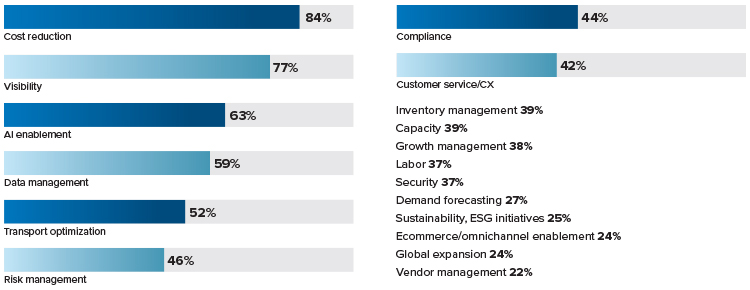
Cost reduction remains the top challenge for technology vendors’ customers, with 85% of respondents citing it, an increase of 5 percentage points over last year. However, a number of other challenges are in the foreground for customers, including some that are growing rapidly in importance. Perhaps the most notable—and least surprising—of these challenges is AI enablement, which was the third most-cited challenge at 63%. That’s a robust 16-percentage point jump from last year’s survey. Its rise is especially stark because it was not even among the options for respondents to consider two years ago, when AI had not yet surged into ubiquity.
Visibility (second most-cited) and data management (fourth most-cited) are also seeing strong growth with increases of 5 and 9 percentage points, respectively, over the past year. Meanwhile, labor has fallen 11 percentage points to 37% over the past two years, and sustainability and ESG initiatives continue to shrink from prominence in the current climate, dropping to 25% with this year’s survey—down 8 points from last year and 16 points from two years ago.
SALES
During the last year-on-year period, were sales generally up or down? About how much?
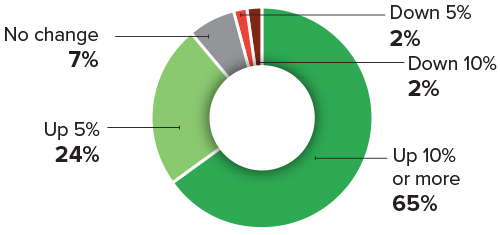 The most notable change from 2025: 65% of respondents saw sales growth of 10% or more during the most recent year-on-year period—up 7 points from last year.
PROFITS
During the last year-on-year period, were profits up or down? About how much?
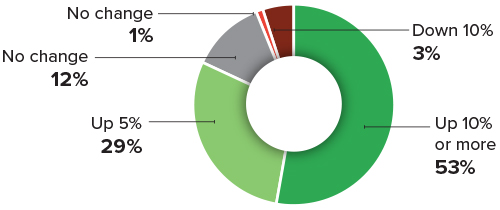 Sales growth did not necessarily correspond with a growth in profits for vendors. In this year’s survey, 53% of vendors reported profit growth of 10% or more—down 2 points from last year—while 29% were up 5%, holding steady from one year ago.
GROWTH
What led to growth in the past year?
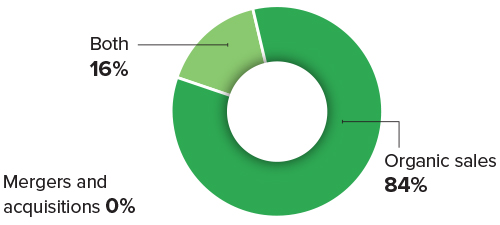 Organic sales represented a smaller portion of vendors’ growth in this year’s survey. While one year ago, 90% said organic sales was what led to their growth, this year that number has fallen to 84%. Meanwhile, the other 16% of respondents pointed to a combination of organic sales and mergers and acquisitions. That left no respondents attributing their growth to M&A activity alone, compared to 1% in 2025.
CUSTOMERS
During the last year-on-year period, did your customer base grow or shrink? About how much?
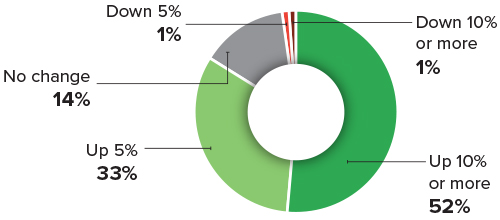 Supply chain and logistics technology providers continue to find plenty of customers for their products overall—and, in fact, to find more and more of them. Of this year’s respondents, 52% reported seeing their customer base grow by 10% or more, the same as one year ago. There was a small reshuffling among the vendors with 33% seeing growth of 5%, which was a decline of 3 points from last year, while 14% did not see their customer base grow, an increase of 5 points.
Just 1% of vendors experienced a shrinkage of 5% or more of their customers, and just 1% reported losing 10% or more of their customer base.
Embracing AI
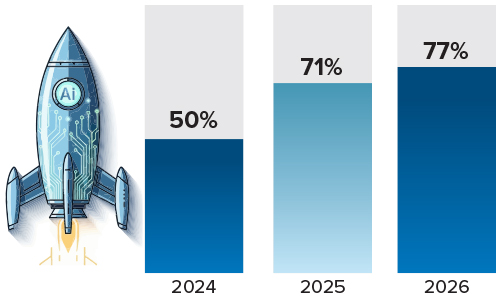 Most vendors (77%) offer artificial intelligence among their logistics and supply chain solutions—marking a quick ascent for the now-foundational technology.
Customer Spotlight
“We see strong and growing demand from small and mid-sized manufacturers across the United States, particularly in food and beverage, chemicals, health and beauty, and industrial manufacturing for supply chain technology that tightly connects inventory, production planning, quality management, and real-time job costing.
“Functionally, manufacturers are prioritizing systems that improve raw material visibility, automate inventory and warehouse operations, enable accurate scheduling based on material availability, and provide real-time cost and margin insight at the job and batch level. This demand is pronounced among SMBs (small and mid-sized businesses) seeking to reduce manual processes, support regulatory and quality requirements, and protect margins amid labor constraints and volatile input costs.”
Kelly Peters
Director of Corporate Communications & Brand, ECI Software Solutions,
a cloud-based ERP technology provider