
AI in Supply Chain Management: How Useful Will It Be in 2026?

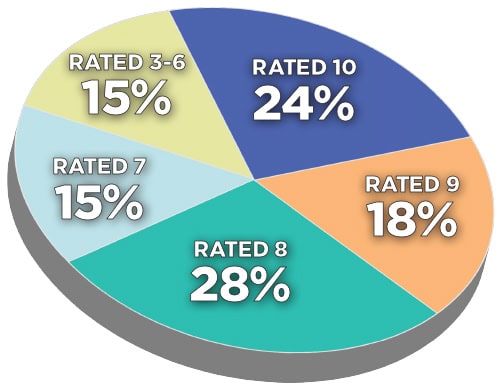 Rating Highly
Readers rated AI’s expected usefulness on a scale of 1 to 10 (with 10 being transformative). Note: Fractions were rounded up.
Average rating: 8
Range of answers: 3 to 10
 Artificial intelligence will be transformative—driving forecasting, inventory optimization, and decision-making. It’s also powering digital twin roadmaps by connecting AI-driven forecasts to simulation models for smarter, faster decision making.
–Brett Webster
Director, Product Management
Dematic
AI will replace most manual processes in supply chain management and may become the new operating system.
–Archival Garcia
CEO
Fluent Cargo
Many AI projects will scale in 2026. For example, agentic AI will automate routine communication to improve efficiency. Additionally, AI-driven computer vision will help warehouses process goods faster, reduce errors, and optimize space utilization, raising service levels. AI will be a 10, but that score will vary based on the organization’s AI readiness.
–Eric Walters
VP, Analytics and Performance Management
DHL Supply Chain North America
AI will move beyond simple automation to enable continuous optimization of entire supply networks through hybrid intelligence (human-AI collaboration). With the advancement of simulation capabilities such as digital twins, AI will provide sharper foresight and adaptability.
–Nick de Klerk
Senior Director, Head of Business Operations North America
TMX Transform
10/10. AI will help bridge the industry to modern technological standards and uncover opportunities to enhance the experiences of our customers, carriers, and employees. The supply chain industry generates an immense amount of data, and AI will bring speed to analytical review while helping diagnose and address operational inefficiencies.
–Craig Remley
Vice President of Truckload Operations
Evans Transportation
 AI will be incredibly useful, elevating decision-making and turning reactive operations into predictive, proactive service for shippers and carriers.
–Zach Jecklin
CIO
Echo Global Logistics
AI is proving transformative by enabling real-time, multifactor forecasting that goes beyond historical data. It helps manage SKU proliferation, predict demand shifts, and optimize inventory across channels.
–Anan Bishara
CEO and Founder
Premium Guard Inc.
It will drive supply chain orchestration—transforming data into foresight. Its real value lies beyond visibility, in predictive intelligence and integrated data.
–Catherine Chien
Chairwoman
Dimerco Express Group
AI won’t replace core logistics logic, but it will radically accelerate how we make decisions, spot inefficiencies, and model scenarios. In 2026, its real value comes from targeted applications, like route optimization, ETA prediction, and resource planning. The more specific the use case, the more powerful the result.
–George Maksimenko
Chief Executive Officer
Adexin
AI will be deeply embedded across supply chains: optimizing carrier selection, automating procurement, and personalizing customer visibility. Its usefulness will be transformative, driving cost efficiency, resilience, and sustainability while freeing humans to focus on strategy rather than repetitive decision-making.
–Jason Roberts
SVP, Digital Enablement
MODE Global
 Today it’s improving forecast accuracy, automation, and working capital efficiency. Broader adoption and embedded intelligence will make decisions faster and more adaptive. It reaches 10 when organizations fully trust AI-driven recommendations and redesign workflows around them.
–Jeff Metersky
SVP, Strategy and Innovation
GAINSystems
AI delivers meaningful productivity gains, accelerates decision-making, improves customer service, and reduces waste. But it’s not a set-and-forget solution—strong leadership and governance are critical to achieve continued success in 2026 and beyond.
–Ann Marie Jonkman
VP, Global Industry Strategies
Blue Yonder
AI will drive management innovations, including improving efficiency at the inventory and warehouse management level and allowing for more accurate forecasting, while also optimizing logistics. We will see exponential growth in the use of AI for risk monitoring, including AI-enabled cameras and tools for a proactive approach to potential disruptions.
–Kara Brennion
Consulting Specialist, Supply Chain Security and Risk Intelligence
BSI Consulting
Agentic systems will automate planning and sourcing in 2026. The most transformative use case will be autonomous end-to-end replenishment. It becomes a 10 when humanoid robotics gain scale.
–Balika Sonthalia
Partner and Practice Leader, Strategic Operations, Americas
Kearney
AI will elevate brokerage, cross-border, and managed transportation by enabling smarter rating, predictive visibility, automated compliance, faster exception resolution, and workflow automation that improves service, speed, accuracy, and overall network performance across the 3PL industry.
–Mike Teresinski
EVP Operations, Managed Transportation & Cross-Border
TA Services
Accelerating Supply Chains
 7.5/10. 2026 is the year of practical AI in operations: triaging exceptions, reacting to weather, verifying invoices, tuning routing in real time, sensing demand signals and flexing capacity, and boosting warehouse/driver safety. Broad rollouts will take 1 to 3 years, but the pace is 5-10x faster than one year ago.
–Sai Teja Yerapothina
Sr. Director, Last Mile Delivery
Walmart
 Success hinges on data quality. While AI excels at demand forecasting and route optimization, the real breakthrough will be handling partner data chaos. Data readiness is the barrier.
–Deepak Singh
Co-founder and Chief Innovation Officer
Adeptia
Agents trained for tasks like forecasting or optimization already add value but remain limited to specific activities. Given the speed of innovation we can expect (and hope) that the promise of pragmatic agentic AI, orchestrating agents with humans-in-the-loop, will begin to take shape and create human-centric AI efficiency.
–Jon Lawrence
Chief Product Officer
JAGGAER
Transformative for those who are ready. AI creates real lift where data pipelines and processes are in place. In last mile, models turn execution signals (stop times, time windows, etc.) into tighter plans, typically yielding better route density, on time gains and mileage reduction. Adoption lags, however, due to data quality, integration and governance.
–Cyndi Brandt
VP Fleet Solutions
Descartes
 6/10. AI will automate and enhance many of the planning and managerial tasks, but the physical movement of goods will still serve as a barrier to full implementation.
–Joe Adamski
Senior Director
ProcureAbility
4/10. AI hype peaked in 2025, but results lagged. While machine learning powers automation hardware, broader applications like demand forecasting remain in early stages.
–Jake Heldenberg
Director, Sales Engineering, Warehouse Solutions, North America
Vanderlande
4/10. We see a high degree of misunderstanding and misdirection each day. AI will have a steep learning curve without accurate input.
–Danny Schnautz
President
Clark Freight Lines
3/10. Most organizations will still be figuring out how to use AI, but early wins will include faster detection of demand changes, supply risks, and quality concerns. Planning teams will gain the most as AI improves diagnosis and speeds response.
–Matthew Derganc
Senior Director
SSA & Co.
3/10. There has been so much talk about AI in 2025, with little traction. Next year, we need to keep focusing on how people are moving in the building and dive deeper with how AI can specifically be applied in labor and workflow.
–Robert Nilsson
Chief Commercial Officer
VARGO
We believe AI usage in supply chain management to be accretive through 2026. Companies will initially incorporate internally to maximize profitability to scale while improving their end customer experience through speed of information and service.
–Rob Hammel
Managing Director
KDL Logistics
AI’s potential impact on logistics in 2026 is viewed modestly with a rating of 2.5 to 3.5. While it will continue to influence refinement and boost personal productivity, we don’t foresee it instigating a systemic overhaul. The large language model, in particular, has been the most effective in recommunicating information but currently lacks the capacity to consistently generate novel insights.
–Gary Horton
Chief Operating Officer
ACI Transport
Ranging from 3 to 10

The level of usefulness will be directly correlated with the ability to leverage AI for agentic orchestrations. We need to move beyond information retrieval.
–Shabbir Dahod
President & CEO
TraceLink