
Mastering the Last Mile of Premium, Perishable Food
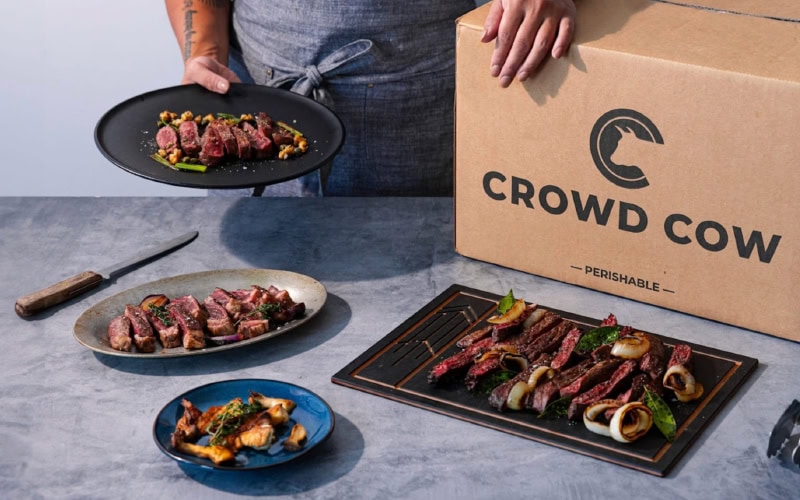
For the past decade, Crowd Cow has partnered with ethical farms, fisheries and other food producers from around the world to source sustainable, quality beef, seafood, pork, and other items. By sourcing from small farms and managing the processing, Crowd Cow can bring its products to many consumers who otherwise might not have access to them. At the same time, Crowd Cow offers many of its suppliers a customer base they might struggle to reach.
THE CUSTOMER
Through its online marketplace, Crowd Cow offers a range of premium food brands, including Wagyu steak, wild tenderloin, and sea scallops. The company provides small suppliers with a wider customer base and allows consumers to customize their product selection and delivery frequency.
THE PROVIDER
Jitsu is a last-mile delivery service that operates in urban areas across the United States for high-volume shippers. The company uses a proprietary AI-powered technology platform to provide reliable, expedited shipping. This service helps logistics teams control their delivery network and ensure a consistent customer experience.
Until recently, however, the delivery companies Crowd Cow worked with often failed to meet established delivery timelines, says Jeremy Sievert, vice president, operations. The company’s products are both premium and perishable, so reliable and efficient cold chain transportation is essential.
To address this, Crowd Cow shifted to Jitsu, a provider of last-mile delivery services for ecommerce firms, logistics providers, and other shippers. After the switch, Crowd Cod’s delivery timelines decreased significantly, Sievert says.
Customers Pick and Choose
Customers visiting the Crowd Cow online marketplace can choose from a range of premium food brands, including wild tenderloin from Frigorifico Pando Farms in Uruguay, beef hot dogs from Pederson’s Natural Beef Farms in Merango, Wisconsin, Wagyu steak that hails from Kagoshima Farms in Japan, and wild Atlantic sea scallops from Bristol Seafood in Portland, Maine.
Customers, including subscribers, can pick and choose which products they’ll purchase and how often they’d like them delivered.
During the pandemic, business “just exploded,” says Sievert. To ensure this growth continues, deliveries have to be consistently timely and accurate.
“The packages are on a clock,” he says. When they’re delivered, all Crowd Cow boxes need to arrive on time, while the products inside are still frozen, and include exactly the items the customers ordered. If this doesn’t occur—for instance, if a box is missing several pork chops or it arrives late and the contents have already started to thaw—the customer likely will end up trekking to the grocery store.
“If we become a hassle, we’re canceled. We can’t afford that,” Sievert says.
Crowd Cow had been struggling to find last-mile carriers that could ensure its services would meet the company’s delivery requirements. One service provider Crowd Cow was using offered only a 70% on-time rate, Sievert says.
In addition to dissuading some customers from future purchases, late deliveries can boost costs. Shipping frozen food products is already expensive, and adding extra ice in case a shipment will be late drives costs even higher.
Crowd Cow began working with Jitsu (previously AxleHire) to handle deliveries on the West Coast, starting with San Francisco, and then adding Los Angeles, Seattle, and Portland. Shortly after that, Crowd Cow added Jitsu’s services in Phoenix and Las Vegas, and then in New York City, New Jersey, and Philadelphia.
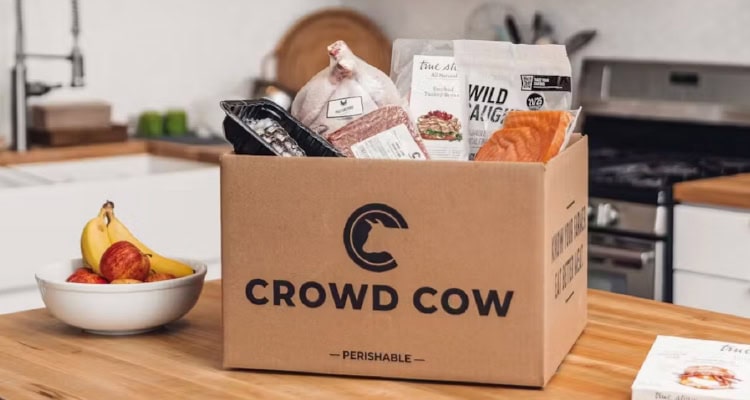
When delivered to customers, all Crowd Cow boxes need to arrive on time, while the products inside are still frozen, and include exactly the items ordered. Partnering with Jitsu for last-mile delivery gives customers a better experience.
Shifting from the company’s previous delivery service providers to Jitsu “gave our customers a better delivery experience,” Sievert says.
Several reasons account for this. To streamline the delivery process, Jitsu has multiple mechanisms in place to ensure the address information provided to its drivers is correct, says Adam Bryant, CEO of Jitsu. For instance, the system incorporates multiple cross-checks to correct any addresses that don’t match an official address. This standardization helps convert an address such as “15 1st St. North” to “15 N 1st St,” and can also correct typos.
In the rare case that a delivery address is inaccurate, the driver can call or message the recipient directly (drivers’ phone numbers are anonymized for privacy) or reach out to the dispatch office for additional information. In many cases, the driver can try to re-deliver that day.
While Jitsu’s service tops that of many other delivery companies, its pricing is competitive. “It’s a win, win, win,” Sievert says.
To ensure that it can quickly move deliveries to customers no matter where they live, Jitsu operates roughly 30 brick-and-mortar sortation and dispatch centers across the United States. The number of facilities continues to grow, typically spurred by client demand, Bryant says.
Goods arrive at Jitsu’s facilities from customer locations that may be anywhere from a few miles to several hundred miles away. As the distance from the shipper to a Jitsu facility increases, so does the minimum transit time. Moving full truckloads of products becomes more useful as the distance increases, as it can keep costs reasonable on a per-piece basis, Bryant says.
Controlling Transport Costs
Jitsu can also help shippers keep transportation costs in check by pairing some client routes, so long as no service is compromised. For example, if two clients have shipments destined for Jitsu’s Los Angeles facility, it may be possible to move the goods on the same truck, Bryant says.
Once a client’s products arrive at a Jitsu sortation facility, the company’s proprietary technology develops the routing schedule for them. The goal is to create dense, efficient routes.
Many shippers lack the resources needed to build multiple brick-and-mortar sortation and dispatch facilities near their customer bases. The next best option is to work with a delivery firm that can provide this, Sievert says, noting that “speed to the customer matters.”
Jitsu can quickly onboard new shipper customers, Bryant says. Its information systems are connected to the major postal consolidators that aggregate shipments from many shippers and sort them by region. Jitsu works with the consolidators to coordinate final deliveries so it can provide an efficient and consistent customer experience.
A member from Jitsu’s client success team will partner with a new shipper to walk through the steps needed to get labels and orders flowing, and to ramp up initial volumes. “We follow a clear playbook on how we launch clients,” Bryant says.
Crowd Cow is connected to Jitsu through its warehouse management and order administration systems, both of which were internally developed. These integrations enable Crowd Cow to transmit order information and physically tender packages to Jitsu, which can then coordinate deliveries.
Crowd Cow’s goal is two days time in transit with no express/air small package shipping, Sievert says. Crowd Cow covers 98% of the lower 48 states with this service level, with a small amount of three-day transit into remote areas of the country.
For labeling, Crowd Cow uses EasyPost, an all-in-one shipping platform. It also has a proprietary integration to Jitsu’s application programming interface (API) to retrieve proof-of-delivery photos. The connection between Crowd Cow and Jitsu is “a plug-and-play easy operation at this point,” Sievert says.
As Jitsu continues to expand its facilities network, Crowd Cow will as well, so long as it makes sense, given the company’s sales volume density in a particular area. “I’ll always expand with them when we can,” Sievert says. As of September 2025, Crowd Cow was planning to launch with Jitsu in several more cities, including Chicago, Milwaukee, and Detroit.
Tech Enables On-Time Deliveries
Jitsu’s on-time delivery consistently remains above 99%, Bryant says. In addition, Jitsu’s technology captures every moment from the time an order comes into its system, while it’s sorted and transferred to a driver, and then delivered, providing end-to-end visibility.
Should an issue arise with an order, Jitsu is able to communicate with the driver. Its call center technology, as well as its database of information on delivery addresses, allow for real-time, dynamic problem-solving that takes into account multiple variables, such as delivery windows, parcel sizes, throughput within the dispatch facility, and the capacity of the drivers’ vehicles, Bryant says.
Jitsu’s sortation technology is internally developed and designed to handle both information that’s accurate, as well as information that isn’t, using algorithms that have been honed over time. Because Jitsu builds its own technology, it can add features to improve quality, such as refining its ability to guide the driver to the correct drop-off location.
Along with speed, Jitsu offers a level of customization that enhances customer service, Sievert says. For instance, if a customer lives in a high-traffic area that’s prone to theft, they can request that the Jitsu delivery driver place the package under a bench on the side of the house, rather than at the front door. The driver also photographs the delivered box to show it’s located where the customer wanted it.
The lower overall transit time Crowd Cow achieved by working with Jitsu helps ensure that its products arrive promptly and on time, which is especially important for customers who rely on consistent deliveries. “Currently we are on a six-week trend of 100% on-time delivery each week,” Sievert says.
By pairing last-mile networks with proprietary technology, Jitsu helps Crowd Cow protect perishables, delight customers, control costs, and scale nationwide without compromising speed or reliability.
Casebook Study: Keeping It Cool
The Challenges
Ensuring consistently reliable and temperature-controlled transportation and on-time delivery for the premium, perishable food products that Crowd Cow offers, while also keeping costs in check.
The Solution
Shifting from previous transportation providers to Jitsu, a last-mile delivery service.
The Results
An increase in on-time delivery rates from 70% to more than 99%, in some cases.
Next Steps
To expand with Jitsu to other metropolitan areas as it makes sense, given the locations of Crowd Cow’s customer base.