
Robotics Turbocharge Inventory
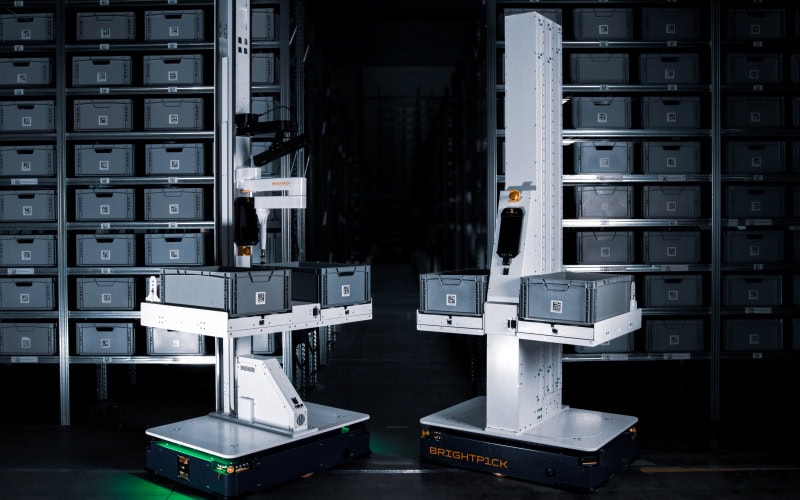
With AI-optimized intelligence and storage-capacity boosting configurations, these robotics systems speed order fulfillment and enable supply chain efficiency gains.
Making Lights-Out Fulfillment Possible
Brightpick, a provider of AI-powered robotic automation for warehouses, upgraded its Autopicker robots to enable lights-out fulfillment. With the company’s latest software updates, including Physical AI and picking-in-motion, Autopicker robots can now autonomously pick and buffer orders without human intervention.
Orders picked overnight are buffered inside the Brightpick system, ready for immediate packing and shipping at the start of the next shift, increasing warehouse throughput and accelerating order delivery.
 Brightpick’s Intuition AI software allows each robot to see, think, and act with human-like responsiveness and adaptability. Intuition continuously evaluates what’s happening across the warehouse and directs each robot to its next task. Embedded within Intuition is Physical AI, a suite of proprietary AI models that enable Autopicker to understand and adapt to its surroundings with human-like judgment.
Autopicker robots use AI-powered decision-making and a mobile robotic arm to autonomously pick individual items from shelves and totes. With 3D vision and force-sensing grippers, the robots operate with human-like dexterity, navigating aisles and shelves using LiDAR sensors and AI, even in low-light environments.
Brightpick offers Autopicker systems through a Robots-as-a-Service model as well as traditional capex purchase options.
Spotting Inventory Discrepancies
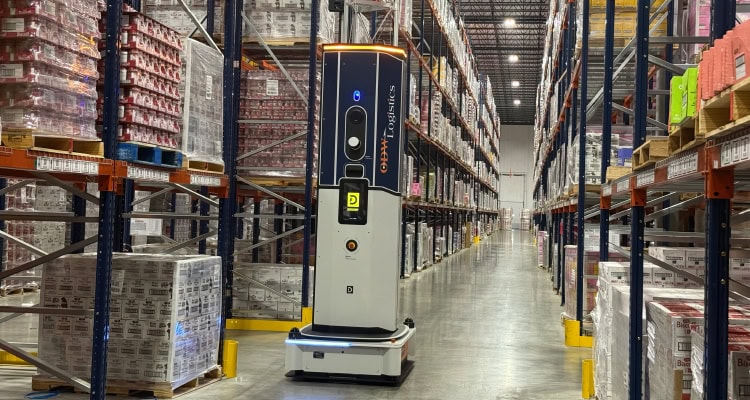
At ODW Logistics’ facility in Columbus, Ohio, Dexory’s autonomous robot and digital twin platform, DexoryView, delivers end-to-end visibility by scanning and analyzing warehouse data in real time. The solution enables ODW Logistics to detect and resolve inventory discrepancies sooner through frequent automated scans, accelerate reconciliation, and reduce labor hours spent on manual checks.
It also supports pallet auditing for CHEP and PECO pallets to reduce chargebacks, captures and analyzes more than 20,000 storage locations per mission, and completes full-facility scans multiple times per week, autonomously and without disrupting operations.

DexoryView’s interface provides ODW Logistics teams with visual confirmation of location data, trend analysis, and actionable insights. By integrating with existing systems, the technology allows ODW Logistics to refocus its teams from searching for discrepancies to correcting them.
“DexoryView has transformed how we manage inventory and identify process issues,” says Kayla Watson, senior inventory manager at ODW Logistics. “The ability to complete autonomous scans, capture detailed data, and act on insights in real time has allowed our teams to work more efficiently, with fewer discrepancies and faster problem resolution.”
Sports Brand Group Speeds Order Fulfillment

Amer Sports deploys Exotec’s Skypod system
Amer Sports—a global group of sports and outdoor brands, including Arc’teryx, Salomon, Wilson, Peak Performance, and Atomic—tapped Bastian Solutions to design and integrate a cutting-edge warehouse in Canada to streamline processes, boost order accuracy, improve work efficiency, and enhance experience for the company’s North American customers.
Bastian Solutions, a Toyota Automated Logistics company, collaborated with Exotec, a global warehouse robotics provider, to develop Amer Sports’ order fulfillment operations. As an integrator of the Exotec technology in the North American market, Bastian Solutions leveraged Exotec’s Skypod system, an automated storage and retrieval system (ASRS) with the ability to handle both each and case picking.
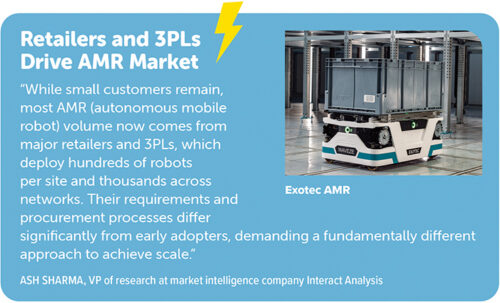
The expansion allows for the facility to consolidate operations under one roof and expand the team to meet growing demand, accelerating order processing and optimizing storage capacity. Exotec’s automation technology leverages autonomous robots to optimize order flow, reducing the need for workers to travel between pick locations. This not only enhances productivity but also boosts order accuracy, enabling faster and more reliable order fulfillment.
Storing and Retrieving with Lightning Speed

AutoStore deployment
Offering high-throughput fulfillment, the AutoStore warehouse automation system offers a cube storage solution to maximize warehouse footprints. AutoStore customers include 3PLs, retailers, manufacturers, automakers, and ecommerce brands.
Intralogistics solutions provider Kardex recently completed its 100th AutoStore project—in less than five years. Kardex has seen rapid growth since 2021: from the first project for one of Germany’s leading ecommerce players Arbeitsschutz-Express, to site number 100 recently ordered by Rhenus Group.
Including extensions of existing systems, its total stands at 120 projects around the globe, with AutoStore systems deployed by Kardex at sites across the United States, including those in Kentucky, Las Vegas, Seattle, Ohio, Houston, Detroit, Illinois, New Jersey, and Mississippi.
Sensor Maker Installs Customized System

Balluff, Inc., a manufacturer of sensor, identification, network, and software solutions, aimed to optimize put-away and picking throughput at its Kentucky facility. Seeking an ASRS to enhance its inventory storage and retrieval process, Balluff partnered with Kardex to deploy a customized AutoStore solution designed to meet current operational demands and future growth for the Americas region.
Kardex was able to take the project from contract signing to go-live in 6 months, coming in on time and under budget. It required no major facility upgrades. The resulting system optimizes space efficiency and process speed, delivering a 177% increase in throughput.
The Balluff project consisted of an AutoStore grid with 20,110 bins, 7 robots, 1 ConveyorPort, and 3 CarouselPorts. The installation was able to maximize space utilization within the existing infrastructure.
Fashioning a Compact Solution
Bleckmann, a supply chain management provider for fashion and lifestyle brands, went live with its AutoStore implementation at its distribution center in Bergen op Zoom (Netherlands) in December 2025.
The AutoStore system uses up to 7 times less space while dramatically increasing storage capacity. The system minimizes picking errors, improving quality and efficiency.
This enables multiple customers’ SKUs to be stored simultaneously, reducing stock shortages and optimizing fulfillment. Radio-controlled robots retrieve items, eliminating manual picking and accelerating processing. This solution supports later cut-off times for next-day delivery, demand forecasting, and rapid dispatch during peak periods.
The AutoStore system also delivers sustainability benefits. Ten robots consume the same amount of energy as a household vacuum cleaner and can operate in the dark.
AI Powers Next-Gen Robotics

Boston Dynamics’ Atlas humanoids may soon integrate Gemini Robotics AI foundation models, thanks to a new partnership between the robot maker and Google DeepMind. (Photo: Boston Dynamics)
As robots shift from rigid, rule-based systems toward more flexible and intelligent operations, AI is unlocking new levels of autonomy, perception, and adaptability across robotic form factors—becoming the central nervous system for next-generation robotics.
Closed-Loop Control and Perception
Physical AI is driven by real-time sensor fusion, machine vision, and embedded inference. Physical AI enables robots to react dynamically to their environment. Cobots, for instance, now use closed-loop systems that continuously ingest and process sensor data to adapt movements on the fly. This enables them to function safely alongside humans in unpredictable settings.
AI Agents for Specialized Tasks
Lightweight, domain-specific agents are emerging to give robots skills such as palletizing, pick-and-place, or machine tending. These agents often live at the edge or within robot controllers and support integration into workflows with minimal training data.
Robotics Foundation Models and World Models
The most transformative trend is the rise of robotics foundation models, which allow robots to generalize across unseen tasks, objects, and environments. Vendors like Dexterity, Skild AI, and NVIDIA have demonstrated early commercial traction, while players like Google DeepMind and Meta continue development in research labs.
These models combine reinforcement learning with diverse datasets to reduce time-to-deployment and scale robot capabilities across use cases.
Closely linked to foundation models are world models, a more advanced AI architecture that allows robots to simulate their environment, predict object behavior, and “think ahead.” World models enable model-based autonomy for complex robots like humanoids.
Source: ABI Research