
The Art of Scaling Up: How Aisya Aziz Balances Code, Clarity, and Culture

Aisya Aziz, LiquiDonate’s CTO, started out customizing MySpace pages as a teenager. Today, she scales the smart technology that reroutes retail returns directly into the hands of families in need.
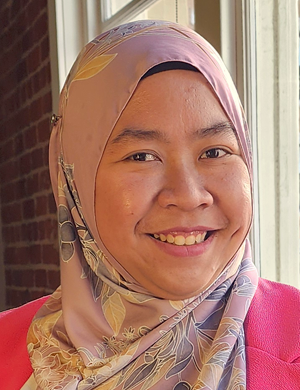
Aisya Aziz, CTO, LiquiDonate
Aisya Aziz built her first website, a simple guestbook, when she was seven years old. As a teen, she helped her friends jazz up their MySpace pages. Now, she’s chief technology officer of LiquiDonate, helping to build the infrastructure that enables the company to transform excess inventory and returns into donations for communities in need. “I knew I wanted to do something good,” Aziz says of her career choice.
This isn’t Aziz’s first role with a startup. After graduating from the University of Maryland with a B.S. in computer science, Aziz joined her family’s business, Authentic Venture Sdn Bhd, which builds SaaS solutions. She started as a programmer and eventually led the software development team. “It was a true bootstrap environment,” she says, noting that she worked in customer service, sales and development, and handled government projects. Twice, she won a startup competition in Malaysia.
Aziz joined LiquiDonate after receiving her M.S. in technology ventures at Carnegie Mellon University. Her education helped her learn how to balance engineering and technical excellence with a solution’s business impact.
Now, Aziz is helping to steer LiquiDonate as it shifts from the startup phase to a growth stage company. She discusses her approach to leadership in a small, growing company.
IL: What is your role with LiquiDonate?
I lead our technology strategy and product development efforts, making sure that our technology supports our mission and vision. This means working closely with our engineering, operations, and partnership teams to build our solutions. I am hands-on in engineering, product decisions, and even coding, but I also think about our long-term vision and strategy.
IL: At a high level, how does the LiquiDonate solution work?
LiquiDonate quickly and easily matches and routes excess retail inventory to nearby nonprofits. Retailers cut supply chain costs and reduce waste.
We do this in two main ways. One is the easy-upload platform we offer for bulk warehouse excess. Second is a Shopify app integration that automatically routes individual returns from customers’ homes to local nonprofit organizations in need of those types of items. Customers of our retail partners have the same online returns experience they would with any other purchase; the matching and rerouting happens in the background.
Nonprofits can easily use the portal to register, ‘shop’ for free, and receive items. Instead of traveling hundreds of miles to a warehouse, usable but unwanted products can travel several miles to a nearby nonprofit. We also provide documentation for the retailer to submit for tax benefits.
IL: Given your interest in coding as a child, did you always plan to go into a technology-related field?
When I was young, I didn’t know coding was a job by itself. I was 16 and building a website, when someone asked, “Do you know this is actually a job?” I said, “What? Programming?”
My mom is Asian, and I thought I’d grow up to be a doctor. I had to tell her I wanted to be a programmer. My mom said it was okay. She even bought me my first laptop.
IL: How do you lead your team as you move from a startup to a growth stage company?
One of the complexities in this current stage is balancing speed and scalability. We need to move quickly because we’re rapidly growing, yet every technical decision comes with long-term implications. We constantly think about how to build for where we’re going, not just where we are today.
In working with my team, I want people to feel empowered and comfortable sharing ideas and challenging assumptions. The best solutions rarely come from just one person.
I also believe it’s important to provide clarity, transparency, and focus. I want to make sure everyone understands not just what we are building, but why we are building it.
IL: What characteristics do effective leaders need, especially when leading a small, growing company?
We have to be collaborative, transparent, and most importantly, empowering. As we grow, I will be moving to focus more on the vision and the team will be building the product. My role will be more about removing roadblocks and helping them prioritize.
At the moment, because I’m hands-on, I understand the challenges the team faces each day. That helps me make better decisions and stay connected to the work instead of watching from a distance.
IL: What’s the most difficult part of your role as LiquiDonate moves from a startup to the growth stage?
Prioritization. At this stage, there are always more opportunities than time and resources. With every decision we make to move forward with one initiative, we also choose what not to do right now. There are times when we need to focus on short-term needs, but in most cases, we focus on initiatives that will create the greatest long-term impact for our customers and for the business.
IL: What is one lesson you learned earlier in your career that remains relevant in your role today?
Products don’t have to be complicated or incredibly fancy. They just need to solve a real problem. It’s easy to get caught up in building the coolest technology, but if you’re not solving someone’s pain point, none of that matters. That’s something I still remind myself today.
IL: What professional accomplishment brings satisfaction?
Our technology is exciting, but what really sticks with me is the human impact. In one case, a mattress we donated went to a family that had just come out of homelessness. It became the first mattress in their new home. When you think about that, it stops being a logistics or software platform. It’s about creating moments that genuinely change someone’s life.
Murati, Perkins, and Malaysian Food
If she could host a dinner party with several leaders—living or not, famous or not—who would Aisya Aziz invite, and what would be on the menu? “If you asked me a few years ago, my answer probably would’ve been Bill Gates and Steve Jobs,” she says.
“But today, I’d invite Mira Murati (former CTO with OpenAI and founder of Thinking Machines Lab, an AI startup) and Melanie Perkins (co-founder and CEO of Canva, a design platform),” Aziz says. “I have so much respect for women tech entrepreneurs, especially in an industry that’s still heavily dominated by men.
“Mira Murati has shown a powerful combination of technical knowledge, strength, and empathy. Imagine being the CTO at OpenAI during the time AI became accessible to the world,” she says. “I don’t think people can imagine life without AI anymore.
“Melanie Perkins is inspiring for a different reason,” Aziz notes. “Her journey doesn’t follow the typical tech founder story. Nothing about it looks overly flashy, yet she built Canva into one of the world’s most successful companies. She became an incredibly strong voice through execution rather than hype.
“For the menu, I’d serve Malaysian food,” she adds. “Introducing people to Malaysian delicacies is one of my favorite ways to connect with them.”