
The Crew Behind Your Cargo: Why Seafarer Shortages Are the Supply Chain Risk Nobody Is Tracking
Supply chain managers have learned to track everything: port congestion, container availability, fuel surcharges, canal transit times. Yet the single input that keeps every one of those variables moving — the people who actually operate the ships — rarely appears on a risk dashboard. That is a blind spot the industry can no longer afford.
Roughly 80% of world trade by volume moves by sea, and every voyage depends on a fully certified crew being in the right port, with the right documents, at the right time. When that does not happen, the consequences look exactly like the disruptions shippers already fear: delayed sailings, blanked port calls, vessels idling off anchorage, and charter rates climbing. The difference is that a crewing failure is invisible until the moment it hits your schedule.
A Shortage Measured in Officers, Felt in Transit Times
The numbers behind the problem have been building for years. Industry workforce studies have warned of a global shortfall of tens of thousands of qualified officers, and the gap is widening as fleets grow, regulations multiply, and fewer young people choose a career at sea. Senior engineers, electro-technical officers, and tanker-experienced deck officers are now among the hardest positions to fill anywhere in world shipping.
For a shipowner, an unfilled officer position is not an HR inconvenience — it is a vessel that legally cannot sail. Flag state safe-manning requirements mean one missing certificate can hold a ship at berth. For the cargo owner downstream, that translates into missed cut-offs, rolled bookings, and inventory sitting in the wrong hemisphere.
The crew change crisis of the pandemic years made this painfully visible, when hundreds of thousands of seafarers were stranded beyond their contracts. But the structural problem predates the pandemic and has outlasted it: the traditional way crews are recruited is simply too slow and too fragmented for how modern supply chains operate.
The Recruitment Bottleneck Hiding Inside the Bottleneck
Traditional maritime recruitment runs through long chains of intermediaries. A shipowner passes a vacancy to a manning agent, who passes it to sub-agents across several countries, who dig through outdated paper CVs and personal contact networks. Each link adds days, fees, and a new opportunity for information to be lost or distorted. A candidate’s certificates may be expired, their sea service unverified, their availability unclear — and nobody discovers it until the joining date is at risk.
Compare that with how the rest of logistics now works. Freight is booked on digital platforms in minutes. Container positions are tracked in real time. Yet the crewing of the vessel itself — the most safety-critical element of the voyage — often still moves at the speed of email attachments and phone calls.
This is the gap a new generation of direct-hiring platforms is closing. One example is jobmarineman.com, a digital recruitment platform built by Marine MAN Ltd, a European ship management company that has been crewing vessels since 2007. The platform connects shipowners directly with seafarers — no chains of sub-agents, no commissions charged to crew members — and structures every profile around the data that actually determines whether a candidate can join a ship: rank, vessel-type experience, STCW certification, visa status, and availability dates.
“In crewing, the real product is time,” says Pavel Manchenko, founder and Managing Director of Marine MAN. “A shipowner does not pay us for CVs — he pays for a certified officer standing on the gangway on the joining date. Every intermediary between the seafarer and the vessel adds days and subtracts certainty. We built JobMarineMan to remove that layer completely: the owner sees the verified candidate, the candidate sees the real vacancy, and they talk directly. Everything else in shipping has been digitized — the crew was simply next.”
What Direct Hiring Changes for Fleet Operators
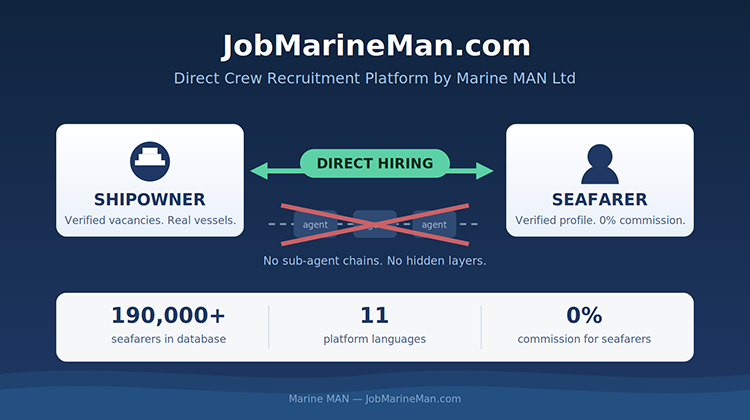
The logic of direct crew recruitment mirrors what digital freight matching did for trucking a decade ago: remove the opaque middle layer, and both sides of the market move faster.
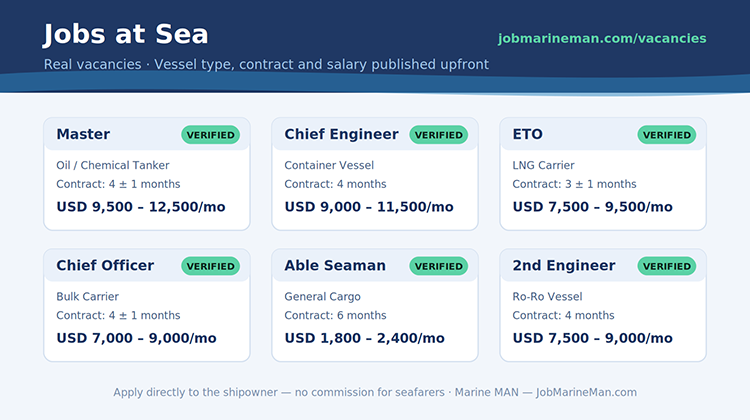
For seafarers, transparency is the draw. Candidates browse verified jobs at sea with real vessel types, contract lengths, and salary ranges published upfront, and apply directly to the employer. Because the platform charges seafarers nothing, it attracts exactly the experienced officers and ratings that owners struggle to reach through conventional channels — a pool that in Marine MAN’s case draws on a database built over nearly two decades in the crewing business.
For owners and operators, the value is speed and verification. Instead of waiting for an agent to “check with his people,” a technical manager can filter candidates by rank, fleet experience, and document validity, and open a direct dialogue the same day. Vacancy-to-joining timelines shrink from weeks to days — and in a market where an idle Panamax burns tens of thousands of dollars a day in lost hire, that difference lands directly on the P&L.
Crewing Is a System, Not a Transaction
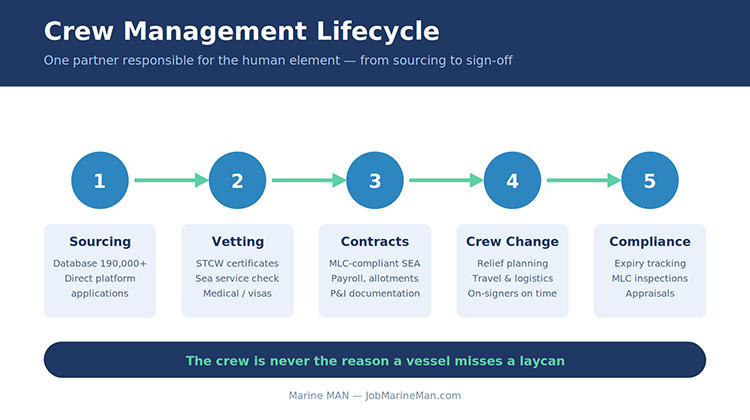
Filling a single vacancy quickly is valuable; keeping a fleet reliably manned voyage after voyage is a different discipline. It involves contract planning, relief scheduling, certificate expiry tracking, payroll across multiple jurisdictions, MLC compliance, travel logistics, and P&I documentation. This is why leading operators increasingly treat crewing as an outsourced system rather than a series of one-off hires.
Full-scope crew management services take over that entire lifecycle: sourcing, vetting, contracts, crew changes, and ongoing compliance under the Maritime Labour Convention. The shipowner keeps commercial control of the vessel; the crewing partner guarantees that the human element never becomes the reason a ship misses a laycan.
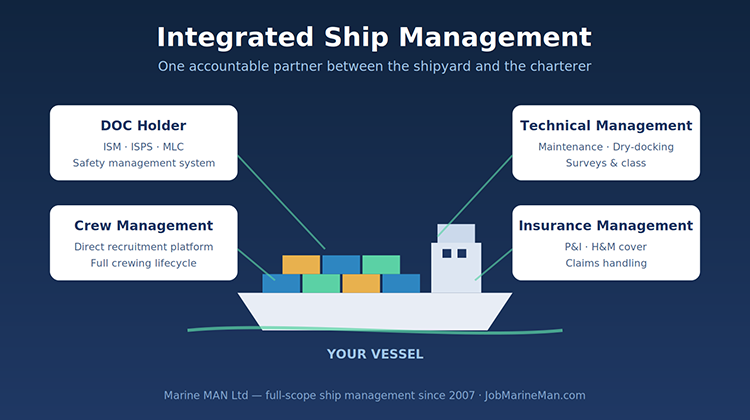
For some operators, the logic extends further. A company that holds a Document of Compliance can also assume technical and safety management of the vessel itself — ISM, ISPS, and MLC responsibility included. Integrated ship management of this kind gives smaller owners and financial investors in tonnage a single accountable partner for everything between the shipyard and the charterer, with crewing embedded in the same quality system rather than bolted on from outside.
What Cargo Owners Should Take From This
Most readers of this magazine will never hire a chief engineer. But if your goods move by sea, crewing risk is already priced into your freight — in schedule reliability scores, in force majeure clauses, in the premium you pay for guaranteed space. Three practical takeaways:
First, ask about it. When qualifying ocean carriers and NVOCC partners, questions about crewing arrangements, retention rates, and manning contingency plans are as legitimate as questions about vessel age or emissions ratings. Second, watch the demographics. The officer shortfall is a leading indicator: trades and vessel segments where qualified crews are scarcest will see reliability erode first. Third, favor transparency. Operators who have digitized their crewing pipeline — the way platforms built on direct hiring now allow — recover faster from disruptions because they can re-crew in days, not weeks.
The maritime industry spent the last decade digitizing the cargo. The next competitive frontier is digitizing access to the people who carry it. The operators who get there first will be the ones whose ships keep sailing when everyone else is waiting for a relief crew — and the shippers who notice will be the ones whose supply chains quietly stop breaking.