
On-Site Container Storage: A Flexible Answer to the Warehouse Capacity Squeeze
Warehouse space is one of the least flexible lines on a logistics budget. A lease is a multi-year commitment sized to a forecast, yet the demand it serves is rarely steady. Seasonal peaks, promotional surges, new product launches, and the safety stock rebuilt after a supply disruption all push storage requirements up and down on timelines far shorter than a property lease can accommodate. The result is a familiar bind: pay for space that sits empty for much of the year, or run short exactly when volume spikes.
On-site shipping containers have become a practical way out of that bind. Rather than committing to more fixed building space, operations place storage containers in their own yards, lots, and dock areas to add capacity that scales up or returns as conditions change. For many warehouse and distribution managers, a well-chosen provider of shipping container services now sits alongside racking suppliers and material handling vendors in the standard toolkit for managing space.
The economics of marginal space
The case for on-site containers is mostly about cost structure. Building space is a fixed cost committed years in advance. A container is closer to a variable cost: you add units when you need them and stop paying when you do not. For storage demand that swings with the calendar, matching a variable cost to a variable need is simply more efficient than carrying fixed overhead sized to the annual peak.
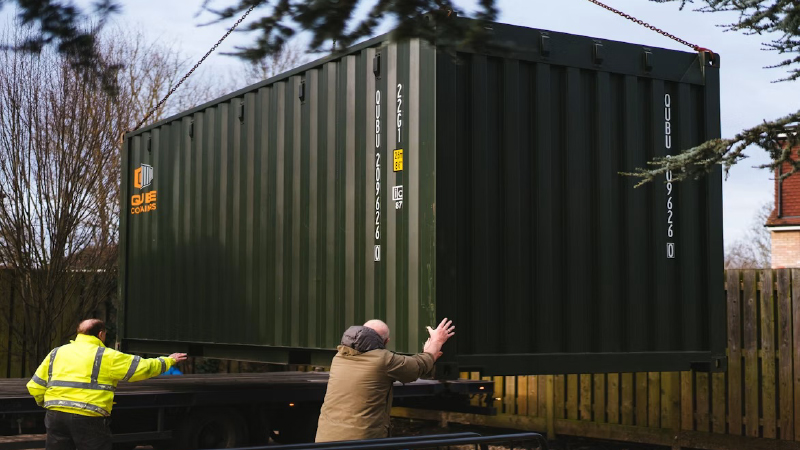
Lead time reinforces the point. Securing additional warehouse space means a property search, negotiation, fit-out, and often a wait of months. A container can be delivered and in use within days. When a retailer needs overflow space before a peak season, or a manufacturer needs somewhere to stage materials for a project that starts next week, that speed is the difference between solving the problem and missing the window.
Exit flexibility matters just as much. Hired containers can be returned when the surge passes, so the operation is not locked into space it no longer needs. That optionality has real value in a market where demand forecasts are increasingly difficult to hold with confidence.
Where containers earn their place
The strongest use cases share a common feature: storage demand that is temporary, variable, or hard to predict.
Seasonal overflow is the obvious one. Retailers and distributors building inventory ahead of a peak can absorb the bulge in containers and shed the capacity afterward, rather than leasing year-round space for a few months of real use.
Promotional and launch inventory works the same way. A large forward buy or a new SKU rollout creates a temporary spike that does not justify a permanent footprint.
Project staging is another fit. Construction, infrastructure, and manufacturing projects often need secure, weatherproof storage close to the work, for a defined period, in a location no permanent warehouse happens to serve.
Containers also bridge transitions. Operations reconfiguring racking, recovering from a facility incident, or relocating sites can use on-site units to hold inventory without interrupting flow. And in last-mile networks, containers can act as forward staging points that put stock closer to delivery zones during demand peaks.
Practical considerations before the unit arrives
On-site storage is straightforward, but a few details separate a smooth deployment from a frustrating one.
Siting comes first. The ground needs to be firm and reasonably level, with enough clearance for delivery, for the doors to open, and for a forklift to work. Local permitting and zoning rules can apply to containers placed on a site for an extended period, so it is worth checking before units land rather than after.
The goods being stored should drive the specification. Standard containers are wind and watertight, which suits a wide range of general inventory. Temperature-sensitive or moisture-sensitive stock may need ventilation, insulation, or climate control, and high-turnover items benefit from shelving, internal lighting, and wider access doors. Matching the unit to the contents avoids damage and keeps picking efficient.
Security and integration round out the list. Containers offer solid physical security on their own, and that can be reinforced with lockboxes and site controls. Inventory held in containers should still be tracked in the warehouse management system so it does not become an invisible pool of stock sitting outside the main building.
Buy, hire, or modify
Whether to buy or hire comes down to how long the need lasts and how predictable it is. Short-term and uncertain demand usually favours hire, with its low commitment and clean exit. Recurring or long-running needs can tip toward purchase, where the cost spreads over years of use. Many operations run a mix: a base of owned units for predictable storage, topped up with hired units for peaks.
Modification is where containers move from blunt instrument to fitted solution. Shelving, racking, insulation, electrical fit-out, lighting, partitions, and additional access points turn a shipping box into purpose-built storage. A provider that can advise on and carry out these modifications, not just drop a standard unit, is far more useful when the storage need is specific.
Choosing a provider
The quality of the outcome depends heavily on the supplier. Condition matters, so it is worth confirming the grade and integrity of any unit, particularly for cargo that cannot tolerate leaks. Delivery capability matters too, since placing a container in a working yard takes the right equipment and planning. And lease flexibility is central to the whole proposition: terms that let you scale up and return units as demand moves are what make containers a flexible lever rather than another fixed commitment in disguise.
On-site containers will not replace the distribution centre, and they are not meant to. What they offer is a way to make storage capacity responsive, adding space when demand calls for it and releasing it when the peak fades. In a period when warehouse space is expensive and demand is hard to forecast, that flexibility is worth having in the plan.