
FedEx Freight Outlines AI and Fuel Strategy Ahead of Spin-Off at ACT Expo
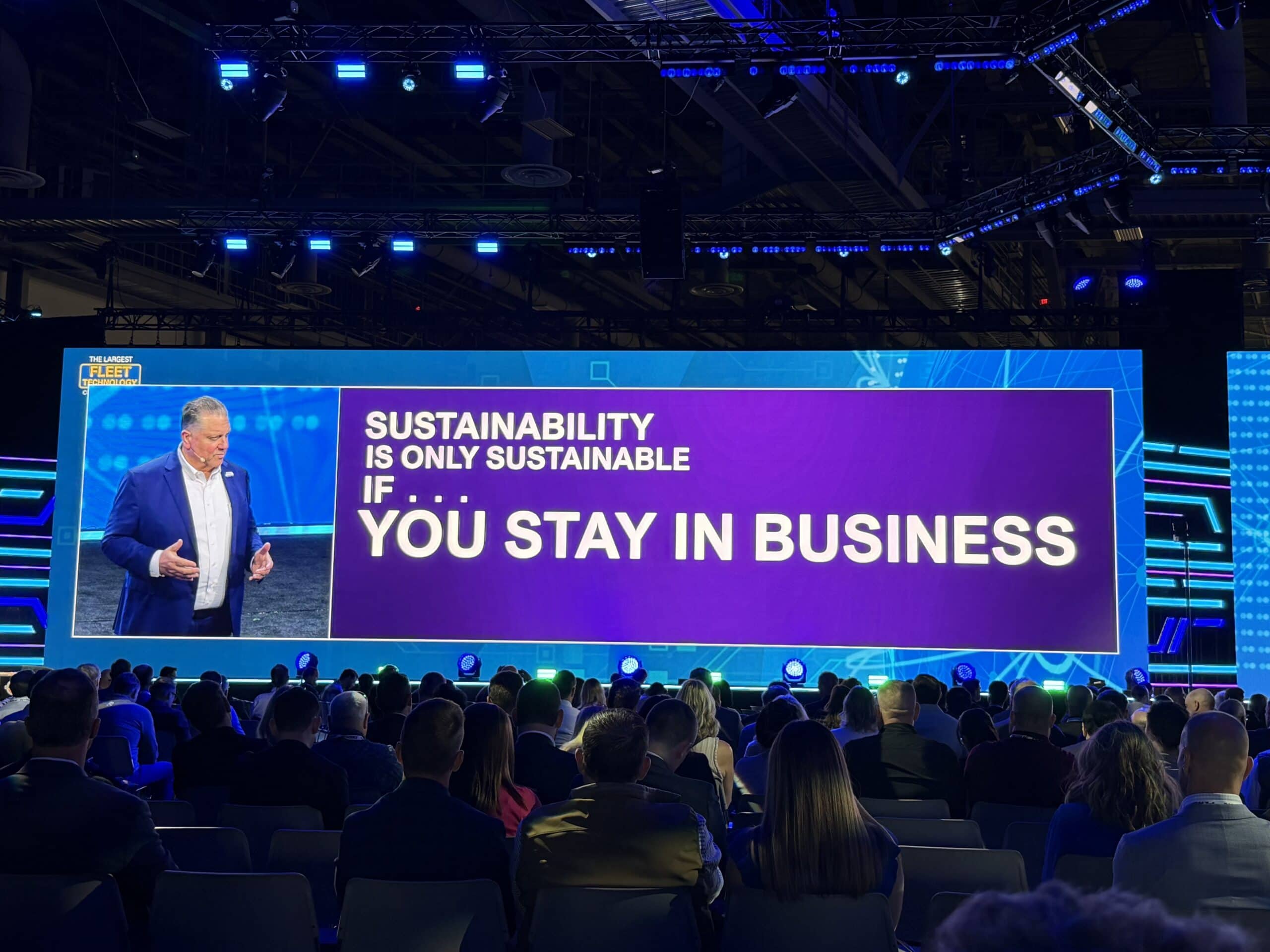
Incoming CEO John A. Smith said FedEx Freight’s spin-off strategy will center on practical sustainability, predictive AI, and network optimization, with a focus on technologies that improve operations as the company becomes a standalone carrier.
With FedEx Freight set to become a standalone company on June 1, incoming CEO John A. Smith used the ACT Expo stage in Las Vegas to lay out how the carrier plans to operate after the spin-off.
The strategy he described reflects a freight market under pressure from multiple directions, including tighter margins, rising service expectations, and growing scrutiny on emissions. Still, his message stayed grounded in execution rather than transformation. Sustainability, he said, has to work inside the economics of the business, not outside of it.
“Sustainability is only sustainable if it makes business sense,” Smith said. “You can only make a difference if you stay in business. It’s really about bridging the gap between environmental stewardship and operational reality.”
That framing shaped a roadmap built around three core pillars: practical clean-fleet deployment, deeper network optimization, and expanded use of predictive AI.
Clean fleet strategy tied to real operating conditions
FedEx Freight is not betting on a single breakthrough technology to reduce emissions across its network. Instead, Smith said the company is matching fuel and powertrain choices to specific duty cycles.
For heavy-duty long haul operations, FedEx Freight is leaning on compressed natural gas (CNG) and renewable natural gas (RNG). Smith pointed to CNG as a proven engine platform that fits the demands of LTL freight while immediately lowering carbon intensity.
Inside the fence, electrification is already being deployed where it makes operational sense. That includes electric forklifts, electric yard hostlers, and electric vehicles for local pickup-and-delivery routes where range is predictable.
Smith also stressed that scaling alternative fuels in heavy-duty freight depends on OEM alignment. He was clear that new equipment has to function as “just another truck,” meaning it must match diesel on durability, weight efficiency, and service support without introducing operational friction.
Network optimization as the biggest emissions lever
Before changing how trucks are powered, Smith said FedEx Freight has focused on improving how freight moves through the network.
The company has shifted from weight-based planning to cube-based dimensional planning. Using dimension-in-motion technology, FedEx Freight now captures more than 90% of shipment dimensions in real time. That visibility has helped increase cube utilization by 12% across the network over the past year, according to Smith.
Network restructuring has also played a major role. FedEx Freight has consolidated 39 service centers while opening new facilities in dense freight markets. Over the past five years, those changes have removed 187 million linehaul miles from the network, representing a 5% reduction in overall linehaul miles.
Using AI in real-time operations
As it prepares to operate independently, FedEx Freight is modernizing its operational stack with native AI capabilities through partners like Salesforce, ServiceNow, and Adobe. Smith made a distinction between broad generative AI discussion and the way AI is being applied in freight operations.
“AI is transforming freight, shifting it from historical reporting to real-time visibility,” he said. “It allows you to be like a quarterback who can anticipate almost every blitz.”
In practice, that shows up in two main areas.
Dynamic capacity management
Predictive analytics are used to evaluate historical shipment patterns, economic indicators, and real-time booking trends. That helps forecast volume and guide decisions around scheduling, and trailer allocation with the goal of reducing empty miles.
Predictive maintenance
FedEx Freight is also moving away from traditional time-based preventive maintenance. Using trailer tracking and OEM data, the company is shifting toward mileage-based servicing that identifies likely failure points before breakdowns occur. The aim is to improve uptime and reduce avoidable costs.
Safety performance and operational reliability
Smith emphasized that technology only works when paired with experienced drivers. FedEx Freight drivers represented more than 50% of award winners at the 2025 National Truck Driving Championships.
The company has paired that driver performance with in-cab technologies including Active Brake Assist, electronic mirrors, and collision avoidance systems. According to Smith, that combination has contributed to a 30% reduction in accidents over the past five years, as well as knock-on effects across reliability, downtime, and service consistency.
A call to the broader freight ecosystem
Smith closed with a message aimed beyond FedEx Freight itself, calling out the need for coordination across OEMs, utilities, and policymakers.
To OEMs, he pushed for reduced proprietary barriers in charging and fueling infrastructure.
“Every truck must be able to pull up to every charger,” he said.
To utilities, he called for faster reinforcement of grid capacity and resilience to support fleet electrification without overloading local communities. And to policymakers, he emphasized consistency over shifting incentives, arguing that long-term capital investment depends on stable regulatory conditions and targeted de-risking mechanisms.
Post-spin-off focus: efficiency over expansion
As FedEx Freight moves toward its June 1 spin-off, Smith’s message was consistent. The next phase is less about expansion and more about precision.
Better network design, fewer wasted miles, more accurate forecasting, and technology that directly supports operations are the levers that matter most.
For the LTL sector, the takeaway from ACT Expo was straightforward: Progress will come less from single breakthrough technologies and more from how effectively carriers use the tools they already have.