
Site Selection: Georgia Beckons

Seeking to locate facilities or expand operations in the Southeast? Georgia is calling. Here’s how the state’s logistics ecosystem continues to enhance connectivity and how leading providers fuel growth.
You can’t discuss Georgia’s role as a national and international logistics hub without two other “G” words quickly entering the conversation: “gateway” and “growing.”
“Gateway” is straightforward. Georgia’s strategic location in the Southeast positions it as a natural distribution gateway to major U.S. consumer markets—including New York, Chicago, Miami, Dallas, and Washington, D.C.
Within a two-day truck haul, companies can reach the majority of the U.S. population. Add multiple federally designated Foreign Trade Zones (FTZs) and extensive international trade routes, and Georgia becomes more than a domestic hub—it is a global gateway connecting the United States to Latin America, Europe, Asia, and beyond.
But the second “G”—growing—requires a closer look. How does a state that has stood at the forefront of logistics for more than two centuries continue to increase its influence?
The answer resides in a combination of long-term strategic vision, close public-private collaboration, and sustained investment in infrastructure, education, and innovation. Executives of Georgia-based companies point especially to the Port of Savannah, citing its strategic location in the state. About 20% of The Home Depot’s imports, for example, enter through the Port of Savannah.
But that is only part of the story.
In addition to the Savannah port, the Georgia Ports Authority (GPA) operates the Port of Brunswick and inland terminals in Murray County and Bainbridge. Together, these facilities support containerized cargo, automobiles, heavy machinery, and breakbulk freight, reinforcing Georgia’s role as a premier—and growing—international trade gateway.
Meanwhile, Hartsfield-Jackson Atlanta International Airport (ATL) is itself a global gateway, offering nonstop service to more than 150 domestic and 70 international destinations. These include major commercial centers across Europe, Asia, the Caribbean, Africa, and the Americas. ATL also holds the distinction of being the first airport in the world to serve more than 100 million passengers in one single year—an indicator of the scale and connectivity that define Georgia’s logistics ecosystem.
Miles Ahead
In addition, there are some 130,000 miles of public roads and more than 4,600 miles of active rail lines in Georgia. The state’s location provides direct rail access to the Mid-Atlantic, Northeast, and Midwest regions of the United States. Both Eastern U.S. Class I railroads, CSX and Norfolk Southern, along with 24 short-line railroads, track across the state.
Infrastructure alone, however, does not secure long-term growth. Georgia’s educational institutions help ensure the pipeline of logistics talent remains strong. The Georgia Institute of Technology (Georgia Tech), Georgia State University, and Georgia Southern University are nationally recognized for their supply chain and logistics programs, producing the next generation of industry leaders while supporting cutting-edge research and applied innovation.
Combine that talent base with a competitive cost of living, business-friendly tax policies, and a skilled workforce, and the result is a formula that continues to attract distribution centers, 3PL operations, and advanced manufacturing facilities.
Mapping Out Success

A long-time leader in the Southeast, Atlanta Bonded Warehouse provides temperature-controlled third-party logistics warehousing, co-packing, and LTL/TL transportation services.
The Georgia Department of Economic Development (GDEcD) states it plainly: “If your 3PL or distribution center is seeking to grow, Georgia is the place to be. When you choose Georgia, you are choosing a solid foundation of air, land, and sea transportation that will enhance your business growth and keep you competitive in the global marketplace.”
Leading companies operating in the state echo that sentiment. From home-grown companies serving the ever-evolving needs of the marketplace—companies like Atlanta Bonded Warehouse, data and technology services provider SMC³, and Savannah-based JIT Warehousing and Logistics—to giants like Walmart, The Home Depot, and UPS, Georgia is clearly the place to be.
“We’re proud to be a part of this community, which is why we’ve invested over $350 million in some of our Georgia distribution centers in the past six years alone,” says Vik Gopalakrishnan, SVP, supply chain automation engineering, Walmart. “It’s all part of our commitment to serving and creating opportunities for the people of Georgia.”
That commitment adds up to very big numbers.
“In Georgia, our team of more than 65,000 Walmart associates is dedicated to getting our customers the products they need with more convenience and speed than ever before, all while keeping our promise of everyday low prices,” Gopalakrishnan says. “To make that happen, we operate 11 advanced supply chain facilities throughout the state.”
Georgia’s long-term commitment to logistics is unmistakable. Through the Georgia Department of Transportation (GDOT), the state plans to invest about $2.4 billion each year until 2050 to improve freight mobility. Major projects include the $1.5 billion-plus Major Mobility Investment Program (MMIP), 40 miles of commercial vehicle lanes on I-75, and infrastructure upgrades to support port connectivity in Savannah.
By focusing on infrastructure, technology, and workforce development, Georgia continues to strengthen its competitive edge. The state’s leadership understands that maintaining top-tier logistics status requires constant reinvestment—and Georgia has demonstrated a willingness to make that commitment.
Ensuring Perpetual Prosperity
Year after year, Georgia maintains its premier position among the nation’s top states for doing business. “It’s a perpetual cycle of prosperity,” says Hal Justice, vice president of sales and operations at Atlanta Bonded Warehouse (ABW), the Southeast’s leading provider of temperature-controlled third-party logistics warehousing, co-packing, and LTL/TL transportation services.
Georgia’s success, Justice says, is rooted in a shared pro-business mindset among both government and industry leaders.
“The political structure, in some ways, has figured out what private industry is doing,” he says. “At the same time, the private sector has recognized that Georgia is an optimal location not only for distribution but also for manufacturing. State leaders have read the tea leaves and, to their credit, have done everything they can to make it easy to do business here.”
A wide range of tax incentives further encourages companies of all sizes to locate in Georgia, Justice adds, noting the long-term economic impact of manufacturing investment.
“When you invest millions of dollars in a plant and put that kind of capital in the ground, you’re not likely to leave anytime soon,” he says. “That’s not a five-year decision—it’s a 20-year-plus commitment.”
Georgia also offers a favorable climate in which to live and work, while its competitive advantage on the business side lies in infrastructure and workforce availability. “The availability of a skilled and reasonably priced labor force, the state’s geography, and the highway system that makes Georgia a major crossroads for over-the-road and rail traffic are critical assets,” Justice says. “There are very few optimization studies for companies building a national distribution network that don’t include Atlanta on the list.”
Atlanta’s centrality to freight movement continues to drive its appeal. “You’ve got a healthy supply of equipment moving through Atlanta because it’s a major user market,” he explains. “Trucks come in looking for a direct route out. Atlanta is within a two-day drive of about 65% of the U.S. population, including the markets of New York, Chicago, and Dallas. You can reach nearly everything within two days from here.”
Offering Connectivity and Longevity
Justice’s perspective reflects long experience in Georgia’s logistics economy. Founded more than 75 years ago, Atlanta Bonded Warehouse is an industry veteran in warehousing services, including supply chain solutions and integrated warehouse management. Its Metro Atlanta facilities are designed to support customers’ warehousing, co-packing, and logistics requirements.
That longevity has also given the company experience navigating national economic cycles while working to minimize cost disruptions for customers.
Looking ahead, Justice says continued investment in Georgia’s logistics infrastructure will help sustain the state’s “perpetual cycle of prosperity.” He points to projects such as expanded inland connectivity at the Port of Savannah as examples of forward-looking strategies strengthening Georgia’s position in the national logistics landscape.
Meanwhile, ABW itself continues to evolve and respond to technological trends while maintaining its hallmark commitment to personal, effective communication with customers. “We really work hard at spotting discrepancies before they become problems,” he says. “I don’t think that’s ever going to change in any successful business formula.”
Fostering Collaboration

SMC³, which provides LTL data, technology, and educational solutions, adds to Georgia’s logistics assets with a core focus on the North American freight market.
SMC³, which operates primarily as a provider of less-than-truckload (LTL) data, technology, and educational solutions, adds to Georgia’s logistics assets with a core focus on the North American freight market. Shippers, carriers, logistics services and technology providers rely on SMC³ to translate intricate LTL transportation pricing and transit detail into data-centric solutions, spanning the entire shipment life cycle.
Headquartered in Peachtree City, some 20 miles southwest of Atlanta, SMC³ also has a satellite office in Louisville, Kentucky, and remote employees across the country.
“Georgia’s advantage is amplified by a highly collaborative, data-driven ecosystem where industry leaders and state agencies work in lockstep,” says Brian Thompson, chief commercial officer. “Organizations like SMC³ provide neutral benchmarks, education, and forums that align shippers, carriers, and technology providers around shared standards and best practices, while state leadership sustains long-term investment and policy continuity through initiatives like the Georgia Center of Innovation and GDOT’s Freight & Logistics Implementation Plan. This combination creates predictability, trust, and speed to market—key factors that consistently elevate Georgia’s logistics standing.”
Asked how he would promote Georgia to logistics professionals exploring logistics sites in the region, Thompson says he would focus on the transportation infrastructure. “If I were addressing a logistics conference, I’d highlight Georgia’s unmatched multimodal connectivity as its foundational advantage,” he says. “Few places combine a premier East Coast container port, the world’s busiest airport, extensive rail networks, and a dense interstate system in a single, well-integrated ecosystem.
“From an SMC³ perspective, what truly differentiates Georgia is the predictability and efficiency this infrastructure enables, allowing shippers, carriers, and 3PLs to plan, price, and execute freight movements with confidence, using trusted industry benchmarks and data standards,” he adds. “I would also point to Georgia’s longstanding commitment to investing in logistics and collaborating with public agencies, ports, and private leaders, continually expanding capacity and modernizing operations to stay ahead of demand. Finally, Georgia’s deep logistics talent base and culture of industry education—reinforced by organizations like SMC³—give companies not just a location, but a sustainable competitive environment for long-term growth.”
Thompson cites the growth and expansion at the Port of Savannah as a vivid example of the state’s commitment to support the logistics industry. “State leadership has consistently backed long-range port planning, rail connectivity, and terminal modernization, helping Georgia strengthen its position as a national gateway for freight movement.”
Committed to Growth
Another recent illustration of the state’s leadership, Thompson says, was the 2025 Georgia Logistics Summit. Hosted by the Georgia Center of Innovation, the annual summit brings together public and private leaders to align on technology, workforce, and infrastructure priorities for the industry. Thompson believes these examples reflect a broader pattern.
“Georgia’s leadership doesn’t just invest in assets, but actively convenes the ecosystem to ensure data, collaboration, and long-term strategy translate into measurable logistics progress statewide,” he adds. “We also hold our annual Jump Start conference in Atlanta, where more than 700 industry stakeholders come to the hub of transportation to connect with other key players in the industry.” The company hosts other educational events in Atlanta as well.
Looking ahead, Thompson says, SMC³ continues to refine and update its product with reliable, innovative solutions, expand API-based intelligence, and invest in analytics that improve predictability and transparency—reinforcing Georgia’s role as a center for logistics innovation and thought leadership.
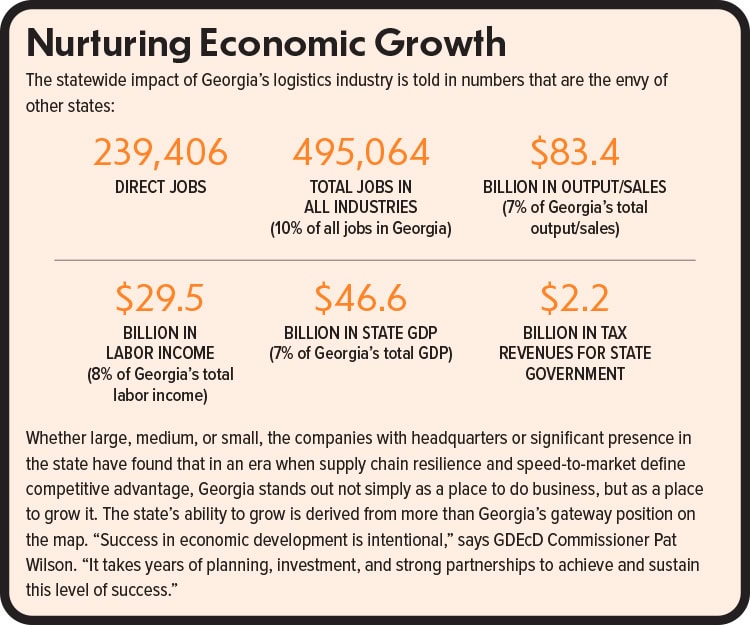
Enhancing the Transportation Network
Savannah-based JIT Warehousing & Logistics is one of the gems in the treasure trove of Georgia logistics. Leaders of the family-owned and operated company are quick to recognize the state government’s leadership for creating an environment in which JIT and other companies can flourish.
“Our state leaders strongly promote investments in our port and transportation network,” says Anna Lockwood, JIT’s vice president. “Logistics providers such as JIT continually update and enhance our facilities to more seamlessly integrate within the supply chain network.”
The company, founded more than three decades ago by Lockwood’s father, Ben Goldberg, has carried forward his vision that companies receiving products via the Port of Savannah (and other companies) require and deserve world-class logistical support.
Goldberg’s vision was to create a company that was simultaneously big and small—big enough to support some of the world’s largest companies, and small enough to give small and medium-sized companies the best in personalized service.
In order to accomplish that goal, JIT and other leading logistics providers in Georgia benefit from close and mutually beneficial relationships with state and local governments. “The Georgia Department of Economic Development and leaders work with businesses to make sure that business in the state is attractive,” Lockwood says. “Our local providers work together to ensure our city remains attractive for all avenues, such as the addition of a breakbulk facility, which has been needed since much of that capacity was shifted to containerized cargo.”
Meanwhile, JIT itself works and invests to remain at the cutting edge of modern logistics. “JIT continues to improve and add to our equipment, so we are ready to accommodate any project,” Lockwood says. “Everything from specialized lift truck attachments to the addition of our second Faymonville Megamax which allows us to move taller cargo to and from the Georgia Ports.”
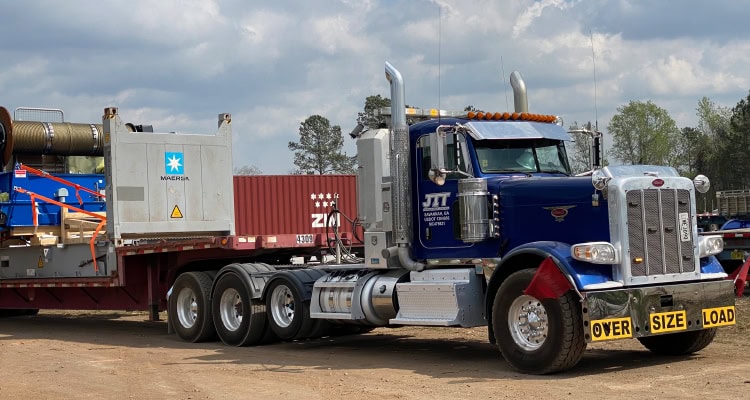
To accommodate a wide range of projects, JIT Warehousing & Logistics continues to improve and add to its equipment.