
Clean Tech Hits Its Stride as Freight Faces a Defining Moment
ACT Expo 2026 signals a shift from experimentation to execution across fleets, fuels, and automation.
By Amy Roach | May 7, 2026
Just a few months before the first badges and lanyards hit necks at the 2026 ACT Expo in Las Vegas this week, autonomous trucking provider Waabi secured $1 billion in venture capital funding to further the deployment of its autonomous truck line. (Yes, that’s billion, with a “B.”) During a keynote speech at the show, Stephen Roy, executive vice president, Volvo Group and president, Mack Trucks, detailed his company’s investments of more than $2 billion in development of its new, more fuel-efficient trucks, and $1 million to improve its advanced manufacturing capabilities in the U.S. In a separate keynote address, incoming FedEx CEO, John A. Smith outlined FedEx Freight’s spin-off strategy, noting that it will center on practical sustainability, predictive AI, and network optimization, with a focus on technologies that improve operations as well as sustainability goals.
That level of confidence and pragmatism regarding advanced clean fleet technology was on robust display at this year’s ACT Expo. While conversations around clean transportation in the past have typically centered on pilots, promises, and policy, this year, the tone shifted decisively toward execution.
Across keynotes, panels, and one-on-one conversations, a consistent message emerged: adopting and scaling clean technology is a key priority, and one that is driven as much by economics as by environmental goals.
Also clear: Today’s vehicles are increasingly defined not just by their powertrain, but by their software. Trucks are becoming a platform unto themselves, with “software-defined vehicles” becoming one of the top buzzwords throughout the conference.
Stephen Roy’s take: “We’ve gone from mechanical machines to electronically controlled powerhouses. Today’s trucks are rolling computers, offering intelligence on wheels,” he said.
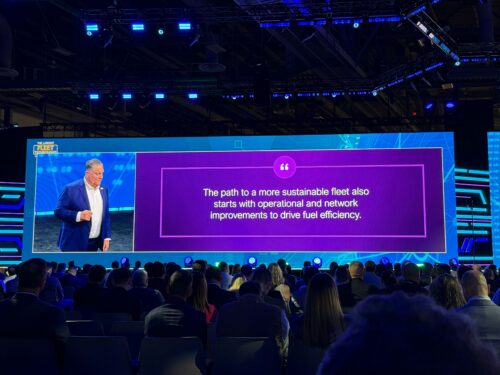
Incoming FedEx CEO John A. Smith gives a keynote address at the 2026 ACT Expo in Las Vegas.
In addition, regulation is reinforcing this shift, with the EPA’s 2027 emissions rules—which tighten NOx standards and extend engine warranty requirements—landing front and center in attendees’ minds.
“I don’t think anyone will go into 2027 with an engine with no changes,” noted Andrea Lukas, director of product management at Cummins, in one panel discussion. Mack Trucks proved her point, announcing at the show the debut of its MP 13 engine, which arrives fully EPA 2027-compliant and delivers up to 540 horsepower and 1,950 lb.-ft. of torque while providing up to 3% improved fuel efficiency compared with previous MP13 engines.
Still, the consensus at ACT was clear: while policy may accelerate adoption, it won’t sustain it. The technologies that win will be those that make economic sense on their own.
Economics Take the Lead
Taken together, the conversations at ACT Expo point to an industry at an inflection point, where cost pressures, regulatory change, and rapid advances in technology are converging to accelerate transformation. And the overarching message is that clean tech can be an economic—as well as environmental—driver.
“Sustainability is only sustainable if it makes business sense,” Smith said in his address. “You can only make a difference if you stay in business. It’s really about bridging the gap between environmental stewardship and operational reality.”
Roy challenged the audience to stop thinking about sustainability as a compliance issue and instead think about it as a key contributor to competitiveness. “Mark my words,” he said, “as we move forward, the most sustainable fleets will also be the most successful.”
Another panelist, Robert Cruess, president and CEO, ZERONox, put it more bluntly, with a reference to the expiration date on government incentive-driven business models: “If you have to rely on green incentives for your product to survive,” he said, “you’ve built a house of cards.”
The clear message is that the technologies that win will be those that make economic sense.
Electrification Finds Its Footing
While battery-electric vehicles remain central to long-term decarbonization goals, ACT Expo made clear that their near-term role is becoming more targeted. Electrification is gaining traction fastest in applications where routes are predictable and downtime can be managed: yard operations, drayage, ports, and vocational fleets.
“Good use cases for electrification are where you have repeatable routes,” explained Paul DiLaura, chief commercial officer, Gatik AI, during a panel discussion, where YMX Logistics CEO Matt Yearling also laid out the demand for electrification in the yard. “Yard trucks are a very good use case,” he noted.
Equipment on display reflected that shift. Manufacturers showcased a growing range of electric terminal tractors, medium-duty trucks, and heavy industrial vehicles designed to replace diesel in controlled environments.
Kalmar, for instance, showcased its latest lithium-ion electric forklift suitable for medium-range heavy-lift applications (9 to 18 tons), aiming to replace diesel products in industries like steel, lumber, concrete precast products, or oil and gas, explained Kalmar’s Joshua Hastert, a regional sales manager, who noted the firm’s 18% increase in order intake in late 2025, driven by new products and market demand. Kalmar also announced it has started delivering its new Kalmar Ottawa T2 EV, an electric terminal tractor with improved thermal management systems, enabling operation in extreme temperatures, from –22°F to over 120°F. According to Kalmar, Penske will be making the T2 EV available for lease starting this month, increasing the options for a transition to electric logistics equipment.
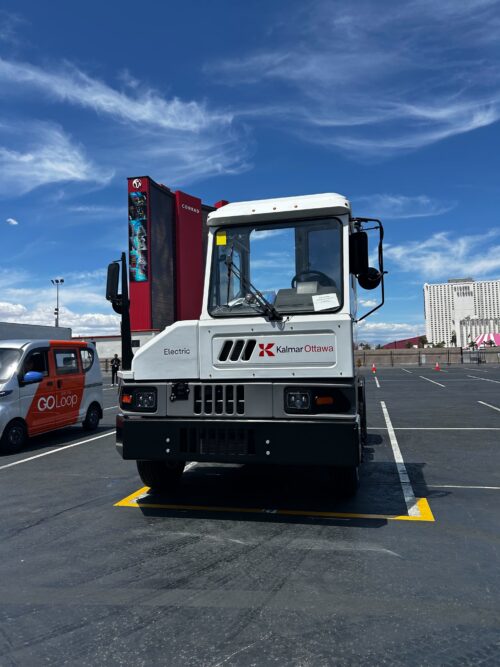
The Kalmar Ottawa T2 EV can operate in extreme temperatures, ranging from –22°F to over 100°F.
Volvo’s Volvo VNR electric, which just crossed 30 million on-road miles and serves regional and urban routes, has been shipping for several years; at the show, the automaker announced its next-generation VNL Electric. Mack’s MD Electric truck is designed for urban delivery and vocational uses like dry van or dump applications. It offers an estimated range of up to 230 miles depending on battery configuration. Mack also offers Mack Pioneer, an electric version of Mack’s new flagship highway truck, optimized for regional haul and drayage. The much-ballyhooed Tesla Semi was also on display; a ride-along showcased its super quiet, minimalist interior and superior handling capabilities.
Operationally, fleets are seeing meaningful benefits. Electric vehicles reduce both fuel and maintenance costs, and in some cases require significantly less preventive maintenance than internal combustion engines.
Helping to optimize EV fleet operations are companies like Better Fleet, which offers a software for EV fleet management that assists fleets in planning EV transitions, including vehicle selection and cost optimization scenarios. Using telematics and route data to optimize energy usage and vehicle performance, “essentially, we try to help make transitioning to EV fleets as simple as possible,” CEO Dan Hilson explained at the show.
But challenges remain. Charging infrastructure, route planning, and energy management continue to complicate large-scale EV fleet deployment.
A Multi-Fuel Future Takes Shape
Another clear takeaway from the show floor and conference sessions is that there is no single path to decarbonization. Instead, fleets are pursuing a diversified fuel strategy. The current diesel price jump, compounded by ongoing global uncertainty around fossil fuel supply, has forced operators to rethink long-standing assumptions.
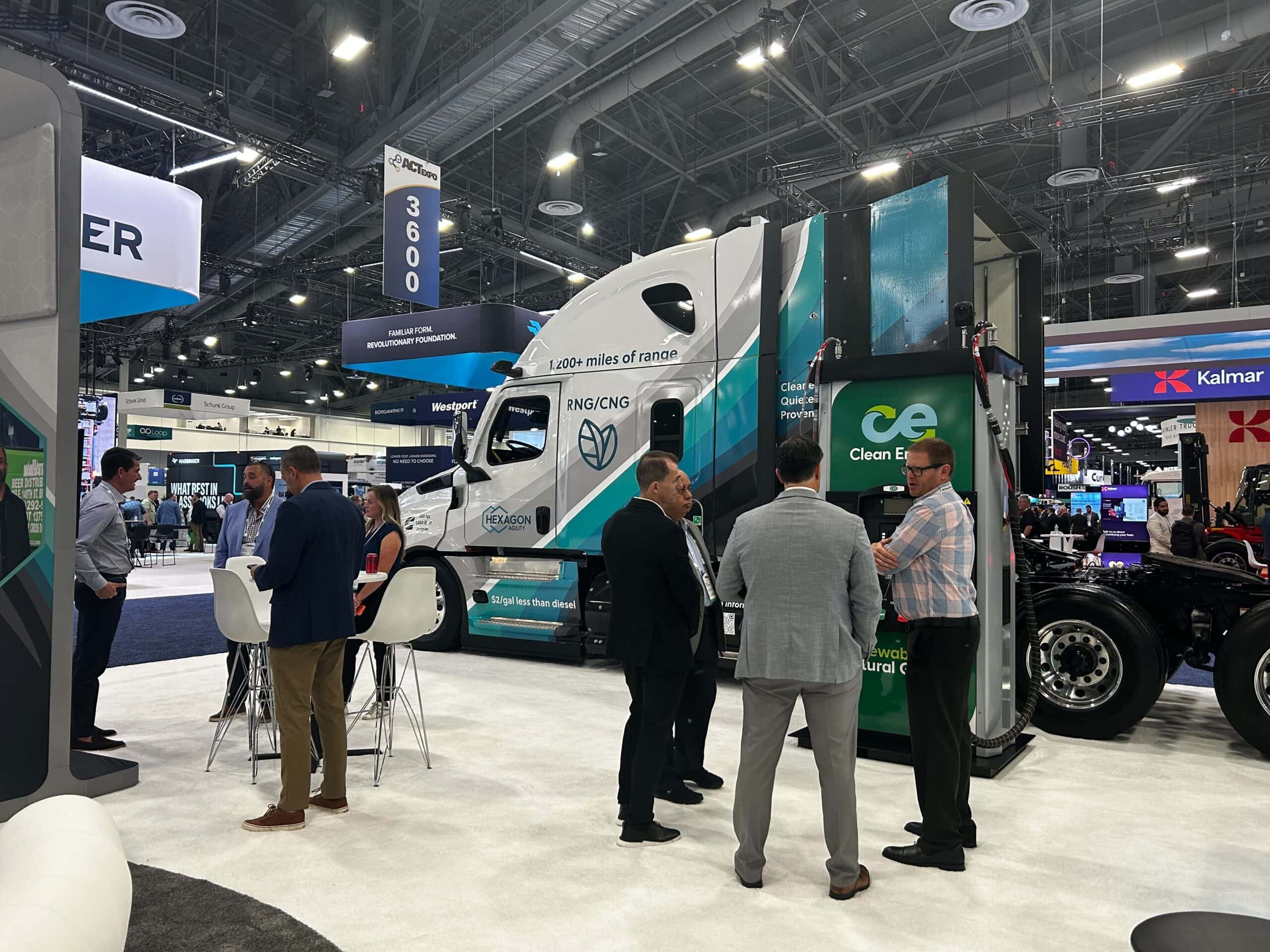
Not surprisingly, alternative fuels were on full display. Natural gas, in particular, is seeing renewed momentum, with advances in compressed natural gas (CNG) and renewable natural gas (RNG) systems addressing some of the technology’s historical limitations, according to Ian MacDonald, senior vice president of sales for the Americas with Hexagon Agility, a supplier of natural gas fuel storage and delivery systems. New configurations are “delivering up to 700 miles of range for day cabs and as much as 1,200 miles for sleeper trucks, while lightweight carbon-fiber tanks help offset weight concerns,” he explained.
At the same time, RNG is gaining attention for its sustainability profile. By capturing methane from waste streams, it offers what MacDonald described as “carbon-negative energy for operators.” Just as important, natural gas can provide a hedge against both fuel price volatility and policy uncertainty. Fleets are also layering in renewable diesel and hybrid approaches, building a three-part strategy to balance cost, emissions, and operational flexibility.
AI Moves From Concept to Core Capability
As it is doing with so many other elements, artificial intelligence is reshaping how fleets operate. According to data collected and presented by TRC Companies (organizer of ACT Expo) at the conference, roughly half of fleets are already using AI in some form, primarily for route optimization and maintenance. More than 60% expect to adopt it in the near future.
Erik Neandross, president of TRC’s Clean Transportation Solutions group, noted that the data also shows early deployments are delivering:
- 12% reductions in maintenance costs
- 20% fewer roadside breakdowns
- 9–10% improvements in technician productivity
In practice, AI is being applied across a wide range of use cases, from optimizing backhaul routes to automating service requests, assisting with battery charging infrastructure solutions, and identifying revenue opportunities. Fine-tuning the benefits use cases for AI was explored in several panels, including a main stage discussion emphasizing the importance of AI in decision-making and operational efficiency.
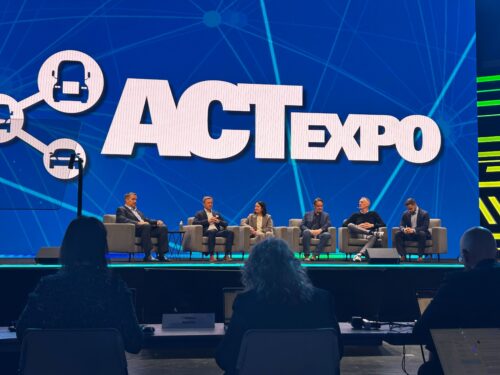
Experts discuss AI’s expanding role in fleet management.
The panel agreed on the necessity of AI fluency, robust data, and strategic use cases to drive competitive advantage. They also discussed the potential of AI in predictive maintenance, route optimization, and long-term planning.
Still, adoption is not without challenges. Data quality, system integration, and change management remain major hurdles. Several panelists emphasized the need for “clean, robust data” and a clear understanding of use cases.
The discussion also included a cautionary note from: Jack Kennedy, CEO of Platform Science: Before jumping in with AI, make sure you understand why you want to use it and what problems you’re trying to solve. “If you get that wrong, AI is going to accelerate wrong real fast,” Kennedy said.
Autonomy Edges Toward Commercial Reality
In its jump from science fiction idea to burgeoning on-road practice, autonomous trucking was perhaps the most closely watched development at ACT Expo, with one practitioner, Lior Ron, Waabi’s chief operating officer, declaring it “the most profound change in the history of the trucking industry.”
Questions linger, however: Where and how will autonomous trucking scale first? For now, the answer is clear: controlled, repeatable environments.
Middle-mile routes, particularly in regions like Texas, are emerging as the leading edge of deployment. Favorable regulations and strong state support have made Texas a hub for autonomous testing and early commercialization, noted Ossa Fisher, president of autonomous trucking firm Aurora, which last year became the first in the country to operate a commercial trucking route on a public highway with a completely unmanned vehicle.
The technology itself continues to advance. Modern systems that were on display integrate cameras, radar, and LiDar to create a 360-degree view of the environment, enabling earlier hazard detection. Sasko Cuklev, head of on-road solutions for Volvo detailed its system, which can identify potential risks more than 10 seconds in advance and make decisions—such as holding at an intersection—to avoid collisions.
Volvo showcased its Volvo VNL Autonomous truck, highlighting its move from pilot programs to industrial-scale deployment, with plans to manufacture hundreds of autonomous trucks at its Virginia plant beginning in 2027. “The VNL is designed for autonomy from scratch, featuring redundant safety systems and advanced sensors for a 360-degree view,” Cuklev explained, also noting the truck’s high utilization rate of 90% compared to 30% for manual trucks.
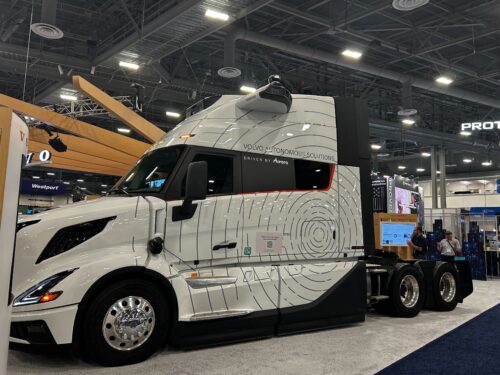
Volvo’s VNL Autonomous truck is designed from scratch for autonomy.
The highly watched autonomous sector was also represented by PlusAI, which showcased its AI-based virtual driver software and participated in live safety maneuver demonstrations; Kodiak, which displayed its SensorPod technology with Bosch hardware samples; and TORC Robotics, which showcased the Freightliner Cascadia 5th Gen Autonomous truck as part of the event’s “Ride & Drive” program.
But the path to scale remains gradual. Most deployments still include safety drivers, with plans to remove them first on long-haul highway routes. And significant challenges remain around infrastructure, data integration, and customer trust.
From Transition to Transformation
ACT Expo 2026 made one thing clear: the freight industry has moved beyond early-stage experimentation and is embracing clean, advanced technologies at a new level, and with renewed understanding of the proven economic return.
The transition is far from simple, however. Infrastructure gaps, capital costs, regulatory uncertainty, and workforce challenges all remain. Achieving success will require not just new vehicles and advanced technologies, but new ways of thinking about how freight moves.