
New-Gen Supply Chains Gain Buzz; Retailers Try Sourcing Strategies to Reduce Risk; Procurement Leaders Are Satisfied with AI Solutions & Other Supply Chain News

Logistics and supply chain news and highlights shaping the future of global logistics.
Welcome to the New-Gen Era
You may not be familiar with the term “new-gen supply chain,” but you’re likely already operating in one, according to Capgemini Research Institute. Its latest report defines a new-gen supply chain as one that is agile, sustainable, and powered by AI.
The idea has gained traction as global supply chains face escalating turbulence from trade disputes to cyber threats and shifting customer expectations, Capgemini posits. What worked yesterday—linear chains built for efficiency—won’t cut it tomorrow, finds the report, New-Generation Supply Chain: Connecting the Links to Reach Common Goals, which draws on responses from 1,000 senior executives across 13 countries and four key sectors.
Key findings include:
- New-gen supply chain is a top priority: 70% of executives rank it among the top three tech trends for 2025, while transformation progress has grown from 54% in 2022 to 72% in 2025.
- AI and agentic systems are reshaping operations: 67% of executives believe agentic AI will boost productivity, and 58% say it will transform supply chain frameworks.
- Sustainability drives efficiency: 76% of organizations have a comprehensive supply chain sustainability strategy, and over three-quarters agree that sustainable practices reduce costs and deliver long-term business value.
The report also offers a roadmap for getting to new-gen, which includes these actions:
- Embrace resilience as an ongoing strategic priority.
- Stay ahead of threats with active risk management.
- Strengthen governance and ensure human-centered agentic AI implementation.
- Collaborate to build sustainable and competitive supply chains.
- Enable robust data foundations through AI and implement cybersecurity protocol throughout the value chain.
- Encourage cross-functional alignment and co-create solutions with suppliers.
Risky Business
Supply chain headlines are filled with geopolitical risk references these days, and for good reason—it’s one of the main factors companies consider when making global sourcing decisions. Rather than deglobalize to avoid the risk, companies are reorienting their supply chain and sourcing decisions to minimize risk and remain resilient.
That’s the lens of Proxima’s latest Global Sourcing Risk Index, developed with Oxford Economics, which zeroes in on the regions retailers rely on most. The study finds that Mexico, Turkey, and Russia sit at the top of the sourcing risk list—but for very different reasons.
Mexico: As nearshoring accelerates, Mexico’s central role in U.S. and EU supply chains brings efficiency gains but also heightened exposure to cross-border security risks like cargo theft, with greater volumes putting pressure on already stretched protocols.
Turkey: Long positioned as a gateway between East and West, Turkey now brings a tangle of price volatility, reputational challenges, and geopolitical friction—making it both a strategic hub and a high-maintenance risk.
Russia: With its ongoing war in Ukraine and deepening sanctions, Russia represents a more clear-cut case of legal and operational barriers that complicate or outright block retail sourcing.
The consequences of these risks are already showing up in the numbers, the Index finds. Retailers face higher logistics and insurance premiums, longer lead times due to Red Sea route diversions, and even working capital strain as they pull forward stock ahead of the critical holiday season to hedge against congestion. Categories from apparel and textiles to furniture, electronics, footwear, and even some foods are feeling the pressure.
Still, the study notes that retailers aren’t standing still. They’re reshaping strategies to build resilience without sacrificing speed or margin. Common responses include:
Multi-sourcing and regionalization: Spreading bets by balancing higher-risk hubs (Turkey, Mexico) with more stable alternatives in Eastern Europe and North Africa.
Flexible transportation strategies: Mixing ocean and air freight, and dynamically shifting port selection to optimize for congestion, lead time, and capacity in real time.
Digitalization and data: Leveraging predictive analytics for smarter inventory management and scenario planning, plus traceability tools to strengthen compliance.
Supply Chain at a Crossroads
U.S. logistics leaders are navigating a powerful convergence of forces reshaping the entire supply chain—from tariffs and onshoring to soaring cost pressures and rapid tech disruption. Indeed, U.S. supply chains are at a “strategic inflection point,” caught between volatile tariffs and a manufacturing sector that is forecast to see its growth rate double, according to software vendor FarEye’s new Eye on the Last Mile report.
These factors aren’t just accelerating change, they’re ushering in what may be an entirely transformative decade, the report notes.
Here’s what stands out most:
Cost escalation dominates concerns: 50% of respondents cite cost pressure as their top worry. Delivery expenses are rising swiftly: an average 12% increase, with some routes seeing spikes of up to 70% tied to higher fuel, wage, and operational inefficiencies.
Third-party logistics providers are increasingly essential: Nearly 90% of companies plan to keep or expand their reliance on 3PL providers through 2030, citing the need for flexibility and scalable solutions.
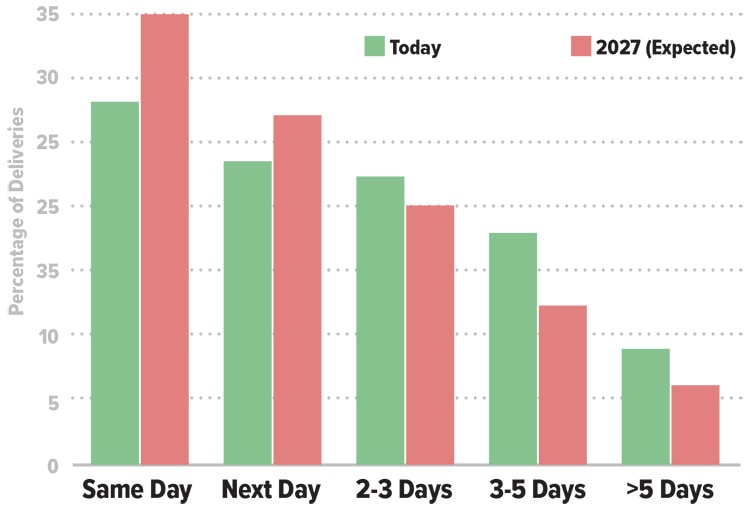
Speed and precision are non-negotiable: 70% of supply chain leaders aim for 99%+ on-time, damage-free deliveries. Looking ahead, two-thirds of all shipments are projected to be same-day by 2027 (see chart).
The 2027 Shift: Two-Thirds of Deliveries in America to Arrive Within 24 Hours
Source: FarEye
Procurement Goes All-In on AI
As with nearly every other aspect of business, the procurement sector is currently undergoing the switch from talking about the promise of AI to actually acting on it. With benefits for streamlining supplier selection, improving spend analysis, and freeing up time for strategic work, AI is poised to deliver measurable value across cost savings, sustainability, and supplier management.
That’s the key takeaway from a new survey of senior procurement leaders by ProcureAbility, which shows that 92% of organizations are satisfied with the AI solutions they’ve adopted, and 88% plan to increase their AI investments over the next year. Rather than broad, end-to-end transformations, most companies are starting with targeted applications where the business case is clear. The most common uses include supplier discovery and selection (77%) and spend analysis and categorization (76%), which give procurement teams quick wins and tangible returns.
The benefits are already materializing, with respondents pointing to the following as the biggest advantages of their AI initiatives:
Cost reduction (55%)
Sustainability gains (54%)
Better supplier selection and management (47%)
Process efficiency/time savings (44%)
However, the report also highlights a maturity gap. While enthusiasm is high, only 59% of companies are using AI in specific initiatives rather than deploying it strategically across the procurement function. The barriers to broader adoption are as much cultural as technical: leaders cite a lack of proven examples (35%), resistance to change (29%), and unrealistic expectations (23%) as the biggest hurdles to more widespread use of AI.
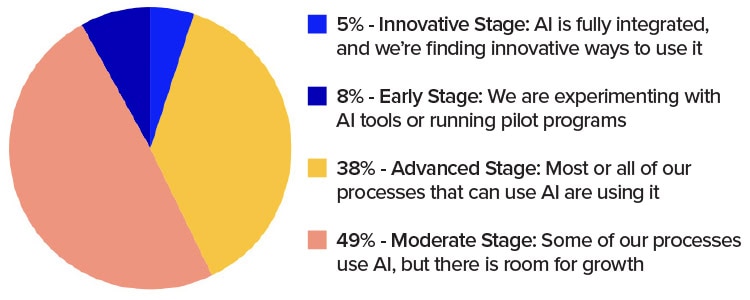
The survey also shows that procurement organizations today are at varying stages of AI maturity (see chart). The majority are still in the early phases, focusing on experimentation and pilot projects.
How would you describe the current stage of AI implementation within your procurement organization?
Source: ProcureAbility
Fleet Safety Trends: From Awareness to Action

Across the transportation industry, fleet safety has become a central concern. Rising accident costs, an uptick in lawsuits, and increasing scrutiny on driver behavior mean that businesses can no longer treat safety as optional. Technologies such as dash cameras, GPS tracking, and AI-powered alerts make it easier than ever to monitor and improve safety—but adoption still often lags behind intent.
That gap between commitment and execution is highlighted in a new Linxup survey of more than 250 fleet managers, conducted during Brake Safety Week in August 2025. The findings reveal a stark paradox: while nearly all managers say safety matters, many fleets still lack the structured programs and proactive strategies needed to reduce risk.
Here are some highlights from the survey:
SAFETY INTENT VS. EXECUTION: 90% of fleet managers cite safety as a top priority, yet 33% don’t have a formal safety program.
EXISTENTIAL RISK: 51% say their business couldn’t survive a serious driver-related lawsuit.
BARRIERS TO SAFETY INITIATIVES: 49% cite driver resistance, 51% worry about privacy, 43% about upfront costs, and 31% simply don’t know where to begin.
Respondents also indicate that telematics use is growing—but still not fully leveraged. The most-cited tools include:
- GPS TRACKING (64%)
- DASH CAMERAS (50%)
- AI SAFETY ALERTS (49%)
- COACHING TOOLS (44%)
In addition, only 60% use telematics data beyond accident prevention—missing chances to drive long-term behavior change.