
Tesla Semi Enters Production as Diesel’s Cost Advantage Collapses
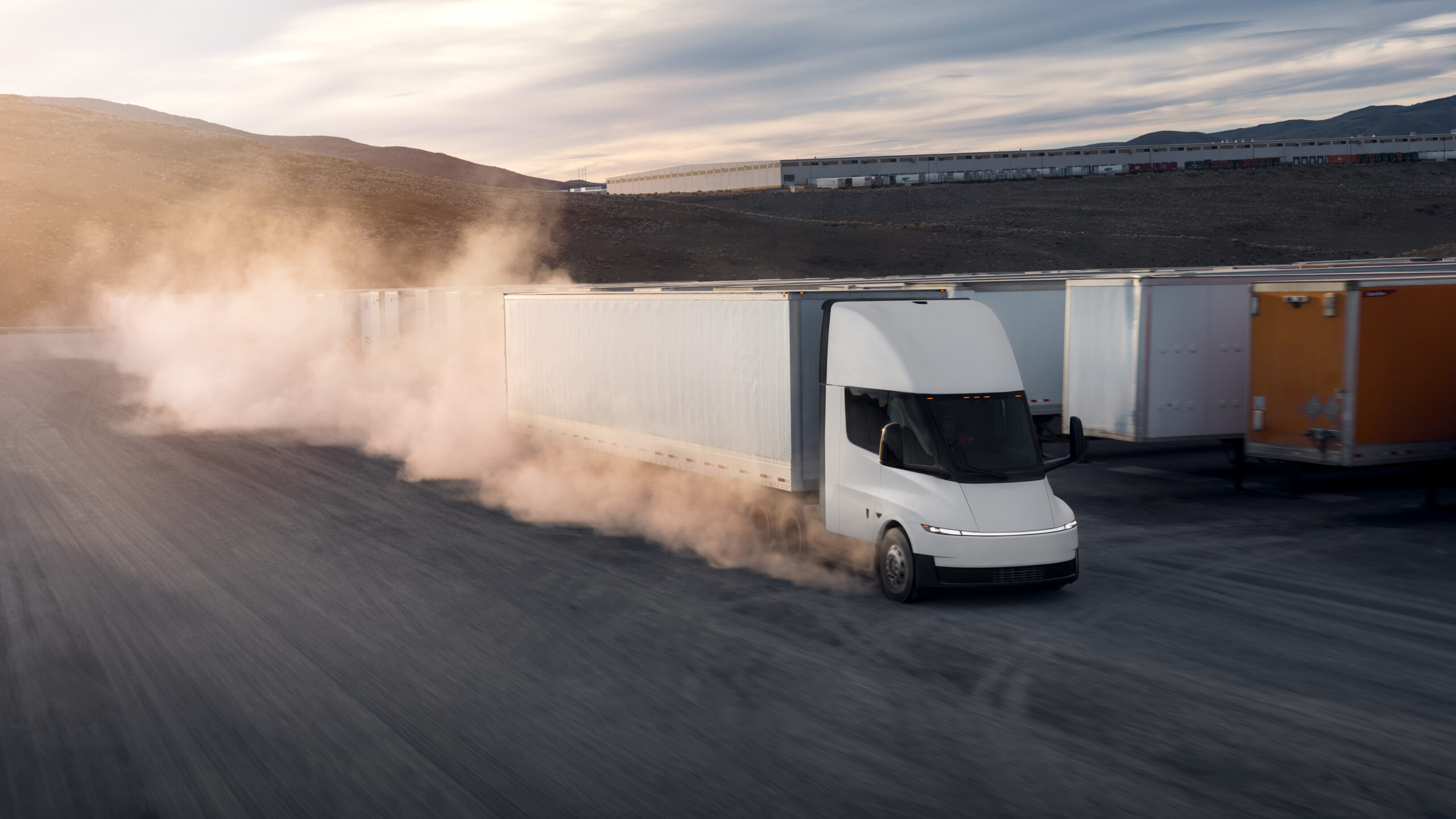
Tesla’s electric Class 8 truck is entering production just as diesel’s cost advantage erodes, forcing fleets to rethink the economics of long-haul freight.
By Ashley Prince | April 24, 2026
For the better part of a decade, the Tesla Semi was trucking’s longest-running punchline. First announced in 2017, the Class 8 electric truck missed its own delivery target seven consecutive times while the company poured resources into passenger cars, AI, and robotics.
By the time a symbolic batch reached PepsiCo in late 2022, the cumulative U.S. delivery count barely exceeded 200 units. Bill Gates had gone on record calling long-haul electric semis impractical, and skeptics had plenty of material to work with.
In its Q1 2026 shareholder filing with the SEC, Tesla flipped the narrative.
Tesla confirmed that the Semi has entered pilot production at a dedicated 1.7 million-square-foot facility adjacent to Gigafactory Nevada. The company indicated a long-term capacity target of up to 50,000 units annually, a figure that translates to roughly $14 billion in annual revenue from a single product line.
Tesla expects higher-volume production of the Semi to ramp in 2026. Specific delivery volumes for the year have not been formally disclosed, but some analyst estimates place first-year output in the 5,000–15,000 range.
Tesla has been working toward this level of Semi production for years, and the timing of its success could prove fortuitous. Rising fuel costs have shifted the broader cost picture for diesel trucks, making electric alternatives more attractive than ever before.
The Total Cost of Ownership Flip
Bernstein published an analysis this spring formally concluding that the Tesla Semi now holds a 3% total cost of ownership advantage over the Freightliner Cascadia diesel in today’s fuel environment.
Trucking is an industry where full-year profit margins typically run between 2% and 5%. A 3% structural cost edge, compounding across an entire fleet over hundreds of thousands of miles, is a competitive moat.
The Semi’s fuel cost runs 15-25 cents per mile against 50-70 cents for a comparable diesel. On a truck logging 200,000 miles annually, the fuel savings alone approach $72,000 per year.
The Tesla Semi is also among the lowest-priced electric Class 8 options on the market, with the 500-mile variant listed at $290,000. The Freightliner eCascadia and the Volvo VNR Electric both list above $300,000.
According to data compiled by the International Council on Clean Transportation from California’s HVIP incentive program, the Tesla Semi’s median price is the lowest among commercially available Class 8 battery-electric tractors.
That said, the sticker price gap between diesel and electric continues to be a barrier to entry for fleets. A new Freightliner Cascadia diesel runs roughly $175,000. At $290,000, the Tesla Semi is still $115,000 more expensive at point of purchase.
For fleets that can absorb the higher upfront cost, the breakeven point arrives in under two years based on Bernstein’s assumptions. Even under conservative modeling that accounts for lower annual mileage and higher electricity rates, the threshold clears well before a typical Class 8 reaches retirement.
How Tesla Hacked Its Supply Chain
While several factors contributed to Tesla’s previous run of missed delivery targets, battery supply proved a persistent challenge.
Between 2020 and 2022, the Semi’s 4680 cell allocation competed directly against Model Y production. The passenger car came with stronger margins, meaning it consistently claimed more resources.
Tesla has since developed an architectural solution to that supply chain problem. The Semi plant now shares a fence line with Gigafactory Nevada, where 4680 cells are produced.
The production model itself has also been redesigned since the original 2017 concept. The current model is approximately 1,000 pounds lighter, optimized for high-volume manufacturing, and built with 1.2-megawatt charging capability from the first unit off the line.
Tesla’s Q1 SEC filing notes the company began ramping LFP cells in Nevada, as well as cathode material and lithium refining in Texas. This ramp-up further verticalizes the company’s supply chain.
Most electric truck manufacturers still rely heavily on separate suppliers, exposing them to the cost and schedule risk that comes with outsourcing.
California Votes With Its Checkbook
California’s Hybrid and Zero-Emission Truck and Bus Voucher Incentive Project (HVIP) operates on a first-come, first-served basis, and its most recent funding cycle offers a clear read on where fleet operators are placing their bets.
In the round covering January 2025 through early February 2026, the Tesla Semi accounted for 965 of 1,067 Class 8 tractor voucher applications, according to ICCT analysis of HVIP data. Daimler, PACCAR, and Volvo combined received fewer than 100.
Voucher amounts for the Semi range from roughly $84,000 to $351,000 per qualifying unit. California has tentatively set aside approximately $165 million for Semi vouchers, making Tesla’s allocation roughly double that of the next-largest recipient.
For a fleet qualifying for the average tier voucher, the effective out-of-pocket cost of a $290,000 Semi can fall below $200,000, narrowing the gap against a new diesel to $25,000 or less before fuel savings enter the calculation.
The program’s structure has generated controversy. Competing manufacturers argue that concentrating incentives in a single brand before volume production has been verified effectively freezes out trucks that are available now. CARB officials counter that certification and delivery requirements must be met before any voucher funds are released.
The Two Risks Diesel Is Counting On
Fleet operators evaluating the Semi seem to be excited about the increasing accessibility of these tractors, as well as the fuel savings and sustainability gains that come with them. That said, decision-makers still have to consider two well-known challenges when it comes to switching out diesel for electric: charging infrastructure and service networks.
Charging Infrastructure
Diesel easily wins the infrastructure argument on raw numbers. There are more than 145,000 fueling stations nationwide versus just a few operational Tesla Megacharger sites as of early 2026.
The counterargument relies heavily on future-looking strategy. Tesla’s Megacharger buildout is corridor-focused by design. In February, the company added dozens of future locations to its network map, bringing the total planned sites to 66 across 15 states. The network targets I-5, I-10, I-15, I-75, and I-95, which collectively carry the overwhelming majority of domestic freight volume.
In January 2026, Tesla signed a buildout agreement with Pilot Flying J, the nation’s largest truckstop operator. The first Megacharger sites will open by summer 2026 at select Pilot travel centers along key corridors, with four to eight stalls per location. Each stall is designed to deliver up to 1.2 megawatts, restoring about 60% of range within a driver’s mandated 30-minute rest break.
The math in favor of electric could be convincing for large and mid-sized carriers that move most of their freight via the corridors included in Tesla’s near-term Megacharger buildout plans. This is especially true for companies that qualify for vouchers to offset the initial purchase price.
For smaller companies and owner-operators running in markets outside Tesla’s target corridors, the Semi is still not a viable purchase. How quickly that math changes will depend on how charging infrastructure is rolled out in the mid-term and long-term future.
Service Networks
Diesel’s service advantage is difficult to replicate. A trained diesel technician is available in every corner of the United States. Tesla’s certified technician network for the Semi is thin, presenting a real operational risk for fleets that need 24-hour uptime on an unfamiliar platform.
The Semi’s pilot fleet data paints a picture that somewhat offsets that risk. According to Tesla, its pilot trucks have logged 13.5 million road miles, with individual units exceeding 440,000 miles. Those trucks had an average uptime of 95%.
Among service incidents, nearly half cleared in under an hour, and 75-80% were resolved within 24 hours. The Semi also eliminates entire failure categories that consume diesel maintenance budgets, including turbochargers, EGR valves, DEF systems, and complex transmission rebuilds at high mileage.
Fewer failures do reduce the dependency on a dense service network. Still, fewer is not zero, and fleets transitioning from diesel will be building technician relationships from scratch.
What Should Fleet Operators Do Now?
Tesla has finally answered the question that has defined the Semi for nearly a decade: Can they actually build it?
The dedicated factory is up and running, and the battery supply chain bottleneck that fueled prior delays has been structurally resolved. On top of that, Bernstein, ICCT, and 965 fleet applicants in California have all concluded the economics of electric trucks are now credible.
For large fleets running fixed corridor routes in California, Texas, and the Sun Belt states, the case for electric is harder than ever to dismiss. It is hard to ignore a 3% total cost of ownership advantage in a 2-5% margin business.
That does not make the Semi the right purchase for every fleet today. Operators running rural routes outside the corridor network, or those without depot-charging infrastructure, face real constraints that the Megacharger buildout timeline has not yet addressed. Service network depth is also a legitimate operational concern for early adopters.
Diesel has held this market for almost a century thanks to the strengths of infrastructure, familiarity, and economics. Those advantages are narrowing or, in the case of economics, flipping altogether.