
Alaska Finds An Edge
Building on solid partnerships with companies that know the terrain and how to navigate it, the Last Frontier is taking off as a partner in global supply chains and energy markets.
While Alaska is not technically the “top of the world,” no matter how often the claim is made—a quick search for “Alaska, top of the world” returns 27 pages of results—the description reflects its global logistics vantage point.
For logistics professionals, the geographical location of the 49th U.S. state does indeed provide distinct strategic advantages. That’s why its strength as a logistics hub continues to attract companies locating sites or operations in the region, notwithstanding the obstacles posed by the state’s vast wilderness.
Is its geographical importance enough to outweigh the challenges of its terrain?
“In a word, no,” says Dr. Darren Prokop, professor emeritus of logistics, College of Business & Public Policy, University of Alaska Anchorage. “Alaska’s place on the map alone does not make a business case for its status as a logistics hub.”
The keyword here is “alone,” because there is so much more that makes the logistics case for Alaska.
More than Location
“It’s the combination of locale and support infrastructure that’s necessary for a logistics hub to meet the demands placed on it by the marketplace,” Prokop explains.
“For instance, Anchorage Alaska’s status as the fourth-largest air cargo hub in the world comes from the demand for Asia-U.S. trade,” he says. “This multi-billion-dollar trade flow requires a world-class airport that offers quick gas-and-go operations. The air cargo freighter planes need to refuel at an intermediate point because they are fully laden with cargo on their inbound-U.S. leg and Anchorage is a convenient halfway point to do this.”
For the logistics equation to work, infrastructure must pair with locale. “Because time is money for the airlines, the airport’s infrastructure hosts more than 100 freighter planes per day with each being refueled within a few hours of arrival,” Prokop says. “This translates to about two million gallons of aviation fuel needed from the airport’s tanks every day. That’s the infrastructure part of the equation. These two pieces make the business case for Ted Stevens Anchorage International Airport as a logistics hub.”
Alaska’s terrain is a constraint that must be overcome both in terms of cost and engineering before any viable business can take place.
“The Trans-Alaska Pipeline System (TAPS) is a good example of this,” Prokop says. “The crude oil is pumped from wells located along Alaska’s Arctic coast at Prudhoe Bay and ends up in refineries in the Lower 48.”
Resilience, innovation, and forward thinking, hallmarks of Alaskan culture, made it happen.
“The initial proposal for transport when the oil was discovered in 1968 was to use oil tanker vessels traveling along Alaska’s west coast or through Canada’s Northwest Passage,” Prokop says. “These ice-packed water routes are slow-going, expensive, and fraught with political and environmental concerns. Instead, it was decided that a pipeline from Prudhoe Bay to the Port of Valdez would be a better option.”
In 1973, Congress passed the law allowing the pipeline to be built. The pipeline was operational just four years later. It was specially constructed to withstand large earthquakes and Alaska’s harsh winters. Though the 800-mile pipeline starts and ends at sea level, it traverses two mountain ranges along its route, reaching more than 4,700 feet at its highest point.
“That’s a lot of upfront effort and cost to make Alaska the energy logistics hub that it is,” Prokop says.
Variations of the pipeline story apply to numerous businesses, including the logistics companies that specialize in working around and through the state’s obstacles in order to optimize its strengths.
One of a Kind
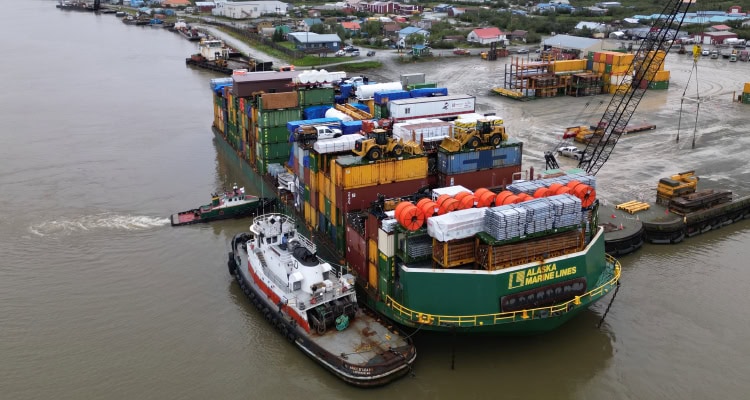
Full-service transportation and logistics provider Lynden has been serving Alaska since 1954.
How do you navigate the unique challenges of Alaska to take full advantage of its equally unique opportunities? “First, it’s the people,” says Jason Jansen, chief operating officer for full-service transportation and logistics provider Lynden, which has been serving Alaska since 1954.
That experience and a deep understanding of the state’s climate and terrain are the keys to success, says Jansen. The company gained its expertise through trial, innovation, and resilience.
“Lynden has extremely dedicated and experienced people who really understand the challenges,” Jansen says. “Lynden companies have been serving the state for many years, building our knowledge and experience.”
Jansen has been there and done that throughout his life. “I started in my childhood,” he says. “I basically spent all of my summers in western Alaska, working in marine and construction.”
Lynden understands Alaska and the unique skillsets that logistics professionals need to forge through its water and ice, mountains and snow, to connect Alaska to the world. Through its long-tenured and highly skilled teams, Lynden has developed the resources and equipment to serve Alaska’s businesses and residents in every region of the state.
The culture of the company reflects the culture of the state, steeped in appreciation not only for Alaska’s beauty but also for its economic and strategic strengths.
“There’s a lot of opportunity,” says Jansen, citing oil and gas, mining, and seafood among the industries that give Alaska its one-of-a-kind status in the global marketplace. “There are so many different key components. We’ve been able to adapt over time and create solutions to fulfill our customers’ needs as projects and opportunities are developed.”
Developing Specialized Solutions
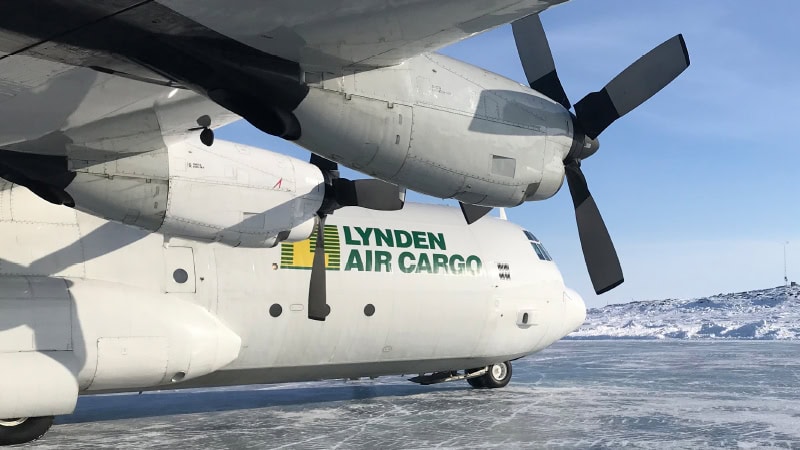
Lynden covers the vast expanse of the state with diverse equipment specifically suited for Alaska’s challenges, much of which the company has developed and designed. These include shallow-draft vessels that can navigate thin water such as shallow bays, rivers, marshes, and sandy coastal areas. In the air, Lynden’s fleet features Hercules aircraft, which can move cargo to remote areas via gravel and ice airstrips and unprepared runways.
“Mainstream fleets typically can’t handle those types of terrain,” Jansen notes.
The company’s multimodal capabilities enable movement to even the most remote locations. “We’ve got everything from trucks that are designed for long-line haul, deep-draft oceangoing barges, all the way to the shallow draft landing craft for going into the most challenging places,” he says.
“A lot of western Alaska locations don’t have docks and typical infrastructure,” he adds. “We have the facilities to transfer cargo to smaller landing craft and make last-mile deliveries where we literally hit a beach and drop a ramp. We use large forklifts to take cargo off the vessel and across the beach and deliver it up into some small communities where marine access or road access is not available.”
“We often combine multiple modes to best fit what’s needed,” he says. “Lynden is able to navigate those challenges to make the process simple for the customer.”
Building on Foundational Strengths
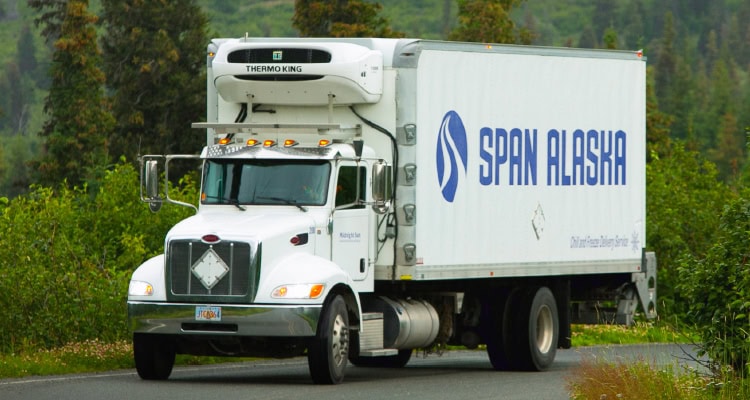
Span Alaska—a subsidiary of North America logistics leader Matson Logistics—offers access to nearly every populated region in Alaska through an integrated network.
For Michael Johnson, president of Span Alaska, logistics in Alaska is more than a function—it is a foundation. In a state shaped by vast distances, harsh weather, and limited infrastructure, reliable transportation determines whether businesses operate, communities grow, and essential goods arrive on time.
“Alaska doesn’t operate on convenience,” Johnson says. “It operates on commitment. If you’re going to serve this market, you have to design your network around reliability, not best-case scenarios.”
A subsidiary of North America logistics leader Matson Logistics, Span Alaska was built on that principle. Founded in 1978, the company operates a 93-door consolidation center in Auburn, Washington, supported by service centers in Anchorage, Fairbanks, Kenai, Kodiak, and Wasilla. Together, these assets provide access to nearly every populated region in Alaska through a single, integrated network.
“For our customers, coverage equals confidence,” Johnson says. “Whether they supply retail stores, construction projects, energy operations, or rural communities, they need to know their products and supplies can reach all points in Alaska—and arrive the way they are supposed to.”
Johnson views logistics as critical economic infrastructure in Alaska. Dependable freight movement supports everything from cost of living to business growth—an understanding shared by both the private sector and state leadership.
That reality is especially clear at the Don Young Port of Alaska in Anchorage, which handles about 75% of inbound cargo and fuel and serves 90% of the population. It is a cornerstone of the state’s supply chain and a key part of Span Alaska’s network.
The Port of Alaska Modernization Program is a vital investment. “The project isn’t just about fixing yesterday’s problems,” Johnson says. “It’s about ensuring long-term resilience. When infrastructure is strong, everyone downstream—from shippers to end customers—wins.”
Addressing Unique Challenges
Still, infrastructure alone is not enough. Alaska’s scale, extreme weather, and limited routing options create unique challenges.
“It’s a long supply chain with very little margin for error,” Johnson says. “When something breaks, the effects travel fast and take time to undo.”
Span Alaska addresses these challenges through proactive planning and operational flexibility. “Our goal is to make reliability repeatable—even when conditions aren’t,” Johnson says. “Customers shouldn’t have to redesign their business plans every time Alaska reminds us how big it is.”
Span Alaska’s reach is a strategic advantage for customers. By integrating ocean shipping, inland transportation, and local expertise, the company simplifies supply chains while expanding access.
“When customers work with us, they’re not stitching together multiple providers to reach different regions,” Johnson says. “They gain one partner that understands the entire state. Dependability improves how customers plan. When they trust the network, they can focus on growth instead of contingency.”
Johnson is direct with companies considering expansion into Alaska. “There’s a cost to entry here—in time, capital, and expertise,” he says. “You can’t shortcut that.”
“The consequences of failure here are amplified,” Johnson says. “If freight doesn’t arrive, businesses and communities feel it immediately. That’s why reliability isn’t a feature—it’s the baseline.”
Ultimately, Johnson sees Span Alaska’s mission as broader than logistics.
“When we help customers reach all corners of Alaska dependably, we’re supporting the state’s entire ecosystem,” he says. “Commerce, development, and quality of life all depend on freight moving the right way.”
Taking a Purposeful Approach
The state actively seeks strong business partnerships—both domestically and internationally, Alaska Gov. Mike Dunleavy emphasizes. This reflects a broader strategy of positioning Alaska as a partner in global supply chains and energy markets, especially in natural resources.
“Whether they are minerals mined in Alaska’s remote interior, or king crab gathered from the bottom of the frigid Bering Sea, the infrastructure needed for production and distribution may have to be purpose-built rather than taken for granted as one so easily does given the extensive, government-provided socio-economic networks available across the Lower 48,” says Prokop.
“Alaska has access to technologies that many in the Lower 48 are used to,” he says. “Examples include fiber optic cables providing high-speed internet and surgical robots for advanced medical care, among others.
“But despite improvements in technology, one constraint remains: Alaska is, in effect, a remote island,” Prokop says. “Furthermore, it has islands within its large land mass.”
Imagine a state two-and-a-half times the size of Texas nestled between the Arctic and Pacific Oceans on one end and the vast Yukon wilderness on the other. Only air travel, coastal water ports, or one highway into Canada connect this “island” with the rest of civilization.
No wonder, then, that logistics professionals with the skills to move cargo over wide and challenging spaces are among Alaska’s most valuable resources.
Alaska’s Global Advantage
STRATEGIC LOCATION. Closest U.S. gateway to Asia, the Arctic, and northern shipping routes.
LOGISTICS HUB. Top global hub for logistics with advanced infrastructure.
COST-EFFICIENT ROUTES. Polar position shortens cargo routes and cuts fuel costs.
KEY PROJECTS. Major airports, ports, and the Knik Arm Bridge & Tunnel.
INVESTMENT OPPORTUNITIES. Open for business, attracting global investors.
Alaska Gov. Mike Dunleavy consistently emphasizes:
- Alaska is “open for business” and actively invites partnerships.
- The state seeks cross-border and international economic relationships.
- Resource development is central to attracting and sustaining those relationships.
- Alaska aims to be a long-term, stable partner for global investors.
SOURCE: Alaska Department of Transportation and Public Facilities