
The New Operational Baseline: How Supply Chains Are Adapting to Constant Shock
September 30, 2026 | By Amy Roach
Supply chain leaders who gathered at the ASCM CHAINge 2026 conference this week in Long Beach are coalescing around one shared realization: Macro disruption (think geopolitical friction, trade policy shifts, hyper-volatile consumer demand, and AI influence, among others) is now the permanent baseline.
As a result, the hunt is on for strategies and solutions that can flex as quickly as the news headlines. The event’s theme of “Turing Complexity Into Capability” was on display as speakers across sessions focused on making basic operational changes while embracing technology advances in order to thrive amid myriad uncertainties.
Discussions centered on updating outdated operating models, moving artificial intelligence into core transactional systems, retraining workers to handle a more complicated environment, and seeking ways to keep up with the rapidly changing landscape of demand.
Navigating Permanent Trade Volatility
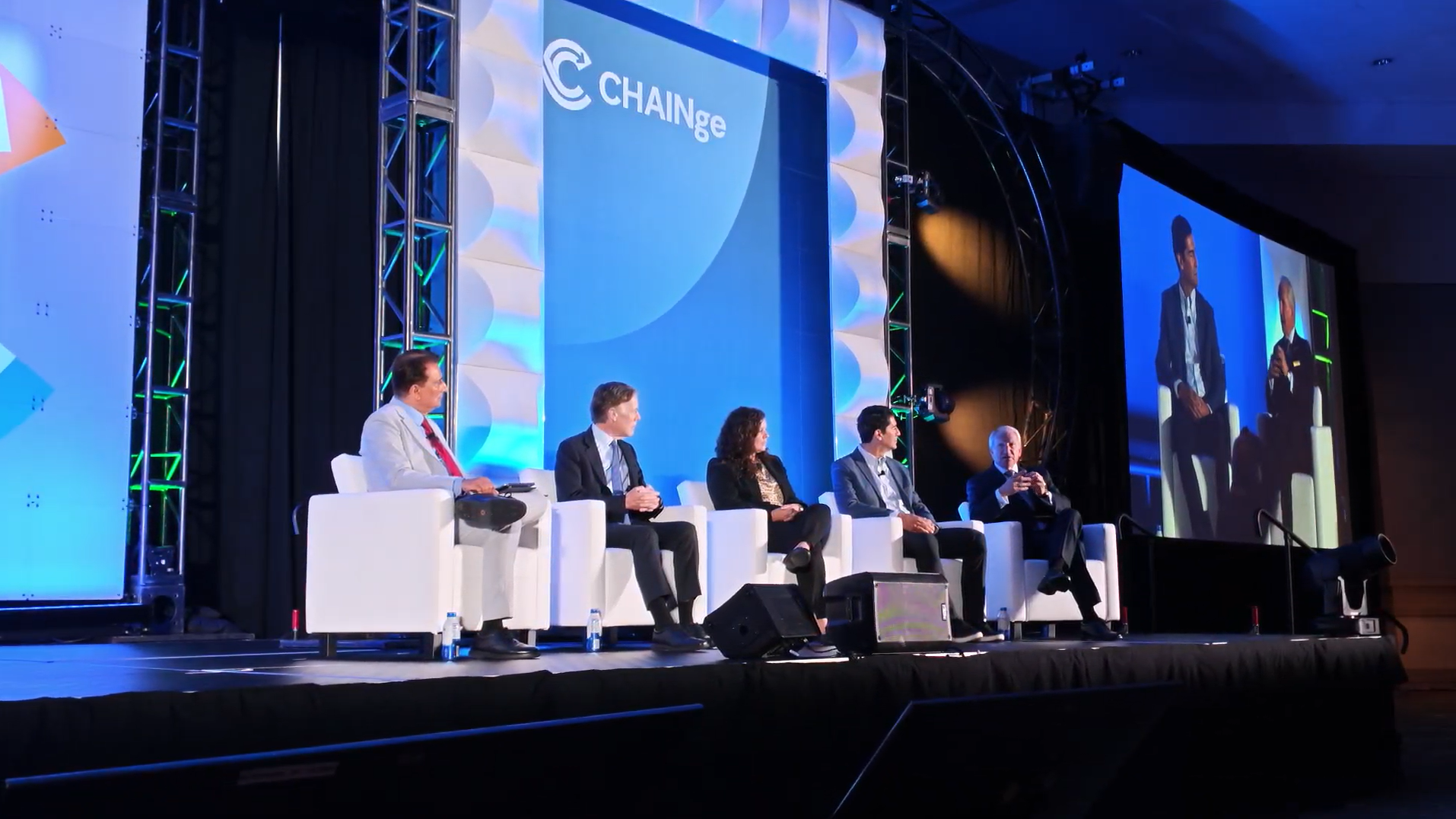
Global shipping continues to deal with major bottlenecks, explored in detail during the opening keynote session moderated by Nick Vyas (Founding Executive Director of the USC Marshall Global Supply Chain Institute) and featuring former U.S. Ambassador to China Nick Burns, Gene Seroka (Executive Director of the Port of Los Angeles), Tosca Derrick (Director of Customs and Trade Advisory at Baker Tilly), and Salvador Minnarro (CEO, Darnel Group). Canal transits through the Suez route remain down by roughly 80%, forcing vessel diversions around the Cape of Good Hope that add 14 to 21 transit days and double vessel-fuel expenses, noted Seroka. Compounded by Panama Canal drought restrictions, shippers face unprecedented route uncertainty.
At the same time, shifting tariff policies have pushed landed-cost unpredictability to new heights. Duty rates on certain trade corridors have surged past 100%—and up to 600% for specific goods like aluminum pans, noted Derrick—driving up domestic consumer prices on items ranging from everyday groceries to building materials.
In response, companies are actively moving production away from single countries. Sourcing through the Port of Los Angeles shows China’s share of inbound cargo has dropped from 60% to 40% in recent years, while volume from Vietnam, Mexico, India, and Latin America continues to rise. However, speakers warned that shifting suppliers is not simple. Second- and third-tier components are often still manufactured in traditional industrial centers, requiring strict origin tracking to meet customs rules.
For high-tech shippers, moving goods across these expanding regional corridors brings new security risks, Jeffrey Shih, CEO of Dimerco Express Group, told Inbound Logistics. Shih noted that high-value cargo theft is surging, particularly in hubs like California and Texas. The stakes are incredibly high: Shih pointed out that single crates of advanced AI infrastructure, such as Nvidia’s Vera Rubin platform, cost millions of dollars for each crate. Playing defense, shippers are turning to embedded tracking sensors that monitor real-time of end-to-end, including airlines, truck stops, and driver routes to prevent cargo loss during final-mile delivery.
To mitigate both duty exposure and port bottlenecks, Shih said, forwarders like Dimerco can route using multi-modal transportation for shipments through regional Asian hubs—combining ocean freight, air freight, or cross-road freight across nations from China to Thailand, Vietnam, and Malaysia to Singapore and transfer to Batam, Indonesia, with final assembly in Mexico before shipping to North America.
Taming the “TikTokification” of Demand
On the retail side, consumer buying habits no longer follow predictable seasonal schedules. Driven by social media and AI search tools like ChatGPT and Gemini, product demand now spikes suddenly in isolated pockets. Oracle’s Gerald Jackson, Vice President of Product Strategy, referred to this fast-moving pattern as the “TikTokification of demand”, while Craig Jones, Chief Supply Chain Officer at footwear brand On, noted that consumers now discover products through AI recommenders and social touchpoints that require brands to respond in real time.
Monthly planning meetings and standard forecasts are often too slow to catch these short demand windows, and as a result, fast-moving apparel and footwear brands are changing how they build out fulfillment networks. “Gone are the days of a two-three year project to build an automation or build a facility,” Jones said. “We’re standing up facilities—granted, not fully automated—but we’re standing up within six to nine months, sometimes quicker, because we’ve got to establish a footprint and move aggressively.” To accomplish this, On relies on agile third-party logistics (3PL) partners and clearer end-to-end inventory tracking.
Moving AI into Core ERP Systems
A central point in the technology sessions was shifting AI projects from pilot programs to practical use. Speakers advised companies to start with specific operational problems rather than trying to automate bad existing processes.
Rather than sending operational data out to external data lakes—which can easily turn into messy, disorganized “swamps,” said Arjun Srinivasan, Senior VP of AI & Data Science with ShipStation Global—software vendors are embedding AI tools straight into core ERP systems. Running these tools inside transactional software keeps data secure and connects different departments faster.
In one design-to-source example presented by Oracle, an embedded AI tool read a new CAD file, identified missing parts, created new item records in the product lifecycle system, and drafted vendor request forms automatically. That single step shortened a process that usually takes weeks down to minutes.
Dimerco sees opportunities for AI to improve operational efficiency and support better decision-making, with human oversight remaining essential.
Retraining the Frontline and Bridging the Applied Skill Gap
Another topic explored at the conference: As physical automation like mobile robots and automated loading dock equipment handle heavy lifting, the role of warehouse workers is shifting.
One aptly named session, The New Warehouse Worker: From Box Mover to Robot Wrangler, explored how frontline staff are moving from purely physical workers to system managers who monitor equipment and resolve exceptions. Providing modern user screens and straightforward training—such as community college courses, APICS certifications, or Lean Six Sigma training—has become an important way to keep staff. Kevin Lawton, host of The New Warehouse Podcast and panelist for the session, noted that frontline turnover can cost companies 50% to 200% of an employee’s annual wage. As such, updating day-to-day tools is necessary to attract younger workers and keep experienced staff on board, he explained.
This frontline shift mirrors a broader demand for practical, competency-based education across the supply chain. Richard Haskell, Sr., Associate Dean at Western Governors University (WGU) School of Business, told Inbound Logistics that employers desperately need decision-makers who possess quantitative and analytical skills grounded in real-world practice rather than abstract theory.
“Employers are looking for experiential learning,” Haskell said, noting that roughly 60% of WGU’s supply chain students are mid-career workers. By pairing students with live client projects, embedded Lean Six Sigma Green Belts, and realistic problem-solving simulations, WGU’s educational model is adapting to upskill workers directly into management and technical roles. Haskell also emphasized that companies must lean into AI tools like large language models and prompt engineering in their training rather than viewing technology as a disruption. Upskilling mid-tier workers can help prevent them from being left behind as AI augments highly skilled roles, he added.
People-First Execution Wins
Throughout the event, speakers agreed that automation and AI are not meant to reduce headcount. Instead, the main goal is to eliminate manual administrative tasks so employees can focus on customer service and operational problem-solving.
And, despite tech investments, conference presenters repeatedly emphasized that software and hardware cannot fix a flawed business setup. Installing expensive software without fixing basic operations rarely works. Real network flexibility requires bringing merchandising, finance, and operations teams together around shared goals, such as overall delivery speed and total cost.