
Transportation Is Only a Fraction of the Solution

Vice President of Sales, CRST Specialized Solutions Sales@CRST.com
CRST.com/specialized
Most companies plan the freight. The smartest companies plan the operation.
When freight stops, business doesn’t just slow down, it feels the impact. A delayed shipment can mean idle labor, missed production, empty shelves, lost sales, and costly recovery.
The real cost of transportation isn’t always on the freight invoice; it’s what happens when the plan breaks down.
The Complexity Isn’t the Freight. It’s the Dependencies.
Complexity isn’t defined by a shipment’s value, weight, or freight class. It’s defined by the operational dependencies, in three categories, required for success.
Physical: size, weight, fragility, specialized handling.
Operational: appointment scheduling, site access, liftgate needs, two-person delivery, installation.
Business: the costliest and most overlooked—a missed milestone, an idle crew, lost production, diminished confidence.
As complexity increases, transportation becomes less about moving freight and more about orchestrating execution.
What a Missed Dependency Actually Costs
The exposure isn’t theoretical. In manufacturing, unplanned downtime can quickly turn into idle labor, missed delivery windows, and cascading supplier costs. In retail, mistimed deliveries can mean empty shelves, excess inventory, and lost sales. These aren’t simply transportation costs, they’re business costs that ripple straight to the bottom line.
Consider a Representative Example
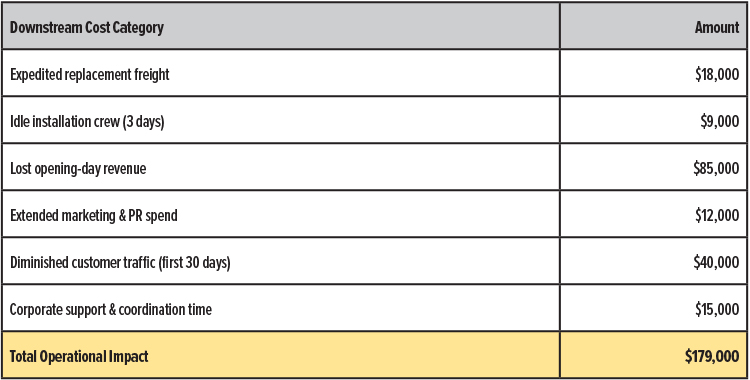
A retailer books a grand-opening fixture delivery through a standard, lowest-cost carrier instead of a coordinated, appointment-based service. The truck arrives two days late with no inside delivery team, leaving fixtures on the dock the morning of the opening.
Saving roughly $3,000 on transportation created $179,000 in downstream costs, nearly 60 times the original savings.
The figures are illustrative, not an audited case, but the pattern is well documented: The transportation line is rarely where the real financial exposure lives.
Do You Plan for Execution or Just Transportation?
Organizations managing complex supply chains increasingly treat these movements as projects, not shipments. Transportation, warehousing, inventory, communication, delivery teams, and on-site execution must function as one system since a breakdown anywhere affects the whole operation.
Five Questions Before You Choose a Strategy
- What happens if this shipment arrives late? A day? A week?
- What happens if it arrives damaged?
- Who is waiting at the destination?
- What additional services go beyond transportation?
- What downstream process depends on this delivery?
The answers determine whether a shipment fits a traditional freight network or needs a specialized strategy.
Executive Perspective
Transportation should be evaluated on total cost of ownership, not cost per shipment. Every provider can quote a rate; few can quantify the value of preventing a missed installation or a delayed opening. High-complexity supply chains are built around reducing risk, not cheaper freight.
In today’s supply chain, the shipment is rarely the project. It’s only one milestone within it.