
Warehouse Robots At Your Service
Offering increased integration options and AI enhancements, warehouse automation systems give workers an even greater assist.
As You Wish: Amazon’s New Warehouse Robot Follows Natural Language Commands
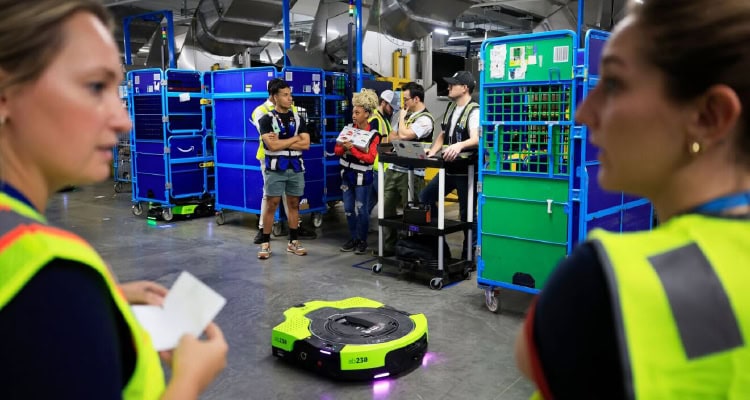
Amazon’s next-generation autonomous Proteus robot acts on natural language commands to take on more tasks across its operations. The new technology builds on the original autonomous robot and expands its ability to assist employees with their daily tasks. Using advances in artificial intelligence, the new Proteus is designed to understand natural language.
Employees will now be able to direct Proteus in the same way they would communicate with a colleague—using plain, conversational language, with no technical commands and no programming interface.
The new Proteus is currently being piloted in Amazon’s labs, with deployment in Europe planned for the first half of 2027.
Like its predecessor, the new Proteus is designed to take on physically demanding tasks—moving heavy carts and covering long distances—so employees can focus on higher-skilled work like managing inventory flow and ensuring quality control.
Amazon’s Proteus
The original Proteus operates in dock areas within fulfillment centers, navigating safely around people and transporting carts that can weigh around 900 pounds. It’s currently deployed at 25 fulfillment centers in the United States.
The next generation of Proteus is designed to go beyond the loading dock. The new system can work anywhere items need to be moved. This includes transporting containers as they arrive at a site, transferring them between workstations, and assisting employees across Amazon’s fulfillment centers and delivery sites.
Only 7.8 inches tall, the Proteus warehouse robot chirps when there’s something in front of it to alert workers it has seen them and will avoid them. It interacts autonomously with charging docks throughout the warehouse, charging every two hours and taking about 15 minutes to recharge.
The new Proteus is part of Amazon’s plans to invest more than $11 billion over the next few years to expand its fulfillment operations in Europe. Amazon plans to grow its European fulfillment center workforce by 25,000 in the coming years.
Ecommerce Fulfillment Provider Takes a Phased Approach to Cobots
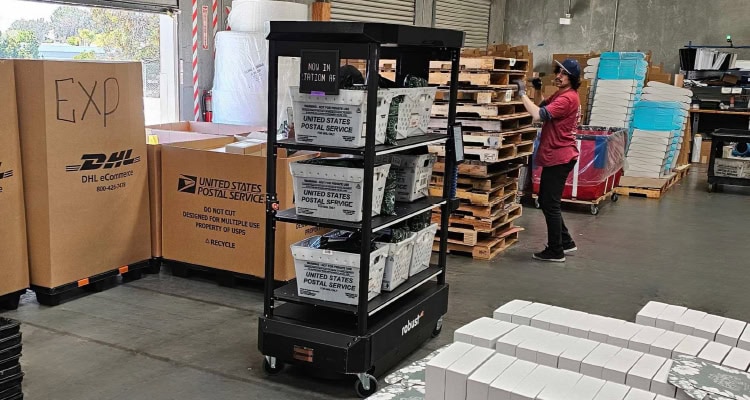
ShipLab deploys Carter
ShipLab, a San Diego-area ecommerce fulfillment and third-party logistics provider, is deploying collaborative mobile robots at its Vista, California, facility. With an initial go-live planned for July 2026, the deployment follows a phased model designed to let ShipLab validate performance at each stage before expanding.
The partnership with Robust.AI, the AI-driven warehouse automation company behind the Carter cobot, begins with a pilot in which Carter will automate tote transport between fulfillment and packing stations.
Upon successful validation, the deployment will expand to a full fleet of Carter robots operating in a broader set of applications across their picking operation.
The phased approach, which Robust.AI structured as a “Crawl, Walk, Run” model, allows ShipLab to build operational confidence incrementally, with Robots-as-a-Service payments deferred at each phase until performance targets are confirmed by both companies.
“The Crawl, Walk, Run model Robust.AI brought to the table was the right approach for us,” says Jake Brenner, CEO of ShipLab. “We get to validate performance at each step, we only pay when the system delivers, and we don’t have to touch our existing operation to make it work.”
Robust.AI’s Carter is a collaborative mobile robot designed to work alongside warehouse associates without requiring changes to existing facility infrastructure. Carter’s software-defined functionality allows operations to expand from simple applications like point-to-point transport to more sophisticated ones like fully integrated order picking.
An Integrated Physical AI Solution Automates Inbound Logistics
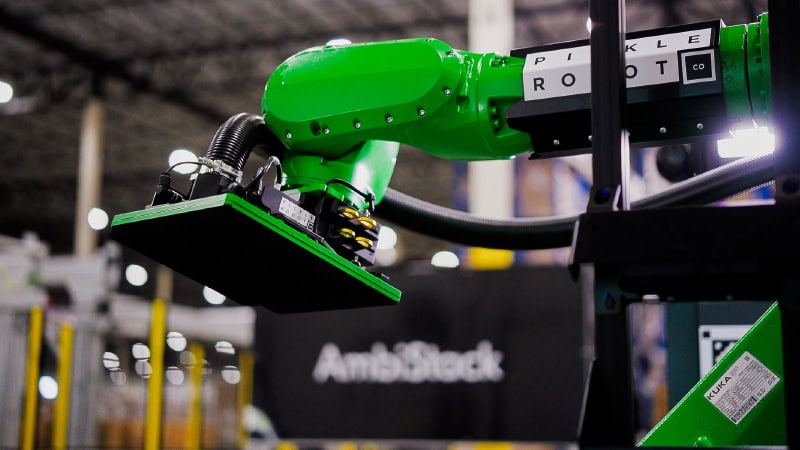
Ambi Robotics and Pickle Robot Company integrated their specialized robotic systems to automate package movement across inbound logistics operations, enabling a continuous dock-to-warehouse workflow.
While warehouse automation has been highly siloed, the deployment provides a glimpse into what an interoperable Physical AI environment looks like in practice: one system unloading mixed freight from trailers and another building pallets downstream, each making independent decisions while contributing to a larger workflow.
It combines Pickle Robot’s trailer-unloading robots with Ambi Robotics’ AmbiStack multipurpose stacking solution, enabling a continuous and autonomous flow of packages from inbound trailers through receiving operations. Cases are unloaded from trailers by Pickle Robot’s systems, then inducted via conveyor into AmbiStack for identification, scanning, and stacking for downstream warehouse operations.
The end-to-end solution leverages existing warehouse infrastructure and systems, enabling customers to automate critical inbound processes without major facility redesigns. It demonstrates how warehouse operators can deploy specialized automation technologies from multiple providers to address labor-intensive workflows.
“As Physical AI transforms supply chains, interoperability will become increasingly important. We believe the future of warehouse automation will be built on collaboration across the industry, where specialized systems work together to solve complex operational challenges,” says Jim Liefer, CEO of Ambi Robotics.
Robotic Arms Tackle Higher-Payload Applications
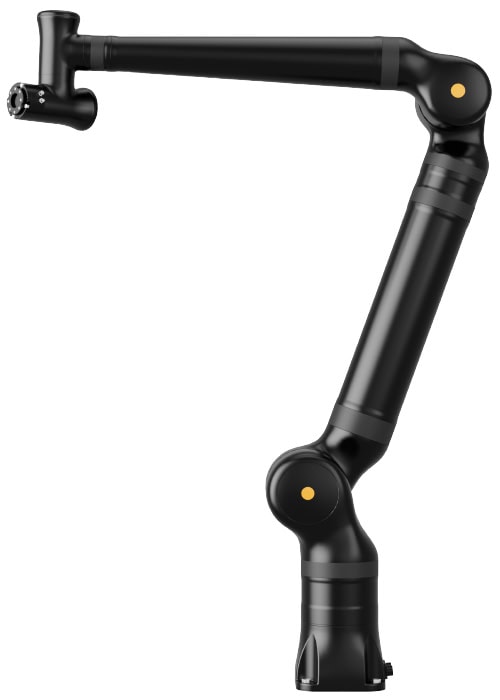
Kassow robotic arm
Kassow Robots, a manufacturer of seven-axis lightweight collaborative robots, introduced two new models, the KR 1824 and KR 1240, that can take on higher-payload applications. Designed for integration into modern production environments, the new cobots support a wide range of applications, including palletizing, machine tending, and materials handling. Their compact design enables deployment in space-constrained environments, with both external and EDGE integrated controller options supporting mobile and modular setups.
The new models deliver improved motion performance, including 50% higher joint torque, 20% faster wrist joint speeds, and up to 40% increased mechanical stiffness. These enhancements enable more stable handling of heavier loads, faster cycle times, and improved precision in demanding applications.
SAFELOG Robots Can Operate Without a Central Control System
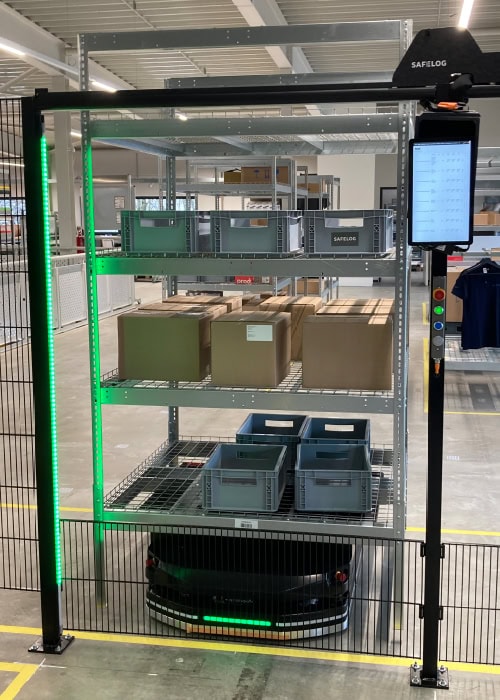
SAFELOG showcased its automated fulfillment systems at LogiMAT 2026.
SAFELOG robot solutions seek to address a gap in fulfillment operations. While automatic small parts warehouses, automated storage and retrieval systems, and shuttle systems have been standard, the biggest bottlenecks often occur in the transition zones between the picking port, consolidation, and packaging areas. This is the pain point SAFELOG seeks to address with goods-to-person models.
Its GT1 system is the flagship model for shelf and pallet-to-person applications. With its compact design, it can move under shelves of various types, lift them safely, and transport them through narrow fulfillment layouts. The GT1 is designed for set structures where the geometry is not perfect. Its maneuverability and turning function make it an ideal solution for dynamic warehouse processes.
The XS1 handles the high-speed routes between the pick port and the packing station. With a travel speed of up to 13 feet per second and container allocation capabilities, it ensures bottlenecks in the pick-pack transition are avoided. The XS1 is ideal for high-cycle environments.
Both the GT1 and the XS1 work with SAFELOG’s agent-based control software, which does not require a central control station. The robots communicate in a swarm, distribute tasks independently, and the fleet remains functional even if individual vehicles fail.
This architecture enables easy scaling without complex infrastructure measures. At the same time, the vehicles support the VDA-5050 standard and can also be integrated into mixed fleets.
For fulfillment operators, this means shorter throughput times, less manual transport, greater process reliability, and the ability to respond flexibly to seasonal peaks. The robots can be integrated into existing layouts without the need for structural modifications.
Sereact Provides the Brains Behind the Operation
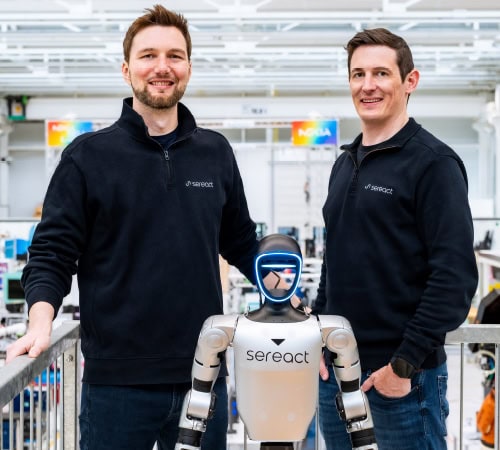
Sereact co-founders Ralf Gulde and Marc Tuscher
Providing Physical AI systems for warehouses and manufacturing, Sereact’s Cortex brain powers single-arm picking cells, dual-arm returns stations, humanoid robots, and Sereact Lens, a 3D perception system for inventory and quality control.
Sereact Lens provides real-time AI perception for each bin, order, and return, eliminating blind spots and keeping the warehouse management system up to date. With high-resolution stereo cameras positioned over bins and conveyors to capture events, Lens reconstructs a detailed 3D point cloud from these images.
Sereact’s Vision Language Action Model (VLAM) is trained on millions of real-world picks, making it a production-ready AI brain for robots.
More than 200 Sereact systems are already live across Europe, making Sereact the most deployed AI picking robot company in the world. Those systems, all running the Cortex brain, have completed more than 1 billion production picks for customers including Active Ants, Austrian Post, BMW, bol., Daimler Truck, DeltiLog, Mercedes Benz, Monta, MS Direct, PepsiCo, and Rohlik Group.
One pick in roughly every 53,000 needs remote human help. Everything else, the robot handles on its own. Every pick Cortex completes informs the model. Sereact has spent five years training on real operations, at night and at peak.
While today’s Cortex sees and picks, the Cortex 2 robotic brain anticipates outcomes before it moves. Cortex 2 thinks first, then acts. It augments a vision-language-action (VLA) with a world model. It runs possible actions against a learned model of physics and object behavior, picks the one most likely to work, and updates in real time as the scene changes.
Teradyne Robotics Unveils Production-Ready Physical AI Systems
Teradyne Robotics, the company behind Universal Robots (UR) and Mobile Industrial Robots (MiR), offers Physical AI systems for industrial applications.
Its beRobox PALTZ palletizer utilizes AI vision to redirect a UR20 robot on the fly, picking up boxes even if they have shifted orientation.
Its AI-enabled pallet jack and the MiR600 operate directly alongside the beRobox palletizer, retrieving pallets, exchanging positions, and returning them to their original locations to complete a coordinated material flow.
Together, this creates a flexible, mobile system that moves between tasks and locations without fixed infrastructure, providing a practical, end-to-end alternative to humanoid robots.
Picking Results Get Livestreamed
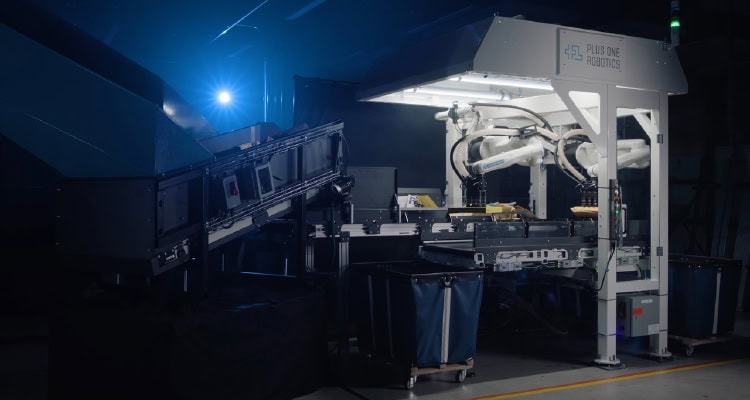
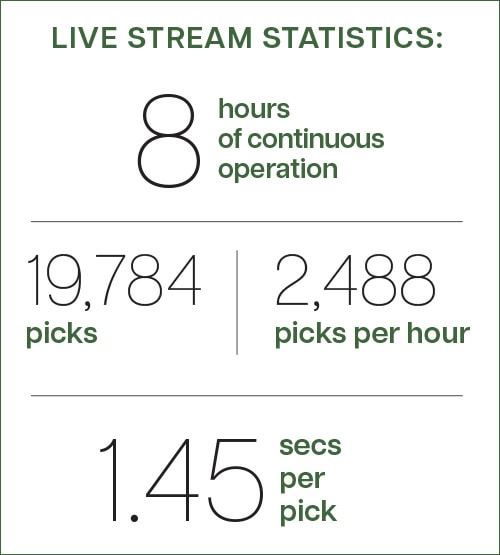 In May 2026, Plus One Robotics hosted a live 8+-hour warehouse parcel induction stream showcasing its AI-powered robotic system operating continuously in a real-world workflow environment.
“The livestream was our way to answer a question many people have: ‘How do my packages get to me?’” says Erik Nieves, founder and CEO of Plus One Robotics. “Robots combined with AI are the reason these parcel companies can handle so much volume and such a wide variety of packages.”
Introduction to Industrial Robotics Course Available On Demand
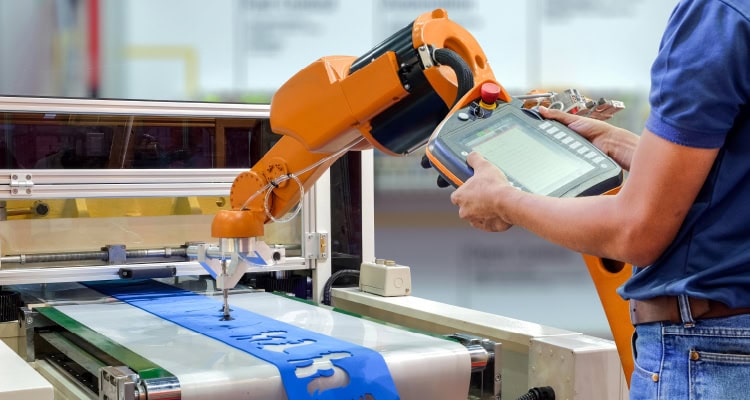
The Association for Advancing Automation (A3), an advocate for robotics and automation technologies, launched an Introduction to Industrial Robotics course. The on-demand program is designed to help professionals across industries build a foundational understanding of robotics as automation adoption continues to accelerate.
The course provides a structured introduction to industrial robotics, helping learners understand how robots work, where they deliver value, and how they are used in real-world environments.
Delivered in an on-demand format, the 2.5-hour course is designed for a range of roles, from workers entering the robotics field, operational professionals overseeing automated systems, and business leaders evaluating automation strategies.
Piloting Humanoids in Warehouse Operations
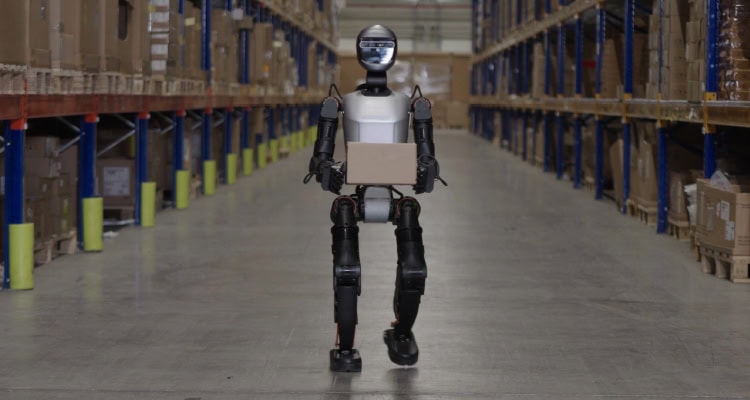
Accenture, together with Vodafone Procure & Connect and SAP, is piloting the use of humanoid robotics in warehouse environments. The pilot program was conducted at Vodafone Procure & Connect’s warehouse in Duisburg, Germany, where humanoid robots were deployed to operate alongside existing warehouse systems.
The humanoid robots used in the pilot are powered by Accenture’s Robot Brain solution, enabling them to interact naturally with human operators through voice, gestures, and text. They are trained in digital twins of warehouse environments.
Receiving inspection tasks through the SAP Extended Warehouse Management system, the humanoid robots’ responsibilities include:
- Autonomously complete visual inspections across the facility
- Identify operational inefficiencies, safety risks, and optimization opportunities across warehouse processes
- Detect misplaced or damaged products
- Assess pallet stacking and weight distribution
- Highlight unused storage space
- Identify potential hazards such as obstacles in aisles or misaligned pallets
- Report findings and recommendations to the SAP system to enable real-time visibility and more informed operational decision-making.
Completing Autonomous Cycle Counts in Freezing Temperatures
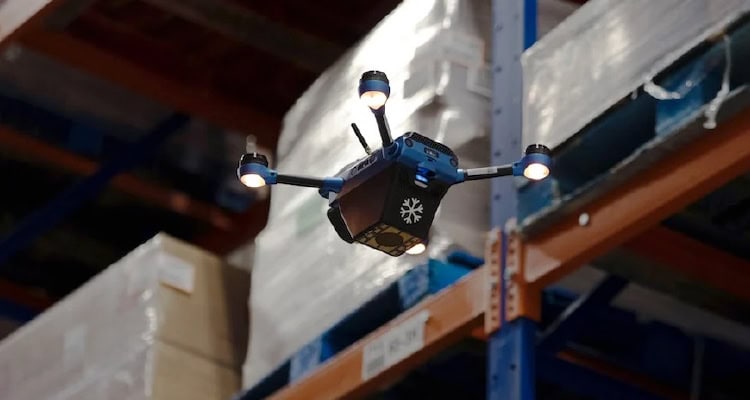
Corvus Robotics launched dedicated cold chain drones for autonomous inventory checks in sub-zero warehouses. Corvus One for Cold Chain can operate continuously in freezer environments ranging from minus-20 degrees Fahrenheit to ambient temperatures.
Designed to withstand extreme cold, airflow, frost, and condensation, the system delivers inventory cycle counts without human intervention, enabling operators to maintain real-time visibility while keeping labor and equipment out of harsh freezer conditions.
Corvus One uses industrial-grade barcode scanners with adaptive focus and exposure control, combined with stabilized flight, to read frosted or low-contrast labels from multiple angles in freezer environments.
Kroger, a national grocer, is using Corvus One for Cold Chain in live freezer operations, where the system is delivering inventory visibility and reducing reliance on manual cycle counts.
A New Dimension to Robot Safety
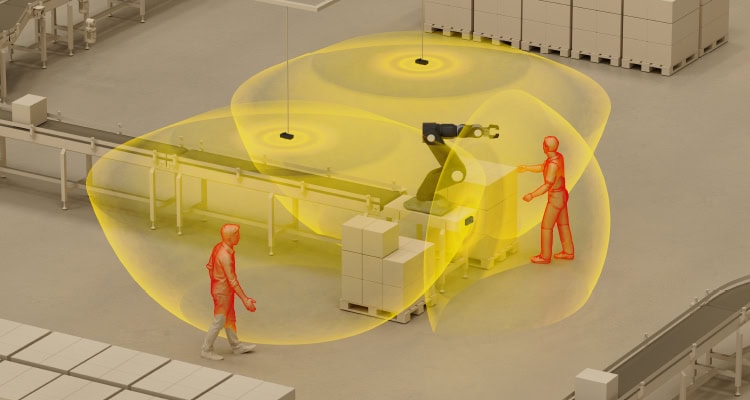
Robot safety is now 3D with acoustic detection and ranging technology (ADAR) from Sonair.
Sonair introduced the first safety-certified 3D ultrasonic sensor for human-robot collaboration. Designed for autonomous mobile robots and industrial automation, ADAR One delivers 180°×180° 3D spatial awareness, detecting people and obstacles at all heights. This eliminates the blind spots that can limit 2D safety systems. Easy integration with a small footprint enables ADAR technology to be embedded flush into virtually any robot form factor, including humanoids.