


Port Tampa Bay
Paul Anderson
President and CEO
Port Tampa Bay’s container business is growing exponentially, alongside Florida’s booming population. Our strategic location allows BCOs and container carriers to get closer to their customers with the expansion of DC capacity along the Tampa Bay/Orlando I-4 Corridor.
Vision 2030
Through Vision 2030, Port Tampa Bay is making disciplined, forward-looking investments to ensure that our customers and Florida’s economy have the infrastructure, capacity, and reliability needed to compete well into the next decade.
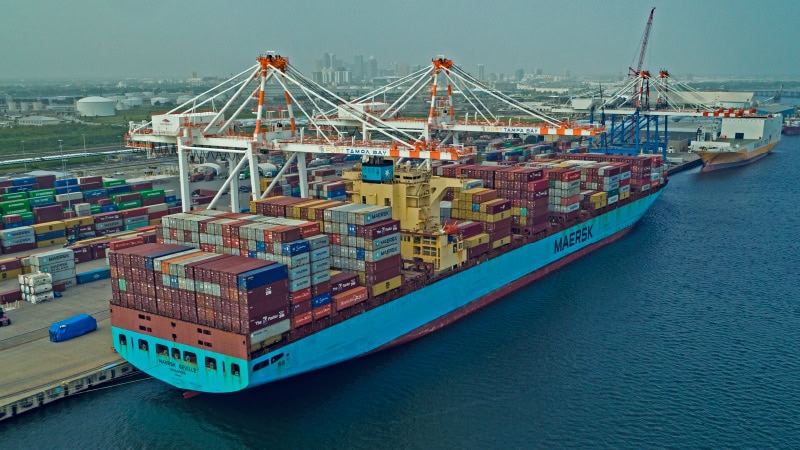
Florida’s sustained population and economic growth are reshaping supply chain strategy across the Southeast. As demand accelerates, ports must be prepared not only for today’s cargo volumes, but for the long-term needs of shippers serving one of the fastest-growing consumer markets in the country. At Port Tampa Bay, our Vision 2030 strategy is focused on doing exactly that, building capacity ahead of demand to ensure reliability, resilience, and competitiveness for Florida’s supply chains.
A key component of this strategy is the Tampa Harbor Navigation Improvement Project, which will deepen the port’s federal shipping channel from 43 feet to 47 feet. Authorized by Congress in 2024, the project received federal funding for design and permitting in 2025. In partnership with the U.S. Army Corps of Engineers, construction is expected to begin in 2028, with completion targeted for 2033. The approximately $1.1 billion project is being delivered through a federal, state, and local cost-share, reflecting its importance to Florida’s economy and trade network.
Deepening the channel will allow Port Tampa Bay to accommodate larger, deeper-draft vessels and support expanded direct all-water services from Asia and other major global trade lanes. For shippers, this means improved vessel efficiency, reduced reliance on transshipment through out-of-state gateways, and greater schedule reliability— factors that have become increasingly critical in a post-pandemic logistics environment.
The benefits of this investment extend well beyond the port itself. The project is expected to support thousands of construction and maritime jobs, generate hundreds of millions of dollars in wages, and unlock billions of dollars in trade growth over time. Equally important, expanded maritime capacity helps ensure that more freight moves through Florida ports, strengthening in-state supply chains as the state’s population is projected to approach 25 million by 2030.
The channel deepening is part of a broader, integrated investment approach under Vision 2030 that pairs waterside improvements with landside infrastructure enhancements. In parallel, Port Tampa Bay continues to advance major capital projects, including a 100-acre container terminal expansion, new truck gates with advanced operating systems, additional post-Panamax cranes bringing the total to six, expanded container berths from 3,200 to 4,500 linear feet, and a rail-served transload facility to improve intermodal efficiency.
For beneficial cargo owners, these combined investments translate into faster turn times, reliable vessel schedules, and competitive logistics costs. Port Tampa Bay’s location—minutes from the region’s largest concentration of distribution centers—allows truckers to make multiple daily turns while benefiting from attractive northbound backhaul opportunities serving markets across the Southeast and beyond. The port’s ability to expand its land footprint further enhances its capacity to support long-term growth.
These efforts align closely with Florida’s broader investments in highway, rail, and logistics corridors, including I-4 and I-75, which connect Tampa Bay to Orlando and other major markets. Ensuring that port capacity keeps pace with inland distribution growth is essential to supporting a resilient and efficient statewide logistics network.
Once complete, the 47-foot channel will place Port Tampa Bay among a select group of U.S. Gulf and East Coast ports capable of handling the largest container vessels in operation. It will further reinforce the port’s role as Florida’s most diversified and strategically located port, serving a rapidly growing population and an increasingly complex global trade environment.