
AI Supply Chain Use Cases: Where It Delivers Value
AI’s potential in supply chains seems boundless. But what do industry insiders see in terms of quantifiable efficiency gains? Does artificial intelligence measure up? Short answer: in spots.
Where AI Delivers Operational Value
✔ Demand forecasting ✔ Warehouse slotting
✔ Freight matching ✔ Shipment visibility
By Nicolai von Bismarck, Partner, McKinsey & Company
 We see AI deliver clear operational value in structured, rules-based environments where workflows are repeatable and outcomes are measurable. In logistics, the front-runner domains include demand forecasting, freight matching, warehouse slotting, and shipment visibility—environments where AI’s ability to process volume, maintain availability, and enforce consistency transforms the economics of operations in ways that were previously unachievable.
McKinsey’s research on AI in distribution operations quantifies the impact: reductions of 20 to 30% in inventory, 5 to 20% in logistics costs, and 5 to 15% in procurement spend. We see companies land firmly in those ranges—one last-mile operator with more than 10,000 vehicles achieved $30 million to $35 million in savings from AI-powered virtual dispatcher agents—a 15x return on a $2-million investment.
Where AI does not yet deliver value is judgment-based, probabilistic work that requires in-the-moment human decisions, nuanced expertise, or complex case management. In logistics, this means exception handling on damaged or misdirected freight, complex customs brokerage, and supplier relationship negotiations where context, trust, and improvisation still matter.
The challenge is both technology limitations—AI struggles with ambiguity and novel scenarios—and human adoption, where frontline workers resist tools that don’t match how they make decisions.
The gap between AI deployment and AI impact remains wide. Many organizations are taking an organic, uncoordinated experimentation strategy that lacks clear linkage to value. Companies that can identify their unique economic leverage points—where AI can create disproportionate impact—and prioritize these high-impact areas are more likely to see meaningful, scalable returns.
Supplier Risk Monitoring
 Share of CEOs surveyed who say AI is delivering measurable value in supplier risk monitoring—yet they also say there are barriers in further scaling AI use in the supply chain including data quality (38%), lack of skills (30%), and clarity around ROI (29%), according to The Global Supply Chain Resilience Outlook report by Proxima, a procurement and supply chain consultancy (part of Bain & Company).*
*The report surveyed more than 500 CEOs at businesses generating more than $500 million in annual revenue across the United States, UK, Australia, Singapore, and Germany.
Where I’m Seeing Gains from AI
✔ Order entry
✔ Carrier calls
By Matt Huckeba, Chief Strategy Officer, Evans Transportation
 When I’m asked where AI is paying off in our supply chain, I point to two places where results show up in the service we deliver every day. Neither is a flashy bolt-on. Both came from a deliberate choice to aim AI at the highest-volume operational work, where small gains compound fast.
The first is order entry. Not long ago, each member of our team manually keyed 100 to 120 orders every single day. Now integrations and AI agents pull shipment details from emails and PDFs and drop clean data straight into our transportation management system. Our team touches one or two orders a day, and only when something genuinely needs a human call. For our shipper partners, that means faster order-to-tender cycles and far fewer billing disputes.
The carrier side has seen an even bigger shift. Over the past several months, AI agents have answered more than 100,000 inbound carrier calls. Each agent identifies the carrier by MC number, confirms safety and setup status, screens out bad actors and spam, and runs an initial rate qualification against the market. Before this, we missed roughly half those calls. Today we answer nearly all of them, which means broader capacity coverage, better pricing surfaced faster, and fewer loads lost because a driver moved on. For shippers, that shows up as more reliable coverage and quotes that hold.
The compounding effect is strategic and, more importantly, relational. By taking repetitive work off our team’s plates, we’ve freed our most experienced people to focus on what no algorithm replaces: the relationships and trust that keep this business moving.
✔ Exception handling ✔ Data entry
✔ Status updates. ✔ Tools and dashboards
By Milton Feliciano, Vice President, Information Technology, iGPS Logistics
 We’ve seen real results, but also real limitations. For repetitive tasks that used to require a dedicated person, like exception handling, status updates, and data entry, AI just does it, cleanly and consistently. That has been a genuine win.
On the development side, AI code assistants have been a force multiplier. Our operations team is getting tools and dashboards built in days instead of weeks. That speed matters when you’re running a live pallet network. But AI isn’t the answer to everything. In a smart pallet business, your edge comes from operational specificity: knowing your network, your customers, your exception patterns. AI doesn’t replace that (yet).
The organizations getting real value right now are the ones who have figured out which problems AI is actually suited for, found AI partners who understand their industry to collaborate with, and had the discipline and patience to stop there.
Physical AI Partnership Accelerates Globally
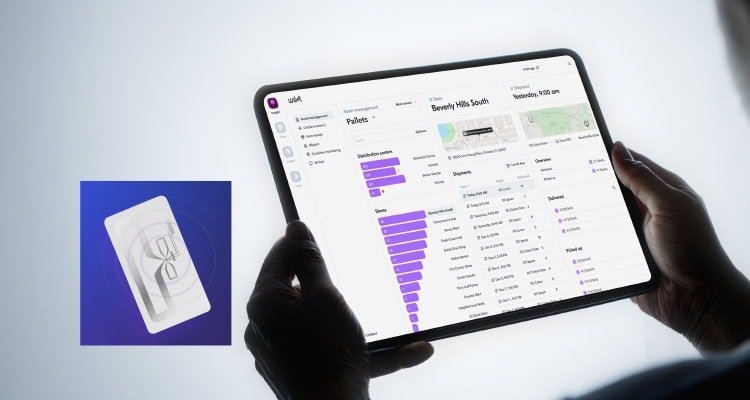
Wiliot platform and IoT Pixel (inset)
Wiliot, a provider of Physical AI for supply chains, expanded its collaboration with AT&T to scale the deployment and operation of its Physical AI platform across enterprise supply chain environments.
The collaboration builds on a multi-year relationship and marks a shift to a systems integration and device certification model designed to support large-scale deployments, ongoing network operations, and future data service delivery for AT&T customers.
As enterprises digitize physical operations, demand is increasing for continuous, item-level visibility across complex supply chains.
Wiliot’s Physical AI platform provides the sensing and intelligence layer—capturing real-time data from battery-free IoT Pixels—while AT&T delivers the network infrastructure, cellular connectivity, and field execution needed to deploy and operate these networks at scale.
Since late 2025, the companies have established a systems integration collaboration in which AT&T delivers deployment and operational capabilities across customer environments.
AT&T is now supporting design, installation, asset tagging, and ongoing maintenance across active deployments, serving as a scaled execution layer for Wiliot’s platform. It is doing this across multiple enterprise environments—including leading retailers, food and beverage companies, and quick-service restaurants—with AT&T completing a significant portion of field deployments in the first quarter of ramp-up.
Wiliot currently works with the majority of Fortune 50 companies that have active supply chain initiatives. Its platform is now deployed across tens of thousands of sites and is approaching hundreds of millions of actively tracked assets.
Physical AI Results
These deployments have improved inventory accuracy to 99% or greater; reduced dock-to-stock time from 24-48 hours to 2-6 hours; reduced receiving labor by 30-50%; reduced mis-shipments by up to 90%; and reduced lost, damaged, and delayed packages by 60%.
The companies are now also working to expand AT&T’s role beyond deployment into network monitoring, alerting, and ongoing operations, with a longer-term plan for deeper integration of Wiliot-generated data into AT&T’s services and enterprise offerings.
Wiliot’s Physical AI platform creates a continuous sensing layer across supply chains, capturing real-time data on location, temperature, and other attributes. This data is processed to generate insights and automated workflows across inventory, logistics, and operations.
By combining Wiliot’s platform with AT&T’s infrastructure, certification, and deployment capabilities, the collaboration lets enterprises replace fragmented visibility with a scalable, real-time system for understanding and managing physical supply chain operations. The companies are expanding deployments across additional customers, sites, and use cases.
Retail

 A new study of 336 retail C-suite executives, conducted by Incisiv in partnership with Manhattan Associates and World Retail Congress, reveals an industry in an unusual position: nearly unanimous conviction about AI’s importance, paired with a glaring absence of the infrastructure to act on it. 91% of retail executives say AI will be table stakes by 2030. Only 29% have built the data and technology foundation to scale it. And only 11% have the AI and data science talent to build it.

Scanning Tech Speeds Inventory Processing
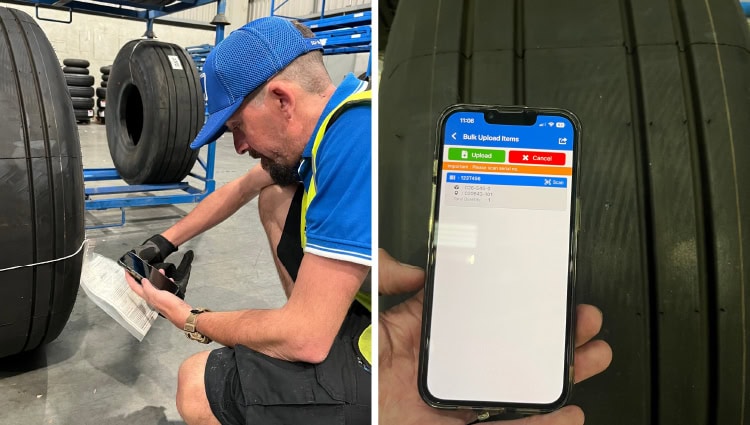
The B&H Worldwide team uses mobile phones to scan inventory.
B&H Worldwide, an aerospace logistics company, implemented AI-driven tire scanning technology at its New Zealand operations. The initiative, integrated directly into the company’s proprietary FirstTRAC platform, reports a 60% reduction in inventory processing times.
As aerospace supply chains face increasing complexity and more stringent compliance demands, B&H Worldwide’s New Zealand station was selected as the global pilot site for this digital transformation.
The solution replaces traditional, manual data entry with a mobile-based scanning SDK that utilizes computer vision and optical character recognition to instantly capture critical tire data.
The new system allows staff to use smartphones or tablets as high-performance scanners, capable of reading both standard barcodes and tire serial numbers directly from the sidewall.
The impact on operational metrics has been immediate:
Processing Efficiency: Inventory handling time has dropped from an average of 4 minutes per unit to just 1 minute, achieving a 60% improvement.
Precision: Error rates have been slashed by 80-90%, with data accuracy now exceeding 99%.
Productivity: Overall units processed per hour have increased by approximately 30%.
The technology is embedded within B&H Worldwide’s FirstTRAC WMS platform through a dual-integration approach developed by the IT team. This ensures stock checks, dispatch requests, and bulk inventory uploads are updated in real-time, providing customers with visibility into their high-value assets.
The New Zealand pilot serves as the blueprint for a global rollout, with Melbourne, Australia, scheduled as the next site for implementation.
Bridging the Procurement Gap
✔ Take a pragmatic approach to AI
By Peddy Hashemi, Managing Director, Global Head of Customer Success, SAP Taulia
 The most successful procurement companies leverage shared data and technology to make better decisions for both the business and its suppliers. The latest SAP Taulia Annual Survey reflects this priority. Almost half of businesses now identify AI as a strategic focus, a significant increase from 2025. However, there is still a noticeable gap between recognizing AI’s potential and embedding it into everyday ways of working.
Those making the greatest progress are taking a pragmatic approach. Rather than looking for one transformational AI project, they are applying AI to solve real business problems. That might mean helping teams identify suppliers who would benefit from early payment, highlighting potential supply chain risks before they become issues, automating routine operational tasks, or providing better insights to support cash flow decisions. These are practical improvements that free up procurement professionals to focus on higher-value conversations with stakeholders and suppliers.
Better data, improved forecasting, and more intelligent recommendations allow teams to have more meaningful conversations with suppliers and customers, rather than spending time gathering information or completing manual processes.
Of course, technology on its own is not enough. AI needs to be trusted. That means strong governance and transparency around how recommendations are generated. There also needs to be confidence that data is being used responsibly. Organizations that treat AI as a decision-support tool, rather than a decision-maker, are far more likely to drive adoption across procurement and the wider business.
 Ultimately, AI is another tool that helps people make better decisions. The competitive advantage will not come from simply deploying AI, but from combining it with experienced teams and strong supplier partnerships. Procurement companies that can bring those elements together will be better positioned to improve working capital, build more resilient supply chains, and create lasting value for both their business and their suppliers.
AI Pipeline
AI tools and systems for supply chain stakeholders

MICHELIN now offers an AI assistant on its fleet platform to help fleet managers.
Carriers gain an AI pricing edge. PCS Software integrated Triumph’s Market Rate Intelligence into its Cortex Opportunity Manager and Backhaul Booster, giving dispatchers live rate benchmarks drawn from more than 65% of North America’s brokered freight. Carriers can now price and prioritize loads before accepting them.
AI gives field work its own paper trail. BeyondTrucks introduced Field Dispatch, a new capability that lets drivers digitally capture customer-directed work in real time. The data feeds directly into billing and driver pay, while informing the development of BeyondTrucks’ next AI tools.
Palletizing lines get a boost from AI. Doosan Robotics unveiled PalletizHD+, a new AI-powered palletizing solution built on its PalletizOS platform. Paired with SwiftMove, an AI-based motion optimization technology, the system can stack up to 11 boxes per minute and generates stacking patterns from box and pallet dimensions.
A phone becomes an AI-powered shelf inspector. Retail technology companies weR and RGIS are expanding their collaboration to bring AI-powered shelf intelligence to retailers across the United States and Europe. weR’s Shelf Engine platform runs on standard mobile phones, using AI and augmented reality to spot empty shelves, planogram gaps, and pricing errors in real time. Through this joint deployment, retailers can accelerate shelf auditing and operational shelf checks.
AI takes over load acceptance calls. HOPTEK’s new LOAD ACCEPTOR automates the decision to accept, price, or route incremental freight, weighing contract loads against spot-market opportunities within minutes of a tender. The tool works across asset and non-asset models and allows human override.
Fleet managers get instant answers. MICHELIN Connected Fleet now offers an AI assistant integrated into its MyConnectedFleet platform to improve fleet managers’ operational performance. The AI assistant acts as a partner for managers of heavy goods vehicle, passenger transport, and light commercial vehicle fleets, providing insights into fuel consumption, driver behavior, and journey-related data.
AI flags risks before the order ships. UPS Capital’s new CommerceShield solution uses predictive AI to score order risk from checkout to delivery, then automates safeguards such as holding fulfillment or requiring signatures. The platform unifies fraud prevention, shipping insurance, and chargeback management in one system.
AI creates a customs-compliant item description from one photo. DHL Express introduced a new system, now live for customers in the United Arab Emirates, that uses AI-powered item identification built into DHL’s browser-based shipping tool. Customers can take a photo of the item they want to send using their smartphone or computer. AI then generates a clear, customs-compliant description and inserts it into the appropriate field for customs documentation.

The RGIS platform, using the weR Shelf Engine to overlay AI product identification, helps associates perform retail store audits.