
4 Most Critical Less-than-Truckload (LTL) KPIs for Shippers

Transportation spend is the most significant portion of overall supply chain costs, with the average company typically allocating 7% to 10% of their annual sales revenue towards transportation expenses.
From manufacturing to retail, optimizing less-than-truckload (LTL) shipping is essential. It helps you control costs to avoid overpaying while still managing the complexities of commingled freight, maintaining high service levels, and minimizing damages in today’s dynamic logistics environment.
Working closely with customers every day, I’ve seen how crucial it is to know your key performance indicators (KPIs) and cost drivers for less-than-truckload (LTL) shipping. Tracking these trends doesn’t just help you control costs. It also strengthens your relationships with carriers, rewards top performers, and ultimately enhances your end users’ experience.
Here’s a deep dive into the critical KPIs every shipper should routinely review when managing their LTL freight.
1. Cost Per Pound (Cost/Lb.) and Cost Per Mile (Cost/Mile)
While often tracked independently, these two LTL KPIs are very intertwined. You can’t fully understand one without looking at the other. Another important factor to layer on top of these costs is Freight Class.
(Source: FreightWise Intelligence LTL Exploration Report)
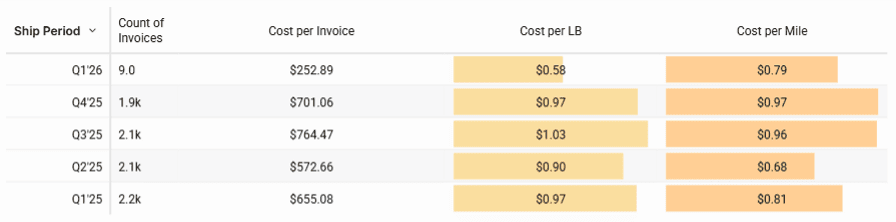
- Cost Per Pound. Understanding the cost per pound of an LTL shipment helps you evaluate if you are shipping minimums or if there are opportunities for consolidation. Inherently, heavier shipments generally have a lower cost per pound due to freight class and other factors.
- Cost Per Mile. Within LTL shipping, shorter distances typically have a higher cost per mile because pickup, delivery, and handling expenses are baked into the rate. This is an area where diving into carrier data is essential. If you have more regional moves, it could make sense to use a regional carrier; conversely, for longer national moves where the cost per mile is lower, a large national LTL carrier may be more effective.
Bonus: Freight Class and FAK (Freight All Kinds). Freight class directly impacts pricing. Higher freight classes generally mean higher costs. It is also important to understand the impact of shipping under an FAK classification versus shipping at an actual class based on your specific commodities. Having visibility into reclassifications and making sure you are auditing your LTL invoices becomes crucial here.
Key takeaway: Regularly benchmarking these KPIs, whether month-over-month or year-over-year, helps shippers stay proactive instead of reactive to cost fluctuations. Even better, analyzing this data on a SKU-by-SKU level allows you to spot if certain products are becoming more expensive to ship, if packaging plays a role, and identify other key cost drivers. This approach also highlights outliers, so you know when to dig deeper into the data or make targeted changes within your business.
2. Fuel Surcharges
In 2026, fuel has been a hot topic. Surcharges represent a volatile, yet necessary, expense tied to fluctuating fuel prices.
Generally, you can’t control these surcharges directly. Carriers base them on fuel indices impacted by many factors. The best strategy is to adjust your budget based on fuel trends, or, when possible, pass those costs on to your customers when there are significant changes. Being able to segment fuel out from your base rate will help you better understand how fuel impacts your shipping rates.
Many third-party logistics providers (3PLs) or managed transportation providers, like FreightWise, help mitigate surcharges through the aggregated spend they move. Sometimes fuel surcharges through a 3PL are lower than what you’d pay going directly to a carrier. Managed Transportation providers can also help you negotiate relief or set caps on these surcharges to ensure costs never exceed a certain limit.
Fuel costs can swing unpredictably, so forecasting and agility in pricing strategy are crucial.
3. Accessorial Charges: Understanding the Fine Print
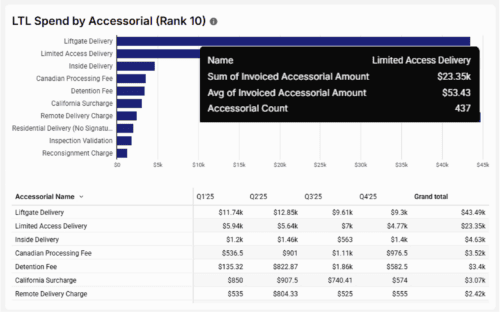
Accessorial fees are charges beyond basic transportation, such as liftgate fees, inside delivery, or excessive length. These fees can quietly erode your budget if left unchecked. Like fuel surcharges, you need to be able to break these charges to manage them properly.
Identifying the top accessorial fees impacting your LTL shipments will help. Here are three common areas we see customers miss opportunities:
- Recognize that carrier accessorials and parameters vary. Not all LTL carriers structure their accessorials and rules the same way. For example, some carriers use different dimensions for overlength. If you have a significant volume of overlength shipments, you must determine if a carrier with a 7-foot threshold is the best choice when others may only deem shipments over 8 feet to be overlength.
- Negotiate accessorial fees. If your business is particularly susceptible to a specific fee, try to negotiate that charge. Once negotiated, ensure your TMS or rating engine is configured to select that carrier for those specific shipment types.
- Stay vigilant for new accessorials. Carriers frequently introduce new fees. It is important to stay alert, especially when rolling out new product types that may trigger unexpected charges.
(Source: FreightWise Intelligence LTL Exploration Report)
The key is to be able to break out those accessorials (including fuel) to treat them as a separate data point. If these costs are baked into your total transportation cost, you won’t see where the biggest impact is. Without visibility, you can’t analyze or improve them.
4. Carrier Breakout & Carrier Performance
Choosing the right carrier portfolio is one of the most powerful levers in LTL optimization, and one of the biggest misses we see at FreightWise. No two businesses are the same, so making sure you have the right LTL carrier mix will go a long way. Being able to break out the cost per carrier (cost per mile by carrier, cost per lb. by carrier) and carrier performance, can help you understand if you have the right carrier mix. You could have a very low cost per pound, but excessive claims with a carrier. Looking at everything holistically will help inform your carrier strategy.
- Leverage regional carriers to improve service and rates on localized lanes when you have regional moves, even if you currently rely on national carriers.
- Understand how each carrier performs on your key lanes and shipment types (such as business-to-business and business-to-consumer), then adjust your carrier mix accordingly.
- Analyze carrier types (national vs. regional LTL carriers) and cost performance carefully if your company ships primarily from a single distribution point.
- Optimize your carrier mix to ensure diversity while maintaining enough volume with specific carriers to hit discount thresholds. Avoid being single threaded to mitigate risk.
Why Data Visibility is Non-Negotiable
Prior to partnering with FreightWise, many companies lack a firm handle on their data, often managing it through disparate spreadsheets and carrier websites. Many legacy Transportation Management Systems (TMS) lack the ability to drill into granular details. Modern TMS technology, like Kuebix, paired with embedded reporting tools like FreightWise Intelligence, empowers shippers with:
- Cross-modal rating engines (including parcel and LTL)
- Detailed invoice auditing that reconciles rated amounts with invoices
- Customizable, embedded dashboards to monitor cost trends, carrier performance, accessorial fees, and fuel surcharge impacts.
Companies with their transportation data in a singular place have a better handle on their shipping cost but also have data to help inform their supply chains in the future.
References
Industry Average Transportation Spend: [CSCMP Annual State of Logistics Report]
Parcel & Post Technology, U.S. Parcel Market Projections
FreightWise Internal Data & Client Experiences