
Beyond the Build: Updating the Next Gen Warehouse
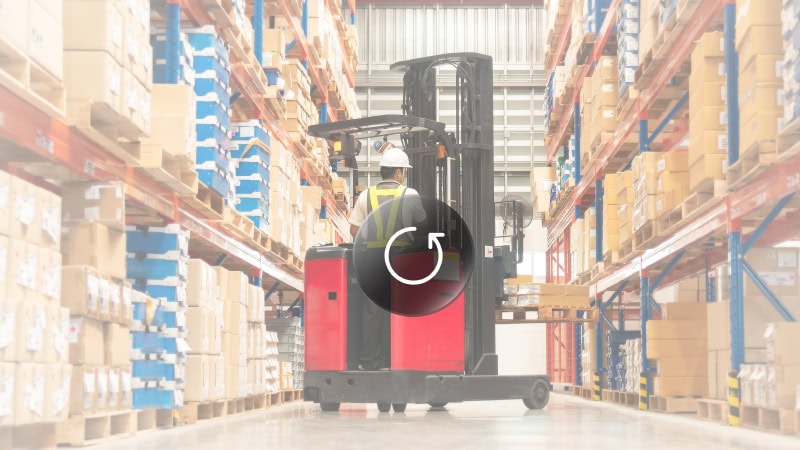
To reset operations effectively amidst ongoing labor constraints and market uncertainty, warehouse leaders are implementing technology and enhancing processes to develop operations that are streamlined, flexible, and intelligent.
Like many sectors of the economy, most warehouse operations are navigating volatility, uncertainty, complexity, and ambiguity—VUCA for short. They face a tight labor market and generally high employee turnover, supply chain disruptions, fluctuating tariffs, geopolitical tensions, and an uncertain economy.
These challenges are occurring even as ecommerce has made speed-to-market even more critical. “Instead of batching orders for efficiency, operations are often required to process and ship in near-real-time, which adds complexity to picking, packing, and outbound logistics,” says Anthony Jordan, executive vice president and chief operating officer with GEODIS Americas.
In addition, many warehouses were built for a workforce they no longer have. While turnover has always been part of the model, it generally hasn’t occurred at the current pace. “You’re asking a less experienced workforce to do better work, faster, with less margin for error,” says Matt Wilson, a principal in the industrials practice with global consultancy SSA & Co. This makes it hard to build consistency and even harder to maintain productivity.
“Optionality” has become key to operating effectively and with resilience in this environment, says James A. Tompkins, Ph.D., chair of Tompkins Solutions Inc. and Tompkins Ventures. Warehouses need to be intelligent, streamlined, and able to quickly pivot.
Savvy warehouse operators successfully navigate today’s complex, volatile environment with thoughtful technology implementations and effective processes. They prioritize ways to simplify workflows and enhance employee engagement to build more resilient teams, Jordan says.
Here are a few leading examples.
Automation on a Roll
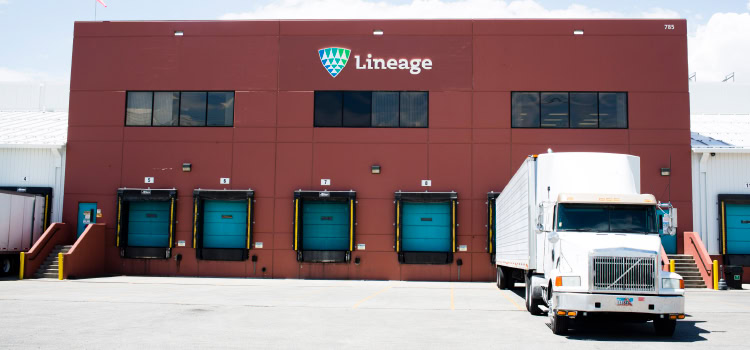
A strategic partnership integrates West Liberty’s food manufacturing with Lineage’s cold storage, aiming for efficiency and enhanced supply chain resilience in producing pre-assembled deli sandwiches.
West Liberty Foods recently launched a line of pre-assembled deli sandwiches. To streamline distribution, the company integrated its state-of-the-art automated sandwich production line directly into the Tremonton, Utah facility of Lineage Inc., a logistics provider.
The integration enables a smooth flow of raw materials into the automated production operation, as well as the efficient movement of finished products into refrigerated distribution. This is the next generation of a partnership between the companies that started 20 years ago.
Lineage inventories the meats, cheeses, and breads that West Liberty uses in its sandwiches. As orders enter West Liberty’s ERP system, they’re transmitted to the Lineage warehouse management system, which then knows which ingredients to move to production.
Once a finished goods pallet is full, it rolls on a conveyor directly to Lineage’s cold storage facility, with no driving, loading, or unloading required. “A 15-foot conveyor takes the pallet away from our plant and it’s automatically in Lineage’s site,” says Brandon Achen, president, West Liberty.
In addition to the efficiency boost, employees gain new skills as they learn to operate and maintain the technology.
The circular product flow removes legs of the supply chain and helps in labor planning, says Timothy Blazek, head of business development, east region, with Lineage.
Two keys to the solution’s success are ensuring that all systems talk to each other and that employees understand how the systems work. Achen and his team worked closely with the equipment manufacturers so that the computerized technology, which sends multiple signals to different nodes and leverages algorithms across the solution, works efficiently and effectively.
The West Liberty team spent about two months training, testing, and debugging the line before ever making a sandwich, Achen says. They also budgeted for a six-month, phased ramp up.
Betting on a WES
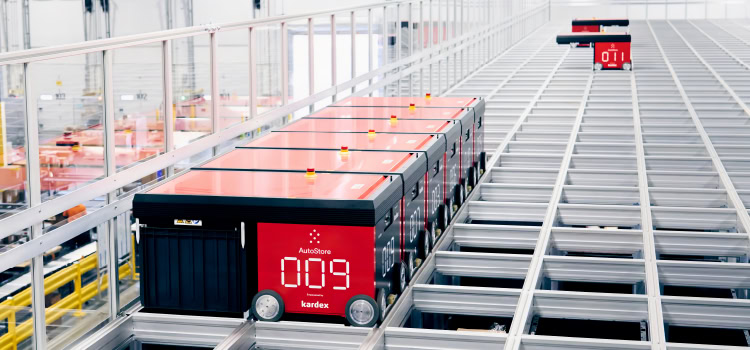
Codale Electric Supply partnered with Kardex to implement an advanced AutoStore goods-to-person system at their new Las Vegas distribution center. This automation, driven by Kardex FulfillX software, significantly improves picking times, accuracy, and operational efficiency.
Codale Electric Supply had been successful in the Las Vegas market. Further growth would require increasing both service levels and product availability, says Blair Healey, supply chain implementation manager with Sonepar, Codale’s parent company.
Codale worked with Kardex, a global partner for intralogistics solutions, to consolidate its three distribution centers in Las Vegas into one facility that fits about 10,000 SKUs into 5,500 square feet, or about one-fifth the previous space.
The new distribution center, located just off the Las Vegas strip, supports both bulk replenishment and same-day, will-call orders. “These are low-forecasting, quick-turnaround orders,” Healey says. Electricians walk in and typically wait while their orders are filled.
The facility’s automation solution is built around an AutoStore goods-to-person system that’s controlled by Kardex’s FufillX warehouse execution system (WES). FulfillX manages all processes from storage allocation to carton selection, using real-time data to sequence orders and balance workloads. This enables employees to fill orders efficiently and accurately.
Previously, pickers would move a cart down multiple aisles to complete their pick, says Anthony Varda, senior sales manager for North American new business with Kardex. With operations spread across three buildings, filling an order often required assembling items from multiple locations.
Now, once items for bulk orders are picked, they travel via conveyor to the packaging station. Two picking ports are designated only for will call orders. These orders are picked immediately, and then an employee is alerted that the order is ready. The time required to process will-call orders has been significantly cut.
Training employees on the system is straightforward, and for the most part, intuitive, Healey says. Many employees view working with the AutoStore system as more desirable than working on some of the more manual operations, he adds. Because walking is greatly reduced, they’re able to concentrate on the task at hand.
The new system supports Sonepar’s strategic vision for market growth, while allowing for it in a scalable way, Healey says. Sonepar can add capabilities, such as carton building or additional conveyance, as the market demands.
Dermalogica Smooths Out Inventory

Dermalogica deployed Corvus One autonomous drones to automate inventory management using AI and computer vision. This system increases warehouse imaging frequency by 600% and saves roughly 120 labor hours per month, reallocating staff to higher-value tasks.
Until recently, taking inventory within the 80,000-square-foot warehouse for Dermalogica, a provider of custom skin care solutions, had been a manual, often time-consuming process. Each workday, an employee would count roughly 200 to 300 of the 6,000 rack locations.
“We would start at one end of the warehouse and work our way all the way through until we got to the other end, and then start over,” says Jason Brown, director of U.S. logistics. The process took about six weeks.
Occasionally, items weren’t in the right location, creating extra work as employees searched for them. “If it was critical, we would deploy the whole warehouse to find a particular product so that we didn’t miss a sale,” Brown says.
To address these challenges, Dermalogica now deploys a Corvus drone. The cycle counting process, which used to take an employee 40 hours per week, now requires just two to three hours per day, Brown says. The drone also provides an updated occupancy report every week, which helps in planning. If large loads are arriving, Brown and his team know whether they can accept them or whether they need to hold or divert them.
Drones can also enhance safety, as they reduce the need for employees to go up on material handling equipment to check inventory.
A Smarter Kick

Sports company PUMA is collaborating with Logistics Reply to implement the cloud-native LEA Reply WMS and AI-powered GaliLEA assistant to modernize its global warehousing.
Global sports company PUMA is working with Logistics Reply to integrate artificial intelligence (AI) into its warehouse operations to boost speed and ensure it can respond quickly to market dynamics.
A first step in PUMA’s supply chain digital transformation was implementing LEA Reply, a warehouse management system (WMS) from Logistics Reply. PUMA then implemented GaliLEA, an intelligent assistant within the LEA Reply platform that provides AI data retrieval and automated technical support.
With GaliLEA, warehouse managers and employees can use natural language queries to obtain information about the WMS or resolve operational issues.
GaliLEA can also provide training on warehouse procedures in multiple languages. As a result, employees often can address these issues without having to call on IT experts, so they can quickly return to their jobs.
Once a problem is documented within GaliLEA, it’s able to draw on its knowledge to provide insight. For example, most orders going from PUMA to big box retailers follow a similar path. However, if GaliLEA notices a particular path is backlogged, it can recommend a different one, says Todd Kolber, partner with Logistics Reply.
Because of its simplicity, PUMA was able to quickly roll out GaliLEA, says Manfred Gastager, senior director, global customer fulfillment with PUMA. A rapid rollout accelerates the time between implementation and the value gained from the solution.
Adapting to Change
In a VUCA landscape, leading warehouses combine automation, intelligent systems, and strategic partnerships to boost speed, resilience, and accuracy—while simplifying workflows, empowering employees, and creating scalable operations ready to adapt quickly to constant change.
12 Ways to Improve Warehouse Processes
Technology implementations aren’t the only way to improve warehouse operations and employee productivity. Often, process changes are also important.
1. Plan labor at work level. Effective labor planning starts with understanding the work and volume, says Matt Wilson of SSA & Co. For example, filling 50 bulk replenishment orders with pallets of oil filters, wiper blades, and air filters going to a distribution center is typically straightforward.
Conversely, 50 orders from independent repair shops, each with multiple line items, like a rotor for a 2019 truck or a sensor for a fleet vehicle, may require a picker to traverse the warehouse dozens of times per order, requiring more labor hours than bulk orders.
2. Check the slotting and layout. Poor slotting and an inefficient layout forces workers to spend more time walking rather than picking.
3. Develop a structure for onboarding and training. Relying on informal training and on-the-job learning depends on workers remaining in their jobs for longer periods of time than many currently do.
4. Consider which department should own improvement initiatives. NFI Industries, a logistics provider, has intensified its focus on continuous improvement and shifted ownership from engineering to operations leadership. While NFI’s engineering team plays a critical role in identifying opportunities, execution sits with operations leaders at the site level.
“By shifting ownership to operations, we created a mindset where leaders feel accountable for outcomes and empowered to take action,” says Jamie Anderson, vice president, workforce strategy.
5. Rethink the hiring model. NFI centralized hiring for positions like forklift operators and material handlers, which account for the bulk of hiring in its distribution operations. NFI also introduced a dedicated site support model. Integrating data-driven insights and streamlining processes across systems reduced time to fill positions, improved consistency, and aligned recruiting with operational needs.
6. Provide frontline opportunities. Buske Academy is a leadership program that offers advancement opportunities to the company’s frontline team. For example, through the program, forklift operators have an opportunity to advance to supervisor roles and from supervisors to general managers. Some general managers are then chosen to help open new facilities. “We want to hire from within, and we want people to grow at Buske,” says Steve Schlecht, director of strategic initiatives.
7. Map processes. By visually documenting a process from start to finish, organizations can expose hidden complexities, redundant steps, unclear handoffs, overly complicated decision-making, unbalanced workloads, and undocumented workarounds that erode capacity, write Mike Halsey and Tony Del Sid in The Labor Factor by Tomkins Ventures and Tompkins Solutions.
8. Enable flexible work. Given ongoing fluctuations in many businesses, warehouse operations can benefit from a flexible workforce. Now, gig workers are available for warehouse positions, just as they are for meal delivery.
9. Cross train. The work in most warehouses shifts from hour to hour, notes James A. Tompkins of Tompkins Solutions. Later in the afternoon, for instance, many employees often are needed to pack ecommerce orders so they’re ready for pickup. Cross-training employees and compensating them for their additional skills can pay off in a more productive workforce.
10. Enable shift swapping. Logistics provider Kenco offers its distribution center associates the ability to swap shifts directly with each other, using what’s essentially a closed marketplace. The company has seen an uptick in retention as employee satisfaction has risen, says Ainsley Williams, VP of innovation and automation.
11. Monitor progress: Kenco uses a third-party solution that enables associates to monitor their progress as they complete different jobs. For example, an employee who runs ahead of productivity expectations might shift to housekeeping work.
12. Reduce repetition. A slight change in instructions can reduce the errors that are more likely when someone goes into autopilot mode because the work is repetitive.
How Southern Glazer’s Delivers Cleaner Loads with Less Rework
 By Karli Sage, Vice President, Supply Chain Management, Technology, and Engineering, Southern Glazer’s Wine & Spirits
Shippers don’t judge you by your dashboards. They judge you by what shows up at their dock. Was the trailer built the right way? Did the right pallets land on the right stops? Did anyone have to chase a short, a swap, or a missing label?
At Southern Glazer’s Wine & Spirits, we operate at national scale with highly dynamic demand, and small gaps get big fast. Some fixes are simple connectivity hacks that keep the floor moving. Others are real tech upgrades that take touches out of the work. Here are 10 tips that help us deliver cleaner loads with less rework.
1. Check the last 10 feet
Walk the dock every day. Look for the basics: right stop order, clear labels, solid pallets, and a trailer that matches how the customer will unload it.
2. Fix WiFi before you fix anything else
If the network drops or scanners lag, people will work around the system. Get coverage right, keep spare devices charged, and make scanning the normal way to work.
3. Build safety into the process
Safe buildings run better. Set up the work so people don’t have to rush, overreach, or guess, and use the right equipment to take strain out of the job.
4. Clean up your data
Make sure case pack, cube/weight, units of measure, and locations are right, and put one owner on keeping them that way. Bad data shows up fast as bad picks and bad loads.
5. Make exceptions simple
Shorts, damage, and mis-picks happen. What matters is having one clear way to flag it, assign an owner, fix it fast, and let the customer know.
6. Automate the pain points
Start with the work that creates the most fatigue or rework. That might be label print-and-apply, stretch wrap, robotics for long travel, or decision support that releases the right work at the right time. The goal is fewer touches and fewer chances to get it wrong.
7. Bring the frontline in early
The people doing the work will spot issues fast. Pull them in early and you’ll get a better design and fewer workarounds later.
8. Run the dock to a plan
Get appointments, staging, trailers, and labor lined up. If you can see what’s coming and what’s late, you can fix problems before they pile up.
9. Standardize handoffs
Decide what “good” looks like when work moves from warehouse to yard to transportation, and use the same standard everywhere. Consistency makes training easier and troubleshooting faster, and it keeps you from relying on tribal knowledge.
10. Protect the customer promise
Be clear on what “great” means for your operation: accuracy, consistency, and on-time. Then build the day-to-day process to protect it when volume spikes.
Do these well and you’ll ship cleaner loads, cut rework, and earn trust with every delivery.

Implications of Robot-Centric, AI-Enabled Warehouses
By 2030, 50% of new developed-market warehouses will be “robot-centric,” making human labor optional, Gartner predicts.
Due to labor shortages and high costs, chief supply chain officers (CSCOs) are accelerating adoption of intralogistics smart robotics (ISRs) to scale operations and move away from obsolete manual models. New facilities are designed where human labor handles exceptions, not daily operations. Coordinating heterogeneous ISR fleets requires multi-agent orchestration platforms.
Warehouse designs now prioritize flexibility using automation-led workflows. Fixed infrastructure is transitioning to software-managed, self-optimizing environments that adjust workflows based on demand or labor availability. This means robotic pickers can be rerouted or tasks reallocated between humans and machines.
Autonomous facilities scale efficiently, requiring reduced lighting and climate control and reconfiguring workflows without physical changes. Automation offers cost advantages for handling higher volumes despite initial capital costs.
Gartner recommends CSCOs take the following steps when designing robot‑centric environments:
- Adopt digital twin and simulation models early to validate layouts and optimize robotic performance prior to construction.
- Favor scalable, software-defined robotics platforms over single-purpose automation for adaptability and reduced obsolescence risk.
- Establish long-term vendor ecosystem partnerships to support future integration, flexibility, and expansion.