
Macrologistics & Micrologistics: A Modern Framework for Unlocking Logistics Performance

President, TransportGistics
In today’s competitive landscape, logistics has evolved from a back‑office necessity into one of the most powerful levers for business performance and differentiation. Yet despite its potential, many organizations still struggle to extract meaningful value from their logistics operations. The reason is straightforward: logistics is often treated as a single, monolithic function—broad, complex, and difficult to manage with precision.
This traditional view leads to inefficiency, missed opportunities, and underperformance. In reality, logistics becomes far more manageable—and far more profitable—when viewed through a dual‑layer framework:
- Macrologistics — the strategic, system-level environment
- Micrologistics — the operational activities that execute daily performance
This distinction is not academic. It is practical, actionable, and directly tied to ROI. Companies that adopt this model gain clearer visibility, more accurate problem identification, and a dramatically improved ability to select and implement effective solutions.
TransportGistics has long recognized that logistics excellence requires both layers working in harmony. The following overview explains the framework and demonstrates why organizations that adopt it consistently outperform those that don’t.
1. The Challenge: Logistics Is Too Big to Manage as One Thing
Most logistics initiatives fail for predictable reasons:
- Problems are defined too broadly
- Solutions are selected without precision
- Technology is over-relied upon
- Incremental improvements are overlooked
- Strategy and operations become disconnected
This “one-size-fits-all” mindset leads to expensive systems, disappointing ROI, and operational frustration. When logistics is treated as a single, undifferentiated function, organizations lose the ability to isolate specific issues and apply targeted solutions.
The macrologistics/micrologistics model solves this by segmenting logistics into two manageable, interdependent layers—each with its own purpose, metrics, and methods. This segmentation allows leaders to focus on the right problems at the right scale, improving both strategic direction and operational execution.
2. Macrologistics: The Strategic Layer That Shapes Performance
Macrologistics represents the big-picture environment in which logistics operates. It defines the structure, policies, and strategic direction that guide the entire supply chain.
Macrologistics includes:
- Network design
- Global and regional transportation flows
- Governance and compliance
- Trading-partner alignment
- Infrastructure and capacity planning
- Long-term performance objectives
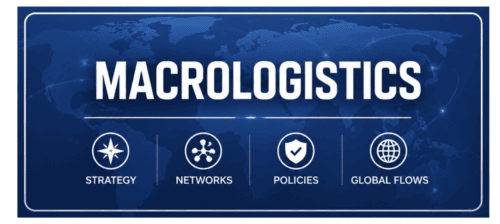
Macrologistics determines what the logistics system is designed to achieve and how it should operate at scale. It answers questions such as:
- How should our distribution network be structured?
- What policies govern our supply chain?
- How do we align with partners and regulators?
- What long-term capabilities will sustain growth?
Without a strong macro foundation, even the best operational improvements fail to deliver sustained value. Macrologistics provides the strategic blueprint—the “why” and “where”—that ensures every logistics decision supports broader business goals.
3. Micrologistics: The Operational Engine
Micrologistics is where logistics happens. It includes the day-to-day activities that move goods, manage inventory, and serve customers.
Micrologistics includes:
- Transportation execution
- Inventory control
- Warehousing operations
- Purchasing
- Order fulfillment
- Customer service

Micrologistics determines how well the logistics system performs today. It is measurable, tactical, and directly tied to cost, service, and efficiency.
Where macrologistics sets the direction, micrologistics delivers the results. It is the engine that converts strategic intent into operational performance. When micrologistics is optimized, companies see immediate improvements in cycle time, cost-to-serve, and customer satisfaction.
4. Why the Dichotomy Matters for Solution Selection
One of the most common reasons logistics solutions fail is that organizations attempt to solve micro-level problems with macro-level tools—or vice versa. This mismatch leads to:
- Overbuilt systems
- Misaligned expectations
- Poor adoption
- Low ROI
The macrologistics/micrologistics framework eliminates this mismatch by clarifying:
- Where the problem actually lives
- What type of solution is appropriate
- How to measure impact at both levels
This clarity is where TransportGistics’ methodology becomes a true differentiator. By applying the MML framework, organizations can isolate the real source of inefficiency and select solutions that directly address it.
For example, a company struggling with high freight costs may initially pursue a macro‑level network redesign. But if the root cause lies in carrier negotiation practices or load consolidation, the solution is micro‑level. The MML framework ensures that investments are targeted, measurable, and aligned with strategic objectives.
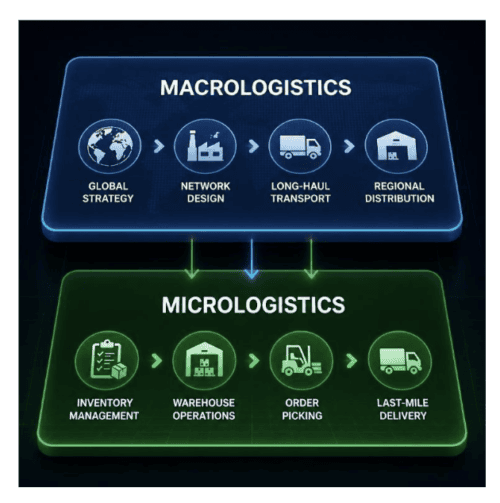
This alignment ensures that operational improvements support strategic goals—and that strategic decisions are grounded in operational reality.
5. The MML Improvement Cycle: A Practical, ROI-Driven Approach
TransportGistics applies the Macrologistics–Micrologistics (MML) method to help organizations diagnose issues, select solutions, and measure results with precision.
The cycle works as follows:
- Identify the micrologistics issue
(e.g., rising transportation costs, inefficient warehouse processes) - Apply a targeted micro-level solution
(e.g., carrier optimization, routing improvements, workflow redesign) - Measure the macrologistics impact
(e.g., network efficiency, service levels, cost-to-serve) - Adjust and iterate
(continuous improvement across both layers)
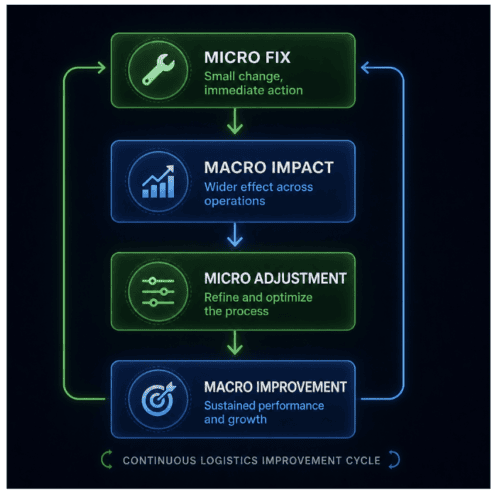
This cycle creates a sustainable improvement engine—one that avoids the pitfalls of “big bang” logistics projects and instead delivers measurable, incremental gains that accumulate into significant value.
By alternating between micro-level action and macro-level measurement, organizations achieve continuous improvement that is both tactical and strategic. The result is a logistics system that evolves intelligently, guided by data and aligned with business objectives.
6. The Business Case for the MML Framework
The MML approach delivers tangible benefits across multiple dimensions:
- Strategic clarity: Leaders gain a structured view of logistics performance and can prioritize investments with confidence.
- Operational precision: Teams focus on discrete, solvable problems rather than vague, system-wide challenges.
- Financial impact: ROI improves as solutions are better matched to actual needs.
- Cultural alignment: Collaboration between strategic planners and operational teams strengthens, reducing friction and improving execution.
- Scalability: The framework adapts to organizations of any size—from regional distributors to global enterprises.
TransportGistics clients consistently report faster implementation cycles, lower total cost of ownership, and higher satisfaction among both internal stakeholders and external partners.
Conclusion
The macrologistics/micrologistics framework transforms logistics from an overwhelming concept into a structured, manageable, and highly profitable discipline. It enables organizations to see logistics not as a cost center, but as a strategic asset—one capable of driving growth, efficiency, and competitive advantage.
TransportGistics stands at the forefront of this approach, offering the tools, expertise, and methodology needed to help companies unlock the full value of their logistics capabilities.
By integrating macrologistics and micrologistics into a unified strategy, TransportGistics empowers organizations to achieve what traditional models cannot: a logistics system that is both agile and aligned, tactical and strategic, operationally efficient and globally intelligent.