
Touchless Forecasting Explained; Top Transportation IT Investment Trends; Manufacturing Outlook 2026 & Other Global Logistics Insights

Logistics and supply chain news and highlights shaping the future of global logistics.
New Buzzword, Explained: Touchless Forecasting
Another day, another new supply chain buzzword. This time, it’s touchless forecasting—an AI-powered approach to demand planning that autonomously gathers, interprets, and analyzes large data sets to deliver precise forecasts with little or no human involvement. The objective is to build a fully automated system that adjusts in real time to market shifts, streamlines inventory management, and frees human planners to concentrate on exceptions and strategic priorities.
That’s a mouthful, but it’s catching on: Gartner recently predicted that 70% of large-scale organizations will adopt AI-based forecasting to predict future demand by 2030. “The value of AI-based forecasting includes improved strategic decision making, faster responses to market changes, and enhanced collaboration workflows,” says Jan Snoeckx, Director Analyst in Gartner’s Supply Chain practice. “To help drive successful adoption, planning leaders should clearly articulate a sense of urgency in pursuing touchless forecasting and place AI as a core element within their technology strategies.”
While touchless forecasting remains limited today, Gartner recommends this five-part plan for implementation:
1. Define a touchless forecasting vision: Assess workflows, tools, and improvements for automation.
2. Establish the business change parameters: Redefine processes and metrics; prioritize change management.
3. Define your touchless data strategy: Expand data sources; ensure quality and governance.
4. Create a technology enablement roadmap: Invest in AI tools; align with data strategy.
Plan for the adoption journey: Build trust in AI forecasts through transparency and benchmarking.
Transportation’s Evolving Role
Transportation is no longer just a cost center—more than ever, it’s viewed as a competitive weapon for shippers and logistics providers. According to Descartes Systems Group’s 9th Annual Global Transportation Management Benchmark Survey, a record 81% of respondents now view transportation as a differentiator in business growth and customer value—the highest level in the nine years of the survey.
The study, which surveyed 616 shippers and logistics service providers across North America and Europe, highlights both progress and persistent gaps in transportation technology adoption.
While transportation management systems (TMS) are recognized as essential, only 17% of respondents report being fully automated, and more than one third remain heavily dependent on manual processes. The divide is particularly stark when comparing leaders—51% of high-performing companies are fully automated—against laggards, where only 5% have achieved full automation.
Other key findings include:
- AI adoption: 96% of respondents report using generative AI in their operations, with top applications in data entry (41%), route/load optimization (39%), freight forecasting (35%), automated load matching (35%), and chat bots for customer service (34%).
- TMS investment: 80% plan to increase IT spending, prioritizing performance management, visibility, and fleet routing. (See chart below.)
- Risk-management approach: Carrier monitoring for insurance, safety, and fraud ranked as a top-three TMS capability, with North American companies placing 7% more emphasis on it than European peers.
- Growth outlook: 72% expect at least 5% annual revenue growth over the next two years.
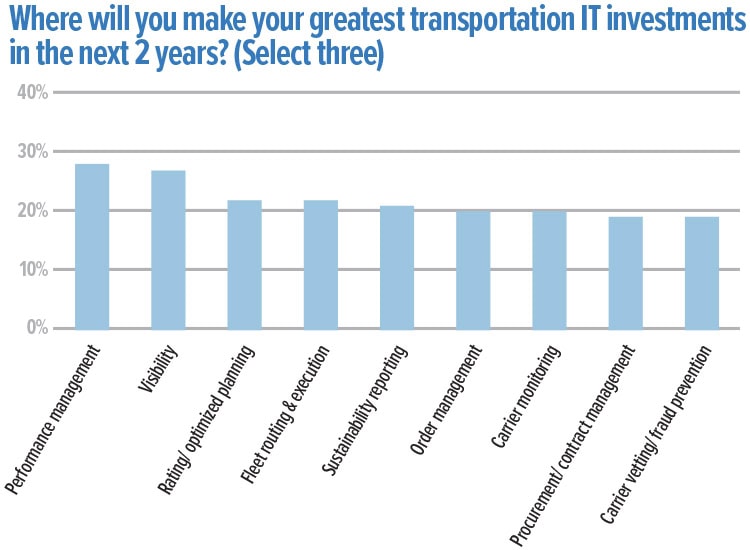
Source: Descartes
Manufacturing Outlook 2026
Global manufacturers will enter 2026 under intense pressure to modernize, adapt, and deliver in the face of relentless disruption, finds the 2026 Manufacturing Outlook Report from Xometry, Thomas, and Zogby Strategies. Survey respondents—300 executives from the United States, U.K., and Europe—see technology, agility, and sourcing resilience as the defining forces shaping the industry’s future.
The report identifies four central themes that are influencing the manufacturing industry in 2026: the acceleration of AI and digital tools; the growing demand for operational agility; rising customer expectations for quality and responsiveness; and the need for stable, flexible sourcing strategies. In addition, closing the talent gap to sustain innovation is one key challenge executives agree upon.
 Why it matters: The supply chain is no longer just about moving goods; it’s a competitive differentiator. From reshoring production to deploying AI at scale, manufacturers are investing heavily to meet customer expectations and navigate volatile global markets.
Here are some key takeaways from the survey:
AI as a Growth Engine
82% of executives view AI as a driver of growth
44% report significant ROI already from AI adoption
85% plan to invest over $100,000 in AI initiatives in 2026
Agility as the New Currency
45% of executives plan reshoring 29% have already reshored facilities
Customer-Centric Mandate
54% note rising product quality demands
46% cite faster delivery as a core expectation
43% of buyers now expect “Amazon-like” supply chain transparency
Sourcing for Stability
76% of global companies plan price increases in 2026, but 18% already face pushback from customers—making strategic sourcing crucial
84% will use new tech and partnerships to manage sourcing and pricing risks
High-Stakes Peak Season

As the holiday peak season approaches, two new surveys paint a clear picture of the challenges and opportunities facing ecommerce brands: consumers are laser-focused on price (see charts) and therefore, tightening their wallets, while brands scramble to navigate tariffs, rising costs, and increasingly demanding customer expectations. Together, the findings underscore a high-stakes environment where value, convenience, and supply chain execution will be crucial.
The surveys—Kenco’s 2025 eCommerce Peak Season Pulse and Passport’s Peak Season 2025 Playbook—offer insights from both sides of the equation: shoppers grappling with inflation, and retailers working to maintain margins while meeting customer demands.
Consumers Cut Spending but Demand Greater Convenience
Kenco surveyed consumers to understand how economic pressures are shaping holiday shopping behavior. The findings reveal a season defined by inflation concerns, demand for deals, and shifting expectations around delivery and returns:
- Inflation and tariffs are cutting into holiday budgets: 28% of consumers plan to reduce holiday spending, up 11% from 2024.
- Price pressure dominates: 58% say inflation is their top concern, compared to just 16% citing product availability.
- Shoppers want deals and control:
75% would choose slower, free shipping over paying for faster delivery.
57% say easy returns are the most influential shipping incentive.
72% call free return shipping the top return-related perk.
51% are willing to pay extra to guarantee a specific delivery window. - Visibility matters: 58% want real-time delivery map tracking, while 37% want photo confirmation.
Brands Brace for Tariffs While Betting on Cross-Border Growth
Passport, a global ecommerce solutions provider, partnered with Drive Research to survey 200 ecommerce leaders across the United States, U.K., and Canada. The research reveals how brands are managing tariffs, fulfillment challenges, and customer expectations heading into peak season. Here’s what they found:
- Tariffs reshape pricing: 87% of brands have already raised U.S. prices to offset tariffs, and 99% say trade shifts are directly influencing peak-season planning.
- International sales outlook remains bullish: 96% expect cross-border orders to rise in Q4 2025 compared to 2024.
- Execution risks are high: only 31% of leaders are “extremely confident” in their ability to handle cross-border fulfillment.
- Customer-first priorities:
57% rank fast, reliable delivery as their top goal this season.
41% say shipping costs are a main focus, with many exploring in-country fulfillment.
37% cite customer satisfaction as their most important KPI.