
Why Financial Control Must Begin Inside Your TMS

Senior Vice President,
Supply Chain Services,
nVision Global
contact@nvisionglobal.com
770-474-4122
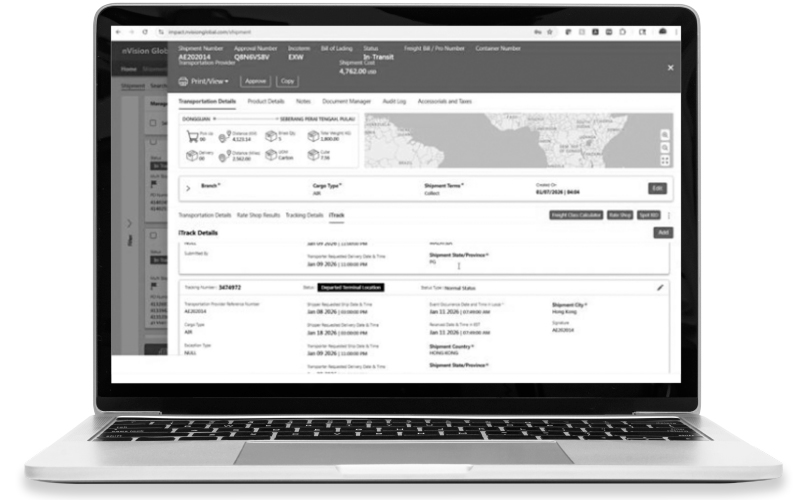
Integrating shipment execution with contract-level rating intelligence allows shipments to be rated using negotiated transportation provider agreements before the freight moves.
For many organizations, a transportation management system (TMS) is primarily viewed as an operational tool designed to plan loads, tender shipments, and track freight. In today’s freight environment, however, execution alone is not enough. The more pressing question is whether a TMS can also support financial control before the invoice ever arrives.
In most traditional technology environments, shipment execution and freight audit operate separately. A TMS may estimate costs using base rate tables or simplified pricing logic, while detailed contract validation occurs later in the audit process.
That separation can create gaps. Accessorial charges, fuel surcharges, and transportation provider-specific pricing nuances often surface only after invoices are received by the freight bill audit provider. By that point, the freight has moved and financial exposure has already occurred.
Integrating Capabilities
One emerging approach is to integrate shipment execution more closely with contract-level rating intelligence. IMPACT TMS by nVision Global reflects this model. Rather than relying solely on estimated rates, the system is paired with the same proprietary rating engine used in nVision’s freight audit and payment operations. This allows shipments to be rated using negotiated transportation provider agreements, including expected accessorials and fuel surcharges, before the freight moves.
The practical implication is straightforward: The contract logic applied during invoice validation is also applied during shipment planning. Establishing expected cost at origin can reduce the likelihood of downstream discrepancies, disputes, and accrual volatility.
Financial Integration Brings Accuracy
The model also extends into financial integration. Shipment data, including rated charges and projected accessorials, can be transmitted throughout the day into a customer’s financial systems. Costs are aligned with general ledger codes and cost centers as shipments are executed, allowing finance teams to model freight exposure in near real time rather than waiting for invoice receipt.
This type of integration supports more accurate accrual forecasting and period-end reporting. Freight becomes a financially structured activity at the point of execution, rather than a cost reconciled after the fact.
Enabling Data Continuity
Another benefit of operating within a unified ecosystem is data continuity. When shipment management and freight audit rely on the same rating logic and contract interpretation, there is less risk of conflicting calculations or re-validation downstream. The data used to plan transportation is consistent with the data used to validate payment.
In a freight environment influenced by fuel volatility, expanding accessorial categories, and increasingly complex transportation provider agreements, system fragmentation can introduce unnecessary uncertainty. Integrating financial discipline into shipment execution represents a shift in how organizations think about transportation management.
Rather than viewing financial control as a function that begins at payment, this approach treats it as a discipline that begins at planning.
For organizations evaluating their TMS strategy, the broader consideration may not simply be operational capability, but how tightly execution and financial governance are connected.