
18 Ways to Break Through Global Supply Chain Complexity

Managing a global supply chain requires navigating ongoing disruptions, fluctuating tariffs, geopolitical tension, and more. Here are 18 tips to help cut through these obstacles.
Supply chain disruptions, fluctuating tariff policies, and geopolitical tensions hammered many organizations over the past few years. Nearly three-quarters of global trade professionals rank U.S. tariff volatility as the regulatory or customs change with the greatest impact, according to the Thomson Reuters 2026 Global Trade Report (see chart).
Tariffs are not the only challenge. Export controls and the Carbon Border Adjustment Mechanism round out the top three challenges cited in the Thomson Reuters report. And financial or operational losses due to supply chain disruptions over the past 12 months were reported by nearly 75% of respondents to Sphera’s The 2026 Supply Chain Risk Report.
Many in the industry expect the volatility and uncertainty to continue. As of early March 2026 , the U.S. tariff landscape continued to shift rapidly following a Supreme Court ruling that struck down widespread tariffs imposed under the International Emergency Economic Powers Act (IEEPA). They were immediately replaced by a new 10% temporary tariff on many goods under Section 122 of the Trade Act of 1974.
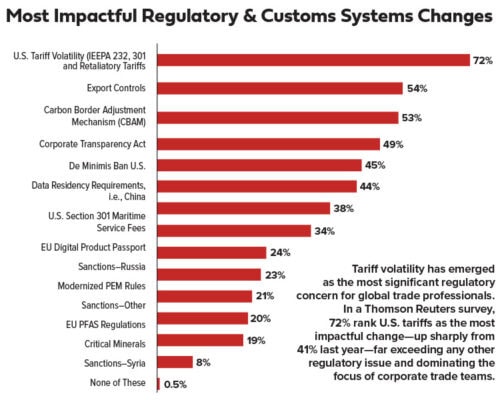
Source: Thomson Reuters 2026 Global Trade Report
Supply Chain Grows in Importance
These shifts are occurring even as supply chain strategy takes on increased importance. It’s no longer just about moving goods from point A to point B. “It’s increasingly tied to customer experience and cost control,” says Josh Steinetz, chief strategy officer of Auctane.
To meet these twin goals, successful shippers build flexibility into their operations. Shippers that can adjust carriers or shift fulfillment strategies, while also maintaining strong visibility across their supply chains, are better positioned to manage uncertainty and protect margins.
The following steps can help global supply chain leaders navigate today’s complexities, so they’re better prepared to rein in costs, meet customer expectations, and address the concerns of their executive teams and boards of directors.
1. Develop Decision Muscle. Decision-making in supply chain organizations has often been siloed and focused on time, cost, and resources. Now, risk is also a consideration, says Eugene Laney, president and CEO of the American Association of Exporters and Importers.
Managing risk requires tapping the insight of experts across multiple departments, such as compliance, finance, legal, and government affairs. Together, these experts can highlight risks and opportunities to assess when and how to adjust supply chains and leverage technology to move products around the globe securely and efficiently—a capability Laney has heard called “decision muscle.”
2. Align Supply Chain and Corporate Strategy. To operate efficiently, meet customer expectations, and fully leverage technology solutions and partners, shippers need a clear and consistent supply chain strategy that aligns with the overall corporate strategy and is applied across the organization.
“This creates a common framework for decision-making and helps ensure that technology, network design, and partner selection pull in the same direction,” says Matthias Hodel, global head, customer development, integrated logistics, with Kuehne + Nagel.
3. Leverage Logistics Providers. Logistics providers have become critical strategic partners in helping companies navigate global complexity, says Chris McCarney, consulting leader, supply chain and procurement with KPMG US. Along with moving freight, leading providers offer end-to-end services, such as multimodal optimization, customs compliance support, and real-time visibility platforms to help shippers monitor shipments and adjust routing quickly.
Many providers also offer tools such as scenario modeling, AI-powered forecasting, and digital control towers that can help shippers evaluate tariff exposure, compare routing options, and anticipate disruptions before they hit, McCarney adds. These capabilities can boost agility and resilience.
Logistics providers can also assist with compliance awareness. For instance, they can help identify Incoterms that may be able to mitigate some tariff impacts.
4. Build Strong Relationships with Your Providers. To leverage the capabilities and solutions that logistics providers can offer, shippers need to develop strong relationships with them. A key step is sharing accurate, real-time data—such as forecasts, inventory information, and compliance documentation—from across the shipper’s networks, McCarney says. With this information, logistics partners are better able to operate proactively.
5. Maintain Areas of Differentiation In-House. While it often makes sense to partner with logistics providers, shippers can also identify internal capabilities. Then, they can determine the appropriate level of collaboration and outsourcing, Hodel says. The goal is to focus in-house resources on areas of differentiation, and then to leverage external partners where they can add the most value.
6. Pay Attention to Details. Regularly reviewing the Harmonized Tariff Codes (HTCs) a company is using can pay off (see sidebar). At times, a different tariff code may be appropriate and legal for a product, and lead to a lower tariff, says Doug Sampson, chief commercial officer of Acme Distribution Centers.
Shifting trade routes can also cut tariff costs. For example, establishing a different country of origin and shipping goods from Taiwan or China into Canada and then into the United States, may be a legal way to reduce the tariff rate, Sampson says. Any additional transportation costs and duties would need to be factored into the calculation. And, the changes need to be structured so they comply with all relevant regulations.
7. Keep an Open Mind. To rein in tariff costs, some companies are considering steps they might not have considered before, such as using foreign trade zones (FTZs). This can require some upfront work. For example, a company may need to bring in components or material goods under one tariff code that’s legal and duty free, assemble the products, and then exit the FTZ under a different, but lower tariff. Again, the transactions need to be appropriately structured.
8. Invest in Technology Now. Artificial intelligence (AI) solutions are already helping some organizations better manage their supply chains, even though the technology isn’t as mature as some others. As AI continues to evolve, the learning curve for use and deployment will become steeper.
“I recommend that businesses start investing in these technologies now, while there is still room to make mistakes and learn from them,” says Vidya Mani, Ph.D., associate professor of business administration at the University of Virginia. Acting now will help position organizations for any turbulence ahead.

Building strong relationships is key to leveraging logistics providers who can help shippers stay resilient in a complex global supply chain.
9. Boost Visibility with Technology. With tariff pressures expected to continue, organizations need to adopt advanced visibility and risk management tools. “Shippers who embrace AI-powered solutions can mitigate short-term disruptions and long-term structural inefficiencies,” says Michael Britton, head of North America market, ocean products with Maersk. Those who delay taking steps risk falling behind.
Visibility platforms powered by AI can help shippers overcome disruptions by integrating first-party operational data with third-party sources to create a unified, end-to-end view of the supply chain, Britton says. Maersk found that collecting information and providing visibility from multiple platforms, and then triangulating the data to ensure accuracy, completeness, and timeliness for every shipment, allows for better inventory planning, smoother production, and reduced exposure to penalties, he adds.
Some AI tools can also anticipate risks, such as port congestion or terminal delays, and provide early warnings, so shippers can reroute or adjust their schedules, Britton says. Solutions that offer dynamic demurrage and detention updates can help shippers better plan pickups, storage, or contract changes, so they can minimize unnecessary costs.
10. Monitor the Geopolitical Environment. Political considerations can influence the regulations that impact global trade. Companies in impacted industries should remain aware of political discussions and how they materialize in operational decision-making, says Constantin Blome, chaired professor for Transformative Innovation and director, Center for Transformative Innovation at the Stockholm School of Economics.
11. Scrutinize Product Exemptions. Tariff agreements often include lists of product exemptions, Mani says. Several factors generally drive exemption decisions. One is a country’s national interests. In the United States, products considered important to maintaining the American economy, such as those used in the aerospace industry, tend to qualify for exemptions.
Industries favored by the administration in power also are more likely to gain exemptions. Currently, this includes sectors of the tech industry. By understanding the factors likely to drive tariff plans, supply chain organizations can better forecast how their products are likely to be impacted and plan accordingly.
12. Consider Customer Expectations. Given several years of ongoing supply chain disruptions, many consumers and businesses view delays as a regular part of business, Mani says. As a result, shippers generally should take a conservative approach when considering major investments in capacity expansions.
13. Connect Disparate Solutions. When technology solutions are siloed—say, warehouse management versus order management versus transportation management—decision-making is often siloed as well. That boosts the likelihood that decisions are optimized for one process but not an entire operation, says Ann Marie Jonkman, vice president, global industry strategies with Blue Yonder. Technology platforms can bring together disparate systems so an organization can identify the impact of a decision on all operations.
For instance, say a manufacturer has orders shipping to various retail stores, and learns that the inbound transportation needed to fulfill these orders is delayed. The impact of any decision, such as keeping workers overtime until trucks arrive or prioritizing the stores that will be the first to receive products, will ripple to multiple areas.
Relying on manual tools such as email and text to make these decisions can cost money and time and impact service, Jonkman says. Modern technology platforms can assemble data from various sources in close to real time, so it’s possible to make an optimal decision for the whole organization.
14. Tackle Top Challenges First. When using technology to manage a global supply chain, it’s most effective to zero in on a few challenges when starting out. “Pick the top three,” Jonkman says. Clearly define each problem and how you want to address it, considering operational, technical, labor, and other constraints, as well as how any solution will align to the broader organization.
15. Apply Strong Governance. Solid trade governance policies are key to supply chain management. For instance, without a dedicated owner or cross-functional team for tariff and trade strategy, it’s difficult to coordinate logistics decisions across procurement, finance, and supply chain, McCarney says. And absent alignment, even the best tools underdeliver.
When deploying technology solutions, organizations need to continually ensure they use clean data, while also testing the results for accuracy and to determine if they’re performing as expected, Jonkman says. Implement guardrails to minimize unwanted risk. This may mean that a supervisor is notified before anyone acts on a decision generated by technology. Managing global supply chain solutions is not a “set it and forget it” project, she notes.
16. Complete Due Diligence Before Making Major Changes. Large structural changes, such as reshoring or diversifying a supplier base, can improve resilience, McCarney says. At the same time, they require thoughtful cost modeling and realistic assumptions about capital, labor availability, and lead times.
For instance, when moving supply hubs, organizations may also need to find logistics providers that can move products from the factory floor to the ports and onto the ships, Mani says. They’ll also want to confirm that any new ports they move to can handle large-capacity ships, as these are often a significant factor in cost-efficiency arguments.
17. Connect with Government Agencies. Companies that make their supply chains known to relevant government agencies like Customs and Border Protection may be able to forestall some questions and delays as their goods move across borders. To start, they can provide the agencies with critical product information and let them know the company wants to comply with relevant regulations, Laney says. The parties can discuss how the company can best comply, as well as opportunities to become part of initiatives like the Trusted Trader Program.
18. Keep the Upside in Mind. Amidst the challenges facing global supply chains, a meaningful upside can be found. “Disruption is accelerating modernization at a pace we have not seen in years,” McCarney says. “Companies that treat this moment as an opportunity, not just a risk, are positioning themselves to come out stronger, more flexible, and far more competitive.”
Mitigating Tariffs Through HTCs and FTZs

Leveraging Harmonized Tariff Codes (HTCs) and utilize Foreign Trade Zones (FTZs) can lead to significant savings.
In an environment of fluctuating tariffs and trade policy uncertainty, supply chain leaders must be proactive and creative to mitigate exposure. Many companies specifically leverage Harmonized Tariff Codes (HTCs) and utilize Foreign Trade Zones (FTZs).
A focused, regular review of the HTCs a company uses can often yield significant savings. A different, yet entirely appropriate and legal tariff code for a product may sometimes be available, leading to a lower tariff rate, notes Doug Sampson, chief commercial officer of Acme Distribution Centers. This diligent attention to the details of trade classification can ensure the most favorable, compliant code is applied.
Beyond classification, companies can explore structural changes such as shifting trade routes to legally reduce tariff costs. For example, structuring a shipment to establish a different country of origin—such as shipping goods from Asia into an intermediary country like Canada before they enter the United States—can, in some cases, result in a lower tariff rate. However, any such change requires careful calculation to factor in additional transportation costs and duties, and adherence to all relevant regulations.
Foreign Trade Zones also require careful structuring. An FTZ is a secure area under U.S. Customs and Border Protection supervision, generally considered outside U.S. customs territory. Companies can bring components or materials into an FTZ under one legal, duty-free tariff code. The product can then be assembled or manufactured within the zone. Upon exiting the FTZ into the U.S. market, the finished product can be declared under a different, lower tariff code, depending on the nature of the final product and its new classification.
This strategy demands upfront work to ensure all transactions are appropriately structured to remain in compliance with customs regulations, but the potential for cost reduction makes it a worthwhile consideration for businesses facing global supply chain uncertainty.